

Pakistani premier’s citizenship offer to Afghans meets ire at home but gratitude in Afghanistan

1 / 2
Afghan refugee children play with tires in Islamabad, Pakistan, on October 6, 2017. Prime Minister Imran Khan has offered citizenship to Pakistan-born Afghan and Bengali refugees. (REUTERS/File Photo)
2 / 2
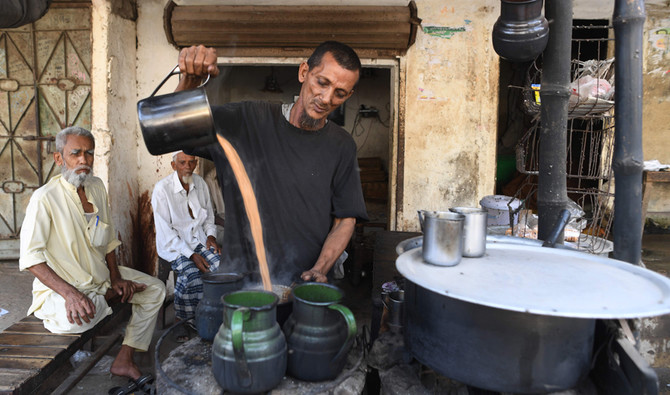
A Bengali immigrant living in Pakistan makes tea at his stall in Karachi on September 17, 2018. (AFP / ASIF HASSAN)
Updated 18 September 2018
Follow

Pakistani premier’s citizenship offer to Afghans meets ire at home but gratitude in Afghanistan

  • Nearly a quarter of a million Bengalis and Afghans in Karachi alone cannot get decent jobs owing to lack of national identity cards
  • The constitution of Pakistan allows citizenship to third generations of Bengali and Afghan refugees living in Pakistan, experts briefed the prime minister

KARACHI/KABUL:  Prime Minister Imran Khan’s announcement offering citizenship to Pakistan-born Afghan and Bengali refugees has brought deep gratitude from the marginalized communities but scathing remarks from the nationalist parties that fear a significant demographic change.

Addressing a fundraiser for hydropower dams at the Sindh Governor House in Karachi, PM Khan said: “An underclass is increasing which is responsible for the hike in street crimes. 

“More than 0.25 million Bengalis and a large number of Afghans are living here, but since they have been denied national identity cards of Pakistan, despite having been born here, they are unable to find jobs or work on meager wages,” Khan explained, adding that this is giving rise to the “underclass” which he also called the “deprived class.”

“In Europe the illegal refugees were granted citizenship through asylum. And such facilities should be extended by Pakistan to Afghan refugees, which share culture, language and customs with their Pakistani brothers,” said Afghan veteran journalist Sami Yousufzai. 

However, materialization of any such plan depends on the backing of the Pakistan’s security establishment, which had been avoiding issuance of security clearances to those who had been applying for citizenship under the country’s law, said Yousufzai. 

Hajji Abdullah, head of the Afghan Refugees in Karachi, said a jirga was under way to pay tribute to Prime Minister Imran Khan. 

“We have gathered to appreciate the landmark announcement by Imran Khan, the only prime minister who spoke for the Afghans, who takes care of Afghans,” Abdullah told Arab News.

Third-generation Afghans are living in Pakistan but no one thought about it. We are facing extreme hardship here, he said. “Whereas our brothers in Europe have got citizenship a long time ago we are still living as refugees in Sindh, Balochistan and other parts of the country.”

“Imran Khan’s statement comes a day after the foreign minister’s visit to Afghanistan was termed as highly successful,” said Iftikhar Firdous, a Peshawar-based journalist. “In the larger context it’s an overt gesture to put Pak-Afghan relations back on track. But it also shows Khan’s effort to reach out to the marginalized communities and portray him as the PM of all,” he said.


Applause from Afghanistan 

Afghan nationals have also hailed the Pakistan prime minister’s overture, largely saying that the move will make life easier for nearly two million Afghans who have lived or have been born in Pakistan after fleeing their country’s various rounds of war nearly 40 years ago.

“It actually is a very positive step. Those Afghans who want to live in Pakistan and become a Pakistani national will welcome it. Afghans acquire nationality of Europe and America ... why not Pakistan?” said Shah Mahmoud, a taxi driver in Kabul. 

Others said Pakistan will benefit more from the offer as it will “reduce the anti-Pakistan sentiment among Afghans.”

However, Daud Junbish, a senior journalist working with the BBC, warned in a tweet about the possible impact of the offer.

“The offer of Pakistani nationality to Afghans is a very serious matter and can have security, political and moral consequences,” he said.


Offer cherished by Bengalis

“Over 2.5 million Bengalis live in more than 115 Bengali majority neighborhoods of Karachi,” said Bachoo Dewan, chairman of the Pak Muslim Alliance, a Bengali political group, adding that a large number also live in Hyderabad, Islamabad, Lahore, Peshawar and other cities of Pakistan.

“We have rendered great sacrifices during 1965 and 1971 for this country but our community still faces discrimination and a large part is being denied Pakistani nationality,” he said, adding: “We are thankful to PM Imran Khan for speaking for our marginalized community.”

Dewan said most Bengalis are denied jobs owing to lack of computerized national identity cards and those who get one work on meager wages which are insufficient to run a household. 


Not well received by nationalists

As Afghans, Bengalis and independent analysts are hailing the landmark offer, Pakistan People’s Party (PPP) as well as both Sindhi and Baloch nationalist parties, said the statement is contemptible. The grant of citizenship to millions of Afghanis and Bengalis, they say, will change the demography, turning the sons of the soil into a minority.

PPP leader and provincial minister Saeed Ghani said his party was “strongly opposed to grant citizenship to illegal immigrants. They should be registered and given work permits as well but giving them citizenship will create problems.” 

The Sindhi nationalist party, Sindh United Party argued: “Instead of giving them citizenship, the government should take steps for the respectful repatriation.”

Agha Hasan Baloch, spokesman of Balochistan National Party-Mengal, which has signed a six-point agenda – including the repatriation of Afghan refugees as one of the points – with Prime Minister Imran Khan’s Pakistan Tehrik-e-Insaf (PTI) party, said the decision will be protested. 

“They (the Afghan refugees) are dangerous and have created several social problems besides changing demography of the province. It’s not justified to offer them citizenship,” Baloch told Arab News.

“We will not compromise. We appeal to Prime Minister Imran Khan to revise his decision,” he said.

However, Azhar Laghari, PTI’s head of Public Relations, told Arab News that the security and intelligence agencies had briefed the prime minister that Afghans and Bengalis are one of the elements of street crime. “He was informed that second and third generations of them live in Karachi and the constitution allows them to get citizenship, so the PM announced that they will be given nationality.”

“Not those who have migrated but their kids who have been born here should be given citizenship, and for this the reservation of nationalist parties will be removed and a policy devised by consulting all stakeholders,” he said.

“The constitution will be implemented and it provides those born in Pakistan with the right to citizenship,” Leghari said.


Saudi-Pakistan defense pact rooted in ‘brotherly ties and strategic alignment,’ Pakistan’s ambassador to the UN tells Arab News

Updated 6 sec ago
Follow

Saudi-Pakistan defense pact rooted in ‘brotherly ties and strategic alignment,’ Pakistan’s ambassador to the UN tells Arab News

  • Asim Iftikhar Ahmad calls deepening defense and economic ties between the two countries as central to regional stability
  • Says his government will confront domestic security challenges firmly while continuing to expand cooperation with the Kingdom 

NEW YORK CITY: Asim Iftikhar Ahmad, Pakistan’s permanent representative to the UN, has praised his country’s strategic partnership with Saudi Arabia, describing their recently signed defense cooperation pact as both historic and central to regional security at a time of heightened militant violence.

“This agreement is very significant, but it should be seen as a continuation and solidification of decades of cooperation and a strong strategic alliance between Saudi Arabia and Pakistan,” Ahmad said in a wide-ranging interview with Arab News at the UN Headquarters in New York.

Rooted in “brotherly ties and strategic alignment on regional and global issues,” the partnership has now been placed “into concrete shape,” he said.

Pakistan and Saudi Arabia signed a Strategic Mutual Defense Agreement on Sept. 17 last year, pledging that aggression against one country would be treated as an attack on both, enhancing joint deterrence and formalizing decades of military and security cooperation.

The pact was signed during Prime Minister Shehbaz Sharif’s state visit to Riyadh, where he met Crown Prince Mohammed bin Salman at Al-Yamamah Palace.

The pact, Ahmad said, was soon complemented by an economic cooperation framework, reflecting a comprehensive engagement. “Saudi Arabia is a major economic partner for Pakistan,” he said, pointing to expanding investment, trade, and development cooperation.

He underlined the deep public and spiritual bond between the two countries, citing the Kingdom’s custodianship of Islam’s holiest sites. “It’s not just government-to-government relations. The people of Pakistan have great respect for Saudi Arabia,” he said.

The strengthening of ties with Riyadh comes as Pakistan confronts a renewed wave of militant attacks aimed at undermining the country’s stability and progress, said Ahmad.

“These terrorist incidents are a continued attempt to undermine Pakistan’s peace and stability,” he said, stressing that they are also aimed at reversing Pakistan’s economic recovery and its growing profile on the world stage. “But we will tackle them effectively.”

Ahmad said the attacks, particularly those along Pakistan’s western border, must be seen in the context of Pakistan’s long-running success against militant groups.

“Over the years, Pakistan has very successfully countered the terrorist and militant presence in the country,” he said, identifying the Tehreek-e-Taliban Pakistan (TTP) and the Balochistan Liberation Army (BLA) as the two main groups seeking to “create instability and chaos through terrorist activities.”

He said the security environment shifted after the Taliban’s return to power in Afghanistan in August 2021.

“What has changed recently is that, ever since the Taliban authorities took over in Kabul, the space in which these groups can operate, regroup, train and recruit has unfortunately increased,” he said. “They are using that space to organize attacks across the border into Pakistan.”

Pakistan, he added, has raised the issue bilaterally and at multilateral forums, including the UN Security Council, citing UN monitoring reports that “clearly identify the large presence of the TTP and the permissive environment in Afghanistan.”

Pakistan’s response, he said, has been firm and ongoing. “We have the capability to address this threat. We have neutralized many of these elements already,” he said. “We will root them out. We know who is supporting them.”

Ahmad also pointed to the large volume of advanced weaponry left behind in Afghanistan following the withdrawal of US and other Western forces. “Billions of dollars’ worth of military equipment abandoned by international forces fell into the hands of the Taliban and eventually these terrorist groups,” he said.

Ahmad said Pakistan’s economic trajectory has improved significantly due to reforms undertaken in recent years.

“There is a whole exercise of economic reform that has been undertaken, including measures linked to the International Monetary Fund program and engagement with bilateral partners,” he said.

According to him, macroeconomic indicators “are pointing in the right direction,” while the government is actively improving the investment climate.

“It’s not just one or two countries showing interest,” he said. “China remains deeply engaged through the China-Pakistan Economic Corridor, Saudi Arabia is exploring major investment opportunities, and we are expanding economic relations with the UAE, Qatar, Turkiye, and the US.”

He linked these gains directly to the timing of the recent terror attacks.

“That is why we see these incidents as a deliberate attempt to undermine Pakistan’s economic progress, its growing role at the UN, and the enhanced profile Pakistan gained after the recent conflict with India,” he said.

On Gaza, Ahmad reiterated Pakistan’s firm condemnation of Israel’s repeated violations of the ceasefire and international law.

“Our position has been very clearly stated in the Security Council, the General Assembly, and by our leadership,” he said. “We are deeply concerned by these continuing violations.”

He recalled Pakistan’s role, alongside the Organization of Islamic Cooperation and Arab partners, in supporting US President Donald Trump’s 20-point Gaza peace plan and in securing the adoption of UN Security Council Resolution 2803 to implement it.

“Our collective expectation, together with partners like Saudi Arabia, Qatar and Turkiye, is that this plan be implemented fully and in good faith,” he said. “First, to achieve a permanent ceasefire, then to enable reconstruction.”

Ultimately, he stressed, the objective is political. “There has to be movement on the political track that leads to the establishment of an independent Palestinian state,” he said. “That is our principle and our ultimate objective.”

Ahmad said Pakistan is using its renewed diplomatic prominence to reinforce its long-standing approach to international peace and security. “We attach equal importance to all Security Council agendas,” he said, highlighting Pakistan’s contributions to UN peacekeeping, peacebuilding, and its advocacy for preventive diplomacy.

Regionally, he said, Pakistan seeks “a peaceful and stable Afghanistan,” supports a diplomatic solution to the Iranian nuclear issue, and maintains strong relations with China.

“At the UN, Pakistan works actively through the OIC, G77, the Non-Aligned Movement and other forums to strengthen multilateral cooperation,” he added.

Addressing concerns about the UN’s financial strain and calls for reform, Ahmad rejected the notion of an impending collapse. “The UN is there to stay,” he said. “The vast majority of member states still have great faith in multilateralism.”

Reform, he said, is necessary — but must aim to make the UN “stronger, more effective, and more responsive” to the priorities of its membership.

He stressed that the organization’s financial problems stem largely from unpaid member contributions. “The problem is not the UN itself, but member states not fulfilling their obligations,” he said.

While calling for greater efficiency, oversight, and accountability within the UN system, he said: “There is no viable alternative to the UN. Our commitment to multilateralism remains strong.”