LONDON: Growth in Iraqi oil production will be squeezed for the next decade despite the country being the second largest OPEC producer after Saudi Arabia and the fourth biggest in the world, according to a report by US consultancy IHS Markit.
The findings come after a week when the price of Brent crude reached $80 a barrel, with supply worries having been heightened by Hurricane Florence heading toward the US, threatening to derail US oil pipelines. Also looming large was the expected effect on supply by the reimposition of US sanctions on Iran.
IHS said that Iraq, which theoretically could produce about 7 million barrels per day (bpd), would only marginally boost output to 2028. The current 4.5 million bpd would only increase to 5 million bpd over the next decade, said IHS analyst Christopher Elsner in an interview with Arab News.
Elsner said that he may revise his forecast upward if conditions in the country improve, but on current thinking, even by 2036 Iraq’s production would only reach 6 million bpd, he said.
A former international energy infrastructure analyst at the US Department of Energy who has worked on Iraqi projects, Elsner commented: “Yes, our numbers are conservative against the official Iraqi data. There is a lot of investment in getting wells out of the ground. And there’s a lot of investment in exporting that oil. But the connections between the oil fields and the storage farms in the south and the export points have been what has really led to the bottlenecks in Iraq.”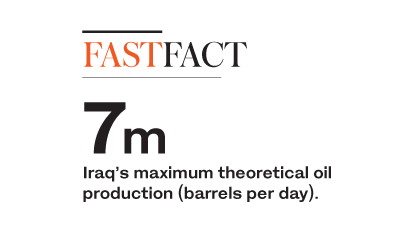
Other impediments were the absence of electricity to run some oil fields, as well as the lack of pipelines, pumping stations and storage space — all of which have constrained capacity.
“Coordinating the purchase of various components such that you can progress without delay … has been another major issue,” said Elsner.
The state-run company responsible for oil projects in mid-stream had “a spotty execution track record,” he added. There was legal uncertainty around contracts, security risks, and water and electricity services were unreliable.
The IHS report added that Iraq’s crude oil consumption is currently 0.7 million bpd, and this was expected to grow very slowly, to 0.8 million bpd by 2030. Iraq’s crude exports are the difference between production and consumption.
The oil-rich Basra province was rocked by renewed violence earlier this month as political protests regain momentum, threatening oil facilities. Thousands of Iraqis have been taking to the streets daily over the past week, torching government buildings and political party offices.
The demonstrations have added to oil supply concerns, although these turn principally around worries about the absence of Iranian crude later this year when US sanctions kick in. India and China have begun to reduce their purchases of Iranian oil while South Korea has already dropped imports to zero on the orders of the Trump administration, according to the Financial Times.


![]()

Iraq oil production to be ‘squeezed for next decade’
Iraq oil production to be ‘squeezed for next decade’
- The state-run company responsible for oil projects in mid-stream had “a spotty execution track record


Latest updates


© 2026 SAUDI RESEARCH & PUBLISHING COMPANY, All Rights Reserved And subject to Terms of Use Agreement.