Pakistan’s travel embargo puts Afghan patients at risk

1 / 2
An Afghan family while registering at a repatriation center in Peshawar
2 / 2
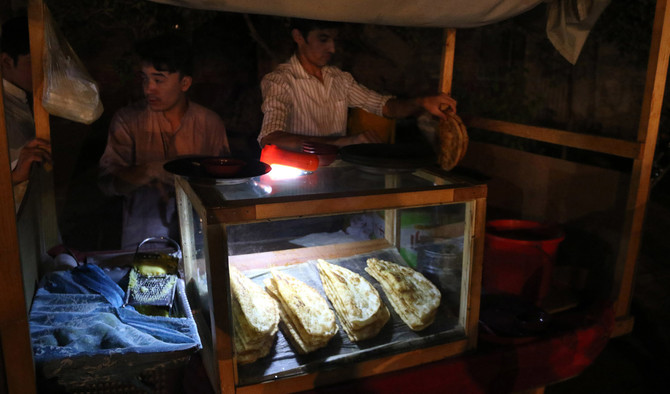
Afghan boys selling parathas at their pushcart in Peshawar
Updated 16 September 2018
Follow

Pakistan’s travel embargo puts Afghan patients at risk

  • 10-day ban in place as part of security measures for Muharram
  • Rights groups urge authorities to allow patients freedom of movement

PESHAWAR: Caught between a rock and a hard place, Muallim Khan, a resident of the Dakka area in Afghanistan, says that he can neither visit a hospital in the capital nor seek treatment in neighboring Pakistan.
This is because a notification issued by Peshawar earlier this week bars the entry of Afghan nationals into Pakistan during the first 10 days of Muharram. Around 3,000 Afghan nationals cross the border for reasons of employment and medical treatment every day – a number that will see a massive decline due to the new regulation.
At the receiving end are people like Khan, 55, who says that despite undergoing surgery in Peshawar, he has been unable to return for a checkup that’s long overdue. “The worst part is that we cannot even go to Kabul because the Afghan authorities have banned the entry of people from suburban areas due to strict security during this month [of Muharram],” he said.
Speaking to Arab News, S P Kaukab Farooq, superintendent of police in Peshawar, said that due to the sensitive situation “they (Afghan nationals) are not allowed to enter the city until Ashura (the 10th of Muharram)”.
Besides Peshawar, the districts of Kohat, Tank and D. I. Khan have been marked most sensitive due to their substantial Shiite population who are often targeted by extremist elements for their religious beliefs.
While the rules were much more lax earlier, officials said the Peshawar terror attack in December 2014 --- which killed 132 children from the Army Public School and which the military blamed the Taliban for – led to the tightening of security measures in the area, with passports now a must for entry into Pakistan. “Even if there is a patient to be brought to a hospital, the authorities demand to see their passport first,” Shamsul Islam, a Revenue Officer of the Landikotal subdivision, said.
Islam added that the permits are no longer issued at the border and instead need to be procured from the main cities in Afghanistan.
Ruing the changes in law which limited him from acquiring a passport on time, Wali Gul, a resident of the Nangarhar province in Afghanistan, said: “My 14-year-old daughter died from tuberculosis and liver dysfunction only because I was not granted permission to travel to a hospital in Peshawar. My family and I made repeated requests to the authorities at Torkham border to allow us to shift my daughter to a hospital in Peshawar but they demanded the patient’s passport first.”
Gul’s daughter died by the time he could make the necessary arrangements and finally cross the border. The aggrieved father urged authorities, on both sides of the border, to make temporary arrangements for patients with serious impediments so that they access medical attention on time.


Pakistani, Bangladeshi officials discuss trade, investment and aviation as ties thaw

Updated 28 December 2025
Follow

Pakistani, Bangladeshi officials discuss trade, investment and aviation as ties thaw

  • Pakistan and Bangladesh were once one nation, but they split in 1971 as a result of a bloody civil war
  • Ties between Pakistan, Bangladesh have warmed up since last year and both nations have resumed sea trade

ISLAMABAD: Pakistan's High Commissioner to Bangladesh Imran Haider on Sunday met Chief Adviser Muhammad Yunus in Dhaka, the latter's office said on, with the two figures discussing trade, investment and aviation.

Pakistan and Bangladesh were once one nation, but they split in 1971 as a result of a bloody civil war, which saw the part previously referred to as East Pakistan seceding to form the independent nation of Bangladesh.

Ties between Pakistan and Bangladesh have warmed up since former prime minister Sheikh Hasina’s ouster as a result of a student-led uprising in August 2024. Relations remain frosty between Dhaka and New Delhi over India’s decision to grant asylum to Hasina.

Pakistan has attempted to forge closer ties with Bangladesh in recent months and both South Asian nations last year began sea trade, followed by efforts to expand government-to-government commerce.

"During the meeting, both sides discussed ways to expand cooperation in trade, investment, and aviation as well as scaling up cultural, educational and medical exchanges to further strengthen bilateral relations between the two South Asian nations," Yunus's office said in a statement on X.

In 2023-24 Pakistan exported goods worth $661 million to Bangladesh, while its imports were only $57 million, according to the Trade Development Authority of Pakistan. In Aug. this year, the Pakistani and Bangladeshi commerce ministries signed a memorandum of understanding to establish a Joint Working Group on Trade, aiming to raise their bilateral trade volume to $1 billion in the financial year that began in July.

The Pakistani high commissioner noted that bilateral trade has recorded a 20 percent growth compared to last year, with business communities from both countries actively exploring new investment opportunities, according to the statement.

He highlighted a significant increase in cultural exchanges, adding that Bangladeshi students have shown strong interest in higher education opportunities in Pakistan, particularly in medical sciences, nanotechnology, and artificial intelligence. Haider also said that Dhaka-Karachi direct flights are expected to start in January.

"Chief Adviser Professor Muhammad Yunus welcomed the growing interactions between the two countries and emphasized the importance of increased visits as well as cultural, educational and people-to-people exchanges among SAARC (South Asian Association for Regional Cooperation) member states," the statement read.

"Professor Yunus also underscored the need to further boost Bangladesh–Pakistan trade and expressed hope that during Mr. Haider’s tenure, both countries would explore new avenues for investment and joint venture businesses."