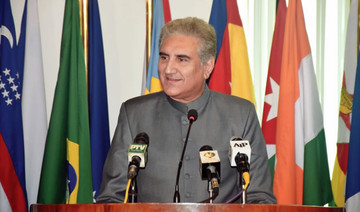
ISLAMABAD: Pakistan’s Foreign Minister, Shah Mehmood Qureshi, discussed a host of bilateral issues, including cooperation and means to facilitate trade and security assistance, as part of his day-long visit to Kabul on Saturday.
“He also reiterated Pakistan’s support for the government’s efforts to bring lasting peace in Afghanistan,” the Pakistan Foreign Ministry said in a statement.
Qureshi underscored the importance of enhanced coordination between the two countries in the areas of counter-terrorism and security and “offered to train Afghan police and law enforcement agencies in Pakistani institutions”, the statement read.
Qureshi’s visit was his first foreign trip abroad where he held high-level talks with his Afghan counterpart, Salahuddin Rabbani, following a meeting with Afghan President Ashraf Ghani and Chief Executive Dr. Abdullah Abdullah.
Detailing the terms for bilateral trade, Qureshi said that Pakistan had decided to waive off regulatory duty on imports from Afghanistan, which led to a record 118 percent increase in Afghan exports this year. He also vowed to “fast-track the standardization and automation of custom procedures and upgrade infrastructure at crossing points between the two countries”.
Another measure agreed upon to facilitate people to people contact included an offer to grant more than 600 scholarships to Afghan students, as part of the second phase of the “3,000 scholarships” program. The students will begin their semester next fall.
Qureshi, on behalf of Prime Minister Imran Khan, also invited Ghani to visit Pakistan. Khan, on his part, sent a consignment of 40,000 tons of wheat as a gift to the Afghan people.
In his engagements with the Afghan leadership, Qureshi conveyed that the new government in Pakistan attached great importance to its relations with Afghanistan and would work toward deepening cooperation in the fields of trade development and connectivity. “Pakistan, along with other partners of Afghanistan, is ready to play a constructive role in facilitating an Afghan-led and Afghan-owned peace process and reconciliation,” the statement read.
He also underlined the need for a dignified and sustainable repatriation of Afghan refugees to their homeland by way of a gradual and time-bound plan. Crucial on the agenda was resolving of the issue concerning the Pakistan Consulate General in Jalalabad. The two sides agreed to expedite matters related to the consulate and ensure its early operationalization.
Both Qureshi and Rabbani also agreed to convene the meeting of the Afghanistan-Pakistan Transit Trade Coordination Authority, in addition to finalizing a date for the Steering Committee of the Joint Ulema Conference. “The visit provided an opportunity to set-out the contours of the new government’s future engagement with Afghanistan to build a mutually-beneficial relationship and enhance cooperation between the two countries,” the statement said.


![]()

Islamabad offers to train Afghan police in Pakistani institutions
Islamabad offers to train Afghan police in Pakistani institutions
- Several areas of cooperation identified during Qureshi’s visit to Kabul
- PM Khan gifts 40,000 tons of wheat to the Afghan people

Latest updates




© 2026 SAUDI RESEARCH & PUBLISHING COMPANY, All Rights Reserved And subject to Terms of Use Agreement.