

2 storms, Florence and Mangkhut, different as water and wind

1 / 7
Resident Joseph Eudi looks at flood debris and storm damage from Hurricane Florence at a home on East Front Street in New Bern, North Carolina, Son Sept. 15, 2018. (Gray Whitley/Sun Journal via AP)
2 / 7
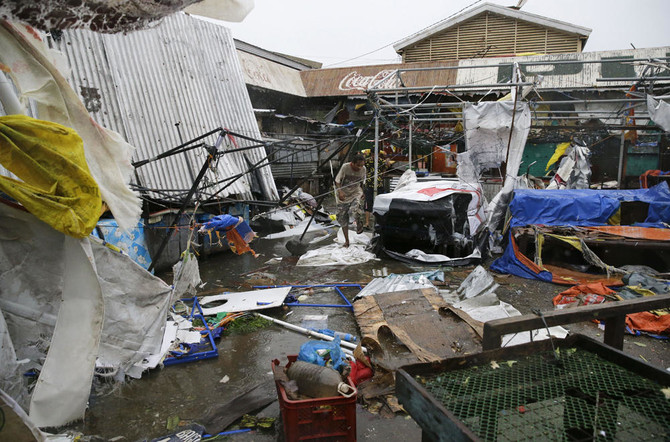
Residents walk along destroyed stalls at a public market due to strong winds as Typhoon Mangkhut barreled across Tuguegrao city in Cagayan province, northeastern Philippines, on Sept. 15, 2018. (AP Photo/Aaron Favila)
3 / 7
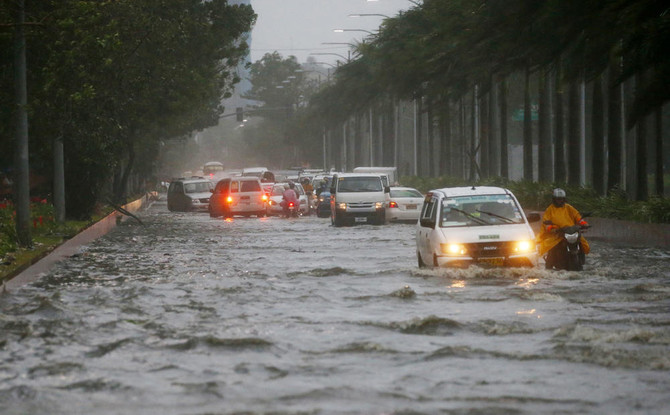
Motorists negotiate a flooded street in Manila, Philippines, before dawn on Sept. 15, 2018 following heavy rains and strong winds brought about by Typhoon Mangkhut which barreled into northeastern Philippines. (AP Photo/Bullit Marquez)
4 / 7
Philippine police give out rice porridge to residents living along the coastal community of Baseco in Manila as they evacuate during the onslaught of Typhoon Mangkhut which barreled into northeastern Philippines before dawn on Sept. 15, 2018. (AP Photo/Bullit Marquez)
5 / 7
Manila police distribute rice porridge to residents living along the coastal community of Baseco as they evacuate at the onslaught of Typhoon Mangkhut which barreled into northeastern Philippines before dawn Saturday, Sept. 15, 2018 in Manila, Philippines. Philippine officials were assessing damage and checking on possible casualties as Typhoon Mangkhut on Saturday pummeled the northern breadbasket with ferocious wind and rain that set off landslides, damaged an airport terminal and ripped off tin roofs. (AP Photo/Bullit Marquez)
6 / 7
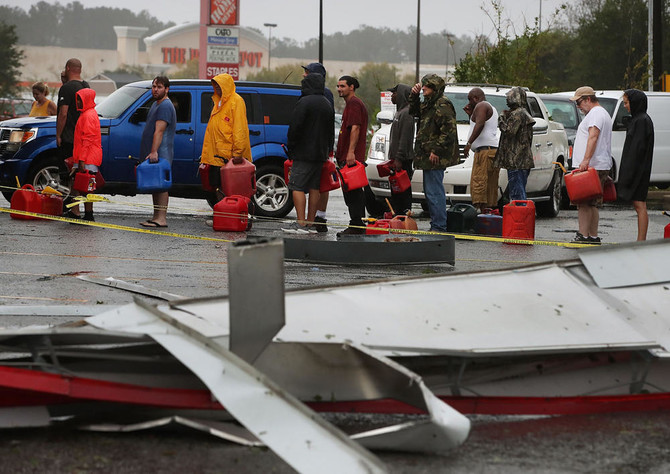
People wait in line to fill up their gas cans at a gas station that was damaged when Hurricane Florence hit the area on September 15, 2018 in Wilmington, North Carolina. (Mark Wilson/Getty Images/AFP)
7 / 7
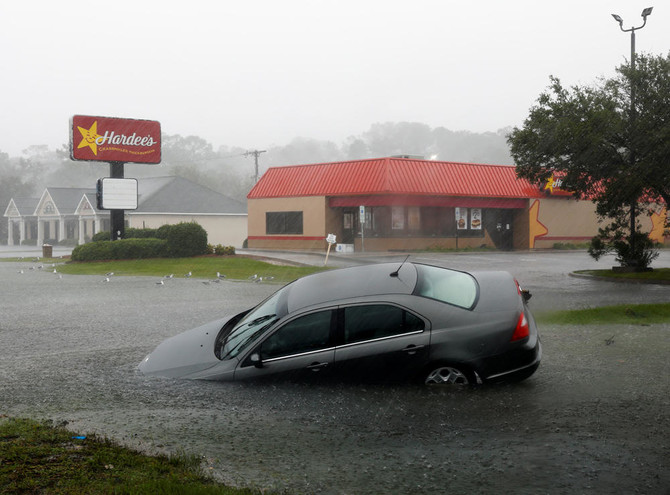
A car washed away by flood waters remains partially submerged as torrential rains continue after Hurricane Florence struck in Southport, North Carolina, US, on September 15, 2018. (REUTERS/Jonathan Drake)
Updated 16 September 2018
Follow

2 storms, Florence and Mangkhut, different as water and wind

  • Storms in the western Pacific generally hit with much higher winds and the people who live in their way are often poorer and more vulnerable
  • But Florence’s watery insured damage total will eventually be higher, says Ernst Rauch, head of climate research for the world’s largest reinsurer Munich Re

WASHINGTON: Nature expresses its fury in sundry ways. Two deadly storms — Hurricane Florence and Typhoon Mangkhut — roared ashore on the same day, half a world apart, but the way they spread devastation was as different as water and wind.
Storms in the western Pacific generally hit with much higher winds and the people who live in their way are often poorer and more vulnerable, Princeton University hurricane and climate scientist Gabriel Vecchi said Saturday. That will likely determine the type of destruction.
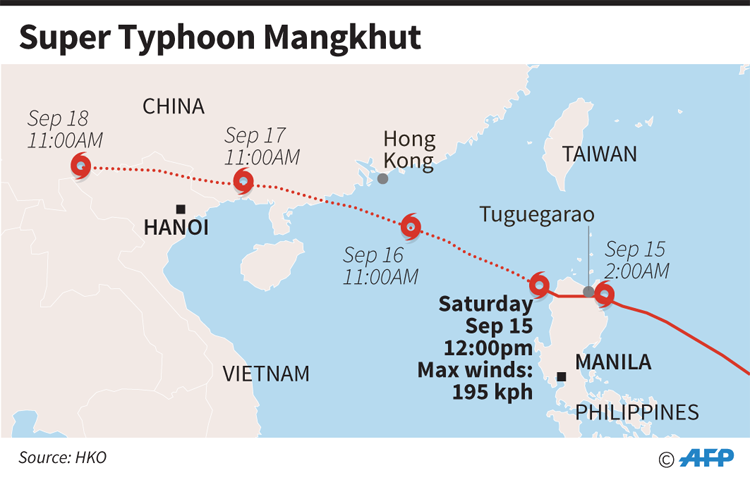
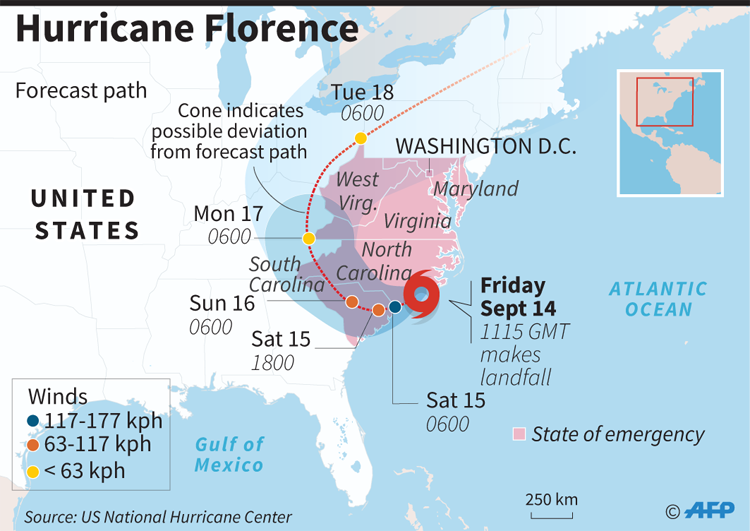
Mangkhut made landfall Friday on the northeastern tip of Luzon island in the Philippines with top-of-the-scale Category 5 winds of 165 mph. Florence had weakened to a Category 1 storm with 90 mph winds by the time it arrived at North Carolina’s coast.
Yet a day after landfall the faster-moving Mangkhut was back out over open water — weakened, but headed across the South China Sea toward China. Florence, meanwhile, was still plodding across South Carolina at a pace slower than a normal person walks. By Saturday morning, it had already dumped more than 30 inches (76 centimeters) of rain, a record for North Carolina.
Experts say Mangkhut may well end up being the deadlier storm. As of Saturday afternoon, the death count in the Philippines was a bit higher, although still far below that of other storms that have hit the disaster-prone island nation. And with Mangkhut now headed toward the densely populated southeast coast of China, it is likely to cause more death and destruction. But Florence’s watery insured damage total will eventually be higher, Ernst Rauch, head of climate research for the world’s largest reinsurer Munich Re, told German media.

That’s because of a combination of geography, climatic conditions and human factors.
The western Pacific has two-and-a-half times more storms that reach the minimum hurricane strength of 74 mph. It has three-and-a-half times more storms that reach major hurricane strength of 111 mph, and three times more accumulated energy out of those hurricanes, an index that measures not just strength and number of storms but how long they last, according to more than 65 years of storm data .
So far this year there have been 23 named storms in the western Pacific and 10 in the Atlantic, both regions more than 30 percent busier than average years. Hurricanes and typhoons are the same type of storm; both are tropical cyclones, but those that occur in the Pacific west of the International Date Line are called typhoons.
The water in the western Pacific is warmer, and warm water fuels storms. There are also only a few pieces of land to get in the way and weaken them, said University of Miami hurricane researcher Brian McNoldy.
“If we are ever going to have a Category 6 (a speculated-on level that’s above current measurement tools), the western Pacific is where it’s going to be,” said meteorologist Ryan Maue of weathermodels.com.
The Philippines tends to get hit nearly every year, the Carolinas far less frequently though with lots of close calls, Maue said. That shows another big difference in the storms. Mangkhut formed further south and stayed south — over warmer water. Florence was out of the tropics when it hit land.
Because of that, Florence was weakened by the dry air and upper level winds of the higher latitudes. Not so the more southerly Mangkhut, which Maue said, “essentially had a perfect environment to intensify to a Category 5 and stay there.”
“Mangkhut and Florence are certainly different animals,” said Colorado State University hurricane researcher Phil Klotzbach. Because Florence is moving so slowly, he said, it will dump more rain than Mangkhut, which is named for the Thai word for the mangosteen fruit.
Both storms have lasted a long time, especially Florence which formed all the way over near Africa 15 days before landfall, McNoldy said. Both storms cover a large area, but Mangkut still dwarfs Florence. Mangkhut’s tropical storm force winds stretched more than 325 miles from the center, while Florence’s spread about 195 miles, Klotzbach said.

Economics also play a role in a storm’s impact. As a developing country, the Philippines is much poorer than the southeastern United States, which means houses tend to be less sturdy and first responders less well equipped, among other factors. This is one reason why, when disaster does strike, the effects can be devastating. In 2013, one of the most powerful storms on record, Typhoon Haiyan , killed 7,300 people and displaced more than 5 million when it swept across the islands of the central Philippines.
Straddling the famous Pacific Ring of Fire, the Philippines is also bedeviled by volcanoes and earthquakes, and while there are considerable patches of poverty in North and South Carolina, it is not the same as the rural area where Mangkhut hit.
Munich Re’s Rauch said about 30 to 50 percent of storm damage is usually insured in the United States but often less than 10 percent in developing countries, meaning nine-tenths of the people hit will end up shouldering a bigger economic burden.
In the United States, “you can’t move houses, but people can move out of the way,” reflecting mounting damages from storms and often lower losses in life, Vecchi said.
As the world warms from the burning of fossil fuels, the globe will see both more extremely intense storms like Mangkhut and wetter storms like Florence, Vecchi said.


Bangladesh takes ‘balanced approach’ with Pakistan as talks of defense deal emerge

Updated 4 sec ago
Follow

Bangladesh takes ‘balanced approach’ with Pakistan as talks of defense deal emerge

  • Air force chiefs of Pakistan and Bangladesh discussed potential defense pact last week
  • Dhaka says plan to procure fighter jets still in early stages, discussions ongoing with several countries

DHAKA: Bangladesh appears to be moving with caution as Dhaka and Islamabad forge closer ties and explore a potential defense deal, experts said on Friday.

Following decades of acrimonious ties, relations between Bangladesh and Pakistan have been growing since a student-led uprising ousted former Prime Minister Sheikh Hasina in 2024.

Talks on a potential defense deal covering the sale of Pakistan’s JF-17 fighter jets to Dhaka emerged after Bangladesh’s Air Chief Marshal Hasan Mahmood Khan visit to Rawalpindi last week, where he met with his Pakistani counterpart Air Chief Marshal Zaheer Ahmed Baber Sidhu and Field Marshal Syed Asim Munir, Pakistan’s chief of defense forces.

Bangladesh’s military media wing, the Inter-Services Public Relations, said the procurement of fighter jets for the Bangladesh Air Force is “in the very rudimentary level,” and currently “under an evaluation process.”

ISPR Director Lt. Col. Sami Ud Dowla Chowdhury told Arab News: “The evaluation process will determine which country’s offer proves befitting for us. The air chief’s visit to Pakistan is part of the evaluation process … Earlier, he visited China, Italy (too).

“Discussions are underway with different countries. Nothing concrete has come yet.”

Talks between the high-ranking military officials are the latest development in Bangladesh-Pakistan ties, which have included the resumption of direct trade for the first time since the 1971 war and the expected launch of a regular route from Dhaka to Karachi at the end of this month, following over a decade of suspension.

Though efforts to expand relations can be seen from both sides, the current interim government of Bangladesh led by economist and Nobel Prize laureate Muhammad Yunus has been “showing some kind of pragmatism,” said Prof. Delwar Hossain of Dhaka University’s international relations department.

“Bangladesh is stepping very cautiously in comparison with the advancement from the Pakistan side. Bangladesh is trying to make a balanced approach,” he told Arab News.

“The present government is always saying that the development of a relationship with Pakistan doesn’t necessarily mean that Bangladesh is moving towards a particular camp. Rather, Bangladesh is interested in having a balanced relationship with all the great powers.”

Trade and economy are “naturally” more preferable areas of cooperation for Dhaka, Hossain said, adding that “we need more time to determine” how far military cooperation will be expanded.

Ishfaq Ilahi Choudhury, a defense expert and retired air officer of the Bangladesh Air Force, said that Bangladesh is “very much in need of advanced aircraft” because its military has not procured new fighter jets in at least two decades.

“Air frigate fighters are badly needed for the Bangladesh Air Force. We had some F-7 produced by China, but they stopped producing these fighters nowadays. Here, Pakistan can be a source for our fighter jets, but it involves … geopolitics,” he told Arab News, alluding to how Dhaka’s defense ties with Pakistan may be perceived by its archrival neighbor India.

Pakistan’s JF-17 fighter jets, a multi-role combat aircraft jointly developed with China, have drawn international interest following their success last May, when Pakistani and Indian forces engaged in their worst fighting since 1999.

Islamabad said it shot down several Indian fighter jets during the aerial combat, a claim Indian officials later acknowledged after initially denying any losses, but without specifying the number of jets downed.

“Our friendship with Pakistan shouldn’t (come) at the cost of our friendship with India,” Choudhury said.

“With this (potential) defense purchase deal with Pakistan, we have to remain very cautious so that it proves sustainable in the long term.”