Iraq parliament elects Sunni lawmaker Al-Halbousi as speaker, breaking deadlock

1 / 2
Iraq's new Parliament Speaker Mohammed al-Halbousi, center, and his political bloc hold a press conference in Baghdad on Saturday. (AP Photo)
2 / 2
Iraq's parliament elected Sunni lawmaker Mohammed Al-Halbousi as speaker on Saturday. (AFP)
Updated 16 September 2018
Follow

Iraq parliament elects Sunni lawmaker Al-Halbousi as speaker, breaking deadlock

  • Al-Halbousi is the former governor of Anbar province and was supported by the pro-Iran bloc inside parliament.
  • Born in 1981, he will be the youngest speaker of parliament in Iraq's history.

BAGHDAD: Rival blocs in Iraq’s Parliament ended a political stalemate on Saturday and elected a Speaker and his two deputies.

The move is the first step in the formation of a government after months of wrangling since elections in May.

MPs elected a Sunni to head the Parliament, a Shiite as first deputy and a Kurd as second deputy, in a return to the power-sharing system adopted since the 2003 US-led invasion that toppled Saddam Hussein.

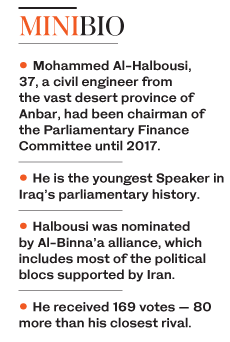
Mohammed Al-Halbousi, 37, a civil engineer from the vast desert province of Anbar, had been chairman of the Parliamentary Finance Committee until 2017. He is the youngest Speaker in Iraq’s parliamentary history. 

Halbousi was nominated by Al-Binna’a alliance, which includes most of the political blocs supported by Iran. He received 169 votes — 80 more than his closest rival.
“The selection of a young Iraqi to fill the post of Speaker is an important development that sends a firm message to the former politicians that they have to leave and make way for the new generation,” said Khamis Al-Khanjar, one of Iraq’s key Sunni figures.

There were no clashes on Saturday between Al-Binna’a and the Reform coalition sponsored by Moqtada Al-Sadr, one of Iraq’s most influential Shiite clerics, who is supported by the US. The last session on Sept. 3 ended in acrimony, when each claimed they had the largest number of seats and should be allowed to form a government. Violent protests broke out in Basra the next day, killing at least 15 people.

Arab News reported on Friday that agreement had been reached between Al-Sadr and his rivals to include some pro-Iran factions in his coalition. Evidence of the deal emerged during Saturday’s parliamentary session.

Al-Binna’a MPs stepped down after their candidate won the post of Speaker, and announced the withdrawal of their candidate for first deputy to allow Sadr’s candidate to take the position.

“The results of the session of Parliament indicate that the agreement between Al-Binna’a and the Reform coalitions can overcome the obstacles and lead the political scene toward the destination they want,” a prominent Shiite lawmaker involved in the talks to form the government told Arab News.

“The conclusion suggests that Al-Binna’a and Reform together are in practice the largest bloc and the real decision maker.

“So, they both silently agreed to not talk about the biggest bloc this time, and the negotiations will move on to form the government as they have been planning.”


GCC states ‘face reliance on Saudi Arabia for food imports’

Updated 06 March 2026
Follow

GCC states ‘face reliance on Saudi Arabia for food imports’

  • With 70 percent of food coming through Strait of Hormuz, analysts warn of inevitable shortages

DUBAI: Some Gulf states may have to rely on overland food deliveries from Saudi Arabia if the US-Israel-Iran war continues to disrupt shipping through the Strait of Hormuz and restrict regional airspace, analysts warned on Thursday.
The region is up to 90 percent dependent on food imports, and price surges and scarcity of some goods are expected.
“With over 70 percent of GCC foodstuffs being imported through the Strait of Hormuz, Gulf states face shortages if the war persists,” said Neil ​Quilliam of the Chatham House think tank. 
“While GCC countries have taken steps to diversify suppliers and ensure sufficient stores to withstand disruption, this can only last several months. At this point, price increases ​and longer lead times will start to hit the markets.”
Commodities analyst Ishan Bhanu said: “The biggest immediate effect will be due to the blockade of Jebel Ali in Dubai, serving about 50 million people. Qatar, Kuwait, Bahrain and Iraq effectively become landlocked and will depend on overland routes through Saudi Arabia.”
Bottlenecks are yet to show and the UAE has said its strategic reserves of vital goods cover four to six months of needs. It urged residents to report unjustified price increases through a dedicated hotline.
Supermarket staff ​throughout the Gulf said shelves remain largely stocked, though suppliers are taking longer to replenish certain products. Iran’s strikes on the Gulf since Saturday prompted panic buying in supermarkets, a dry run for what could come. 
“Perception of risk matters, and even if stocks are sufficient now, public runs on supermarkets can spook the public,” Quilliam said.