

US to impose tough sanctions on Iran in November, including flights

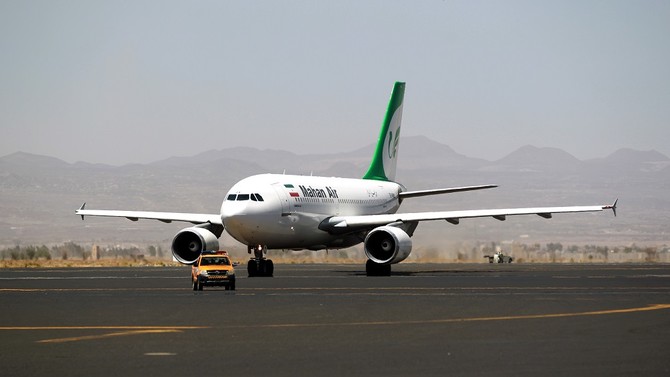
An airplane of Mahan Air sits at the tarmac after landing at Sanaa International Airport in the Yemeni capital on March 1, 2015. (File/AFP)
Updated 14 September 2018
Follow

US to impose tough sanctions on Iran in November, including flights

  • Sanctions on Iran will start Nov. 4, which will effect Iranian carrier Mahan
  • The US says Iran is the world’s leading state sponsor of terrorism

The US Assistant Secretary Marshall Billingslea said on Thursday that the United States will impose tough sanctions on Iran starting Nov. 4, including sanctions on Iranian carrier Mahan and its supporters.

Billingslea praised Gulf countries’ unprecedented support for the administration’s efforts to put an end to Iran’s influence in the region.

“Iran, the world’s leading state sponsor of terrorism, continues to fund groups like Hizballah and Hamas and bankroll the Syrian regime’s slaughter of its people while advancing its missile program and sowing regional instability,” he said refereeing to Lebanon’s Hezbollah and Hamas in Gaza.

“Russia provides weaponry and defense materiel to Iran, and extensive support to the Syrian regime enabling Assad’s brutal targeting of his own citizens,” US Assistant Secretary added.


Iran protest instigators will receive no leniency, judicial chief says

Updated 6 sec ago
Follow

Iran protest instigators will receive no leniency, judicial chief says

TEHRAN: The head of Iran’s judiciary warned that those behind a recent wave of anti-government protests could expect punishment “without the slightest leniency.”
What began earlier this month as demonstrations against the high cost of living boiled over into a broader protest movement that represented the gravest challenge to the leadership in years.
The protests have abated under an internet blackout that left the country largely cut off from the outside world.
“The people rightly demand that the accused and the main instigators of the riots and the acts of terrorism and violence be tried as quickly as possible and punished if found guilty,” judicial chief Gholamhossein Mohseni Ejei was quoted as saying by the official Mizan online news portal.
He went on to say “the greatest rigor must be applied in the investigations,” but insisted that “justice entails judging and punishing without the slightest leniency the criminals who took up arms and killed people, or committed arson, destruction, and massacres.”
The Iranian government has put the death toll from the protests at 3,117, including 2,427 people it has labeled “martyrs” — a term used to distinguish members of the security forces and innocent bystanders from those described by authorities as “rioters” incited by the US and Israel.
Rights groups have accused authorities of repeatedly using live ammunition on protesters, but Col. Mehdi Sharif Kazemi, commander of Iran’s special police, maintained authorities had used only non-lethal measures such as water cannon to quell the unrest.
“The use of weapons (by the police) during this operation has sparked some criticism, but in fact, the police did not resort to using any firearms,” he was quoted as saying by the Mehr news agency.
“We used non-lethal means in order to guarantee the safety of the population and avoid any killings.”
Italian Foreign Minister Antonio Tajani urged the EU to list Iran’s Revolutionary Guards Corps as a “terrorist organization” following the crackdown on protests.
Tajani said he would propose the idea “in coordination with other partners” at a meeting of EU foreign ministers in Brussels on Thursday.
“The losses suffered by the civilian population during the protests demand a clear response,” he wrote on X.
He also called for the EU to levy individual sanctions against those responsible.

The EU has already sanctioned several hundred Iranian officials over crackdowns on previous protest movements and over Tehran’s support for Russia’s war on Ukraine.

The bloc has also banned the export to Iran of a raft of components that could be used in the country’s drone and missile manufacturing.
Last week, EU chief Ursula von der Leyen announced plans to ban additional exports of critical drone and missile technologies.
An EU official on Friday confirmed that the proposal to designate the IRGC as a terrorist organization was on the table for this week’s meeting, but said it requires unanimity for approval and that “we are not yet there.”