US shale groups lock in revenues as output nears Saudi and Russian levels

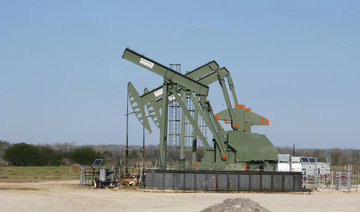
A gas flare burns at a fracking site in rural Bradford County, Pennsylvania. (Reuters)
Updated 13 September 2018
Follow

US shale groups lock in revenues as output nears Saudi and Russian levels

  • Hedging activity picks up pace
  • Swaps increased last week

NEW YORK: US shale producers are locking in prices for their production as much as three years into the future in a sign that strong domestic crude pricing is nearing a peak, according to market sources familiar with money flows.
US crude prices for 2019 and 2020, based on an average of each year’s monthly contracts, have climbed this week above $68 and $64 a barrel, respectively, the highest levels in over three years. The rally comes even as front-month prices have dropped from the three and a half year highs touched during the summer.
“Hedging activity has picked up considerably over recent weeks and this will continue to be the case as producers begin to frame budgets for next year,” said Michael Tran, commodity strategist at RBC Capital Markets, noting the rally in forward prices are encouraging the producer bets.
Hedging can reduce risks associated with volatility in oil prices, acting as an insurance contract to lock in a future selling price and fix spending plans. Such longer-term bets signal US producers will continue to expand output, keeping a lid on prices, according to crude traders and brokers.
The nation’s output this year has climbed above 10 million barrels per day (bpd), close to top producers Russia and Saudi Arabia. That output is forecast to grow next year by 840,000 bpd to average 11.5 million bpd.
There was a large uptick in crude swap activity last week, with just shy of 8 million barrels changing hands in a day, an energy derivatives broker said, signaling strong hedging interest. Swaps are a type of contract that allow producers to lock in or fix the price they receive for their oil production.
Almost 80 percent of the swap activity was split evenly between calendars 2020 and 2019, and the remaining 20 percent for this year, the broker said, adding that there was a small amount of calendar 2021 activity during the week.
The market sources declined to say which oil companies were actively hedging in recent weeks.
The move to hedge at these levels could prove risky for producers in a market where the price of oil for immediate delivery is higher than for later deliveries.
Many US shale producers hedged second-quarter production at about $55 a barrel, which backfired as US crude climbed to more than $70 a barrel last quarter, the highest level since 2014.
As a result, producers are using more “collars,” a financial instrument that provides price protection on the downside while allowing them to share in some of the upside if prices rally.
“We’ve been building a lot of collar structures,” Christian Kendall, chief executive of Denbury Resources Inc. said last week, noting that the instruments will protect its production at about $60 a barrel and provide upside if oil rises to the high $70s per barrel.
Denbury is nearly 50 percent hedged for 2019 and will add hedges to get to 60 percent to 70 percent of production, Kendall said.


Beyond government: how digital defense is becoming a priority across Saudi Arabia

Updated 7 sec ago
Follow

Beyond government: how digital defense is becoming a priority across Saudi Arabia

RIYADH: Saudi Arabia’s cybersecurity market is entering a decisive growth phase, driven by rapid digital transformation, expanding cloud and artificial intelligence adoption, and increasingly robust regulatory frameworks.

Sustained public and private investment under Vision 2030 is expected to propel the sector into one of the fastest-growing and most structurally advanced cybersecurity markets in the region.

According to Dimension Market Research, the Kingdom’s cybersecurity market size is expected to reach $11.3 billion by the end of 2033 at a compound annual growth rate of 14.2 percent.

Projected size of the cybersecurity market in Saudi Arabia

In recent years Saudi Arabia has experienced consistent and strategic growth in cybersecurity investments, largely fueled by the rapid adoption of digital services across organizations.

Samer Omar, cybersecurity and digital trust leader at PwC Middle East, said there was around SR15.2 billion ($4.05 billion) of investment in the sector in Saudi Arabia in 2024, and if current trends continue, most market assessments suggest the industry could reach between $7 billion and $9 billion by 2030.

“What matters most is how organizations are maturing. As more services move to the cloud and AI becomes embedded in day-to-day operations, security is increasingly part of early decision-making rather than an afterthought,” Omar told Arab News.

Samer Omar, cybersecurity and digital trust leader at PwC Middle East. (Supplied)

He added: “I expect the market to continue growing as organizations strengthen governance, modernize legacy systems, and invest in more advanced monitoring and response capabilities.”

This market expansion is not just reactive or trend-driven — Saudi Arabia’s cybersecurity growth is structurally anchored in Vision 2030’s digital-first agenda, mandatory regulatory frameworks, and the sheer scale of state-led investments in digital and infrastructure projects.

According to Maximilian Chowanetz, partner at Kearney Middle East, and his colleague San Jain, principal in the firm’s digital and analytics practice in Dubai, the market is currently valued at approximately SR17 billion, is projected to more than double to around SR35 billion by 2030, reflecting annual growth of over 15 percent.

“Unlike many emerging markets where cybersecurity adoption remains uneven, Saudi Arabia combines giga-projects, nationally deployed digital platforms, and expanding cloud infrastructure with increasingly stringent compliance requirements across sectors. This creates sustained, non-discretionary demand for advanced cyber capabilities, particularly in critical infrastructure protection, cloud security, and operational technology/information technology convergence,” Chowanetz and Jain said in a joint statement.

They added: “As digital services become embedded across the economy, cybersecurity is evolving from a supporting IT function into a core enabler of national resilience and economic competitiveness. These fundamentals position Saudi Arabia as one of the fastest-growing and most structurally advanced cybersecurity markets in the region.”

Investment beyond finance, government

Cybersecurity is increasingly emerging as a key priority across various rapidly evolving sectors.

In Saudi Arabia, cybersecurity investment is growing not only in finance and government but also across sectors such as healthcare, energy, and the broader digital economy, where fast-paced digitization is surpassing conventional security frameworks. These industries lie at the crossroads of national priorities, operational risks, and major technology rollouts under Vision 2030.

From PwC’s lens, Omar shed light on how in the energy and industrial sectors the integration of connected technologies is on the rise, heightening the demand for robust protection of operational systems. Similarly, healthcare providers are broadening their digital health offerings, making security and privacy essential components of daily clinical practices.

“Telecoms, cloud providers, and data centers are also strengthening their capabilities as they support the Kingdom’s growing digital infrastructure. Retail, e-commerce, and education are evolving quickly as well, each with their own requirements as they introduce new digital platforms and services,” he said.

The official added: “What ties these sectors together is the recognition that secure digital services are essential to future growth. As the Kingdom continues progressing toward Vision 2030, cybersecurity is becoming a core enabler for sectors that are modernizing at pace.”

Maximilian Chowanetz, partner at Kearney Middle East. (Supplied)

From Kearney’s perspective, Chowanetz and Jain also highlighted how healthcare is digitizing at speed, with electronic health records, telemedicine platforms, and connected medical devices expanding the attack surface and making data protection and patient safety critical imperatives.

“In energy and critical infrastructure, the integration of smart grids, renewables, and industrial IoT is driving demand for advanced OT and industrial control systems security frameworks, an area where Saudi Arabia’s scale positions it as a global reference point. Alongside this, the rapid expansion of the digital economy, underpinned by cloud adoption and connected ecosystems, is elevating the need to secure data, networks, and edge devices,” they said.

The two spokespeople added: “Together, these sectors represent where cybersecurity is no longer discretionary, but foundational to service continuity, public trust, and economic resilience.”

Opportunities for local, global players

As with many other sectors in Saudi Arabia, cybersecurity presents a wealth of opportunities for both local and international players to tap into.

Omar from PwC highlighted that a major focus is growing cybersecurity talent, with rising demand pushing many organizations to rely on managed services and expert support.

He underlined that small and medium-sized businesses also present key opportunities, seeking affordable, user-friendly security solutions, ideally with Arabic-language support, to match their needs.

“As cloud adoption increases, there is rising demand for cloud security, identity management, and secure development practices. Industrial environments also need tailored support as they integrate older systems with modern technologies,” Omar said.

He added: “We’re also seeing interest in practical guidance related to the Personal Data Protection Law, along with locally relevant threat intelligence and training. These needs create space for both local and global providers to offer solutions that help organizations move forward with confidence as the digital economy continues to grow.”

From their side, Chowanetz and Jain shed light on how the Kingdom’s cybersecurity market holds major opportunities, with key gaps in capability, scale, and specialization — especially as demand expands beyond the public sector.

They went on to note that talent shortages are driving demand for managed services, automation, and upskilling to maintain resilience. Meanwhile, SMEs remain underserved, facing rising regulatory pressures but lacking affordable cybersecurity solutions — creating strong demand for scalable, compliance-ready offerings.

San Jain, principal at Kearney Middle East’s digital and analytics practice in Dubai. (Supplied)

“Sector-specific solutions remain underdeveloped, particularly in areas such as health care device security, OT and ICS protection, cloud sovereignty, and IoT segmentation. Addressing these gaps will be critical not only to strengthening national cyber resilience but also to attracting investment, accelerating localization, and supporting sustainable growth across Saudi Arabia’s digital economy,” Chowanetz and Jain said.

Awareness increasing for individuals, SMEs

As digital services expand under Vision 2030, cybersecurity in Saudi Arabia is becoming a personal priority, with risks now extending to homes, devices, and daily transactions. At the same time, people are becoming more aware of protecting their personal data and managing their digital lives more securely.

From PwC’s side, Omar indicated that clearer data protection laws and educational initiatives have improved public awareness of cybersecurity, especially among younger audiences.

“Over time, this gradual change plays an important role in building long-term digital confidence and supporting the Kingdom’s wider digital ambitions,” he said.

On Kearney’s behalf, Chowanetz and Jain clarified that with national platforms like Absher and Tawakkalna and the rise of fintech and smart cities, cybersecurity in Saudi Arabia now directly affects individuals, expanding risks beyond organizations to personal data and daily life.

“As consumer awareness rises, driven by both local experience and global breaches, trust is becoming the critical currency of Saudi Arabia’s digital ecosystem. This shift is accelerating demand for user-centric security solutions, stronger data protection frameworks, and shared accountability between institutions and citizens to ensure confidence, resilience, and long-term digital adoption,” they said.