Middle East Apple fans will not have long to wait for new iPhone models

1 / 6
Apple aficionados in the Middle East will not have long to wait before they get their hands on the new iPhone (AFP)
2 / 6
Apple aficionados in the Middle East will not have long to wait before they get their hands on the new iPhone (AFP)
3 / 6
Apple aficionados in the Middle East will not have long to wait before they get their hands on the new iPhone (AFP)
4 / 6
Apple aficionados in the Middle East will not have long to wait before they get their hands on the new iPhone (AFP)
5 / 6
Apple aficionados in the Middle East will not have long to wait before they get their hands on the new iPhone (AFP)
6 / 6
Apple aficionados in the Middle East will not have long to wait before they get their hands on the new iPhone (AFP)
Updated 13 September 2018
Follow

Middle East Apple fans will not have long to wait for new iPhone models

  • Apple aficionados in the Middle East will not have long to wait before they get their hands on the new iPhone
  • As befits the hype, glitz and glamor of an Apple launch, the company revealed the details of its new smartphone models

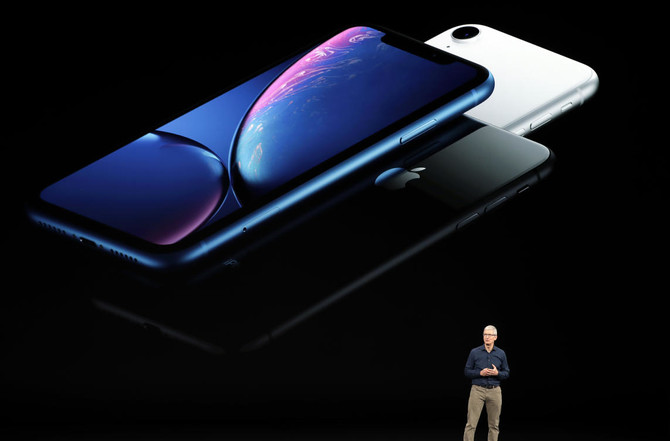
CUPERTINO, California: Apple aficionados in the Middle East will not have long to wait before they get their hands on what the company are calling the “most beautiful and advanced” iPhones.
As befits the hype, glitz and glamor of an Apple launch, the company revealed the details of its new smartphone models and a new smartwatch in Cupertino on Wednesday.
And technology-lovers will only have a few days to wait before they can pre-order the latest incarnations of the world’s most popular phone, with orders being taken from Sept. 14 and shipping for Saudi Arabia and the UAE starting on Sept. 21. iPhone addicts in Oman and Bahrain will have a week longer to wait, with the iPhones arriving in the two countries a week later on Sept. 28.
At the launch, Tim Cook confirmed the names of the new models — which had been leaked earlier in the day — as iPhone XS, XS Max and XR, as well as revealing release dates for global regions.
The major changes from previous models will be greater gearing toward internal upgrades rather than design changes, with all models improved with the fitting of the advanced A12 chip.
The new piece of kit is 50 percent more energy-efficient and faster than the previous processor, with apps loading 30 percent faster, too.
The A12 Bionic chip has an 8-core design — allowing it to run more advanced machine learning. At the launch, Apple called it a “breakthrough.”
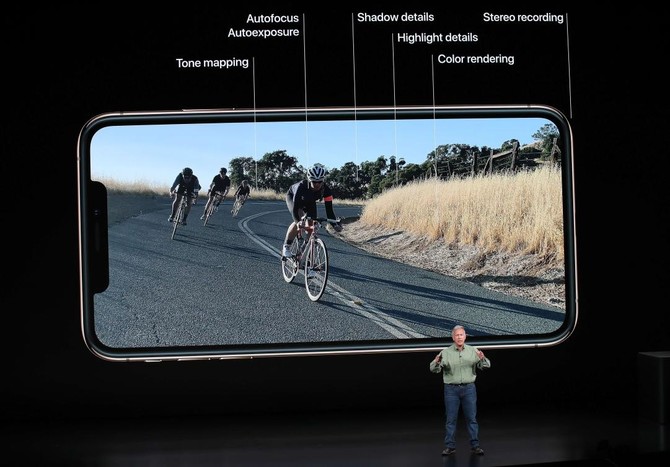
The largest screen Apple has produced represents the firm’s attempt to feed consumer appetite for watching and recording videos, as well as taking photos.
The biggest news for most smartphone users was the announcement of the new phone’s dual-Sim capability, meaning users will have access to two phone numbers on the same iPhone at the same time.
But the price-tag of the top model will again have even the most ardent Apple fan wincing, with the XS Max going for an eye-watering $1,100 — $100 more than last year’s iPhone X. In the aftermath of the launch, questions were being asked about how high technology firms can push the prices of smartphones before consumers kick back.
Apple launched the iPhone X last year, and for the first time in more than a decade sales did not go as well as analysts had anticipated. But with Apple boosting the average iPhone selling price by nearly 20 percent, it still meant a bumper year for the tech firm.
By manufacturing more expensive iPhones, Apple has been able to boost profits despite falling demand due to people upgrading their phones less frequently. iPhones fetched an average price of $724 during the April-June period this year, a 20 percent increase from a year earlier. This time around, the iPhone XS will stay at the $999 mark while the iPhone XR will use cheaper materials and sell for about $750.
Apple also announced a new Apple Watch, which will move further into medical device territory. It has a larger screen and a built-in sensor that can detect irregular heart-rates and perform an electrocardiogram, as well as detect when a user has fallen.


‘The future is renewables,’ Indian energy minister tells World Economic Forum

Updated 22 January 2026
Follow

‘The future is renewables,’ Indian energy minister tells World Economic Forum

  • ‘In India, I can very confidently say, affordability (of renewables) is better than fossil fuel energy,’ says Pralhad Venkatesh Joshi during panel discussion
  • Renewables are an increasingly important part of the energy mix and the technology is evolving rapidly, another expert says at session titled ‘Unstoppable March of Renewables?’

BEIRUT: “The future is renewables,” India’s minister of new and renewable energy told the World Economic Forum in Davos on Wednesday.
“In India, I can very confidently say, affordability (of renewables) is better than fossil fuel energy,” Pralhad Venkatesh Joshi said during a panel discussion titled “Unstoppable March of Renewables?”
The cost of solar power has has fallen steeply in recent years compared with fossil fuels, Joshi said, adding: “The unstoppable march of renewables is perfectly right, and the future is renewables.”
Indian authorities have launched a major initiative to install rooftop solar panels on 10 million homes, he said. As a result, people are not only saving money on their electricity bills, “they are also selling (electricity) and earning money.”
He said that this represents a “success story” in India in terms of affordability and “that is what we planned.”
He acknowledged that more work needs to be done to improve reliability and consistency of supplies, and plans were being made to address this, including improved storage.
The other panelists in the discussion, which was moderated by Godfrey Mutizwa, the chief editor of CNBC Africa, included Marco Arcelli, CEO of ACWA Power; Catherine MacGregor, CEO of electricity company ENGIE Group; and Pan Jian, co-chair of lithium-ion battery manufacturer Contemporary Amperex Technology.
Asked by the moderator whether she believes “renewables are unstoppable,” MacGregor said: “Yes. I think some of the numbers that we are now facing are just proof points in terms of their magnitude.
“In 2024, I think it was 600 gigawatts that were installed across the globe … in Europe, close to 50 percent of the energy was produced from renewables in 2024. That has tripled since 2004.”
Renewables are an increasingly important and prominent part of the energy mix, she added, and the technology is evolving rapidly.
“It’s not small projects; it’s the magnitude of projects that strikes me the most, the scale-up that we are able to deliver,” MacGregor said.
“We are just starting construction in the UAE, for example. In terms of solar size it’s 1.5 gigawatts, just pure solar technology. So when I see in the Middle East a round-the-clock project with just solar and battery, it’s coming within reach.
“The technology advance, the cost, the competitiveness, the size, the R&D, the technology behind it and the pace is very impressive, which makes me, indeed, really say (renewables) is real. It plays a key role in, obviously, the energy demand that we see growing in most of the countries.
“You know, we talk a lot about energy transition, but for a lot of regions now it is more about energy additions. And renewables are indeed the fastest to come to market, and also in terms of scale are really impressive.”
Mutizwa asked Pan: “Are we there yet, in terms of beginning to declare mission accomplished? Are renewables here to stay?”
“I think we are on the road but (its is) very promising,” Pan replied. There is “great potential for future growth,” he added, and “the technology is ready, despite the fact that there are still a lot of challenges to overcome … it is all engineering questions. And from our perspective, we have been putting in a lot of resources and we are confident all these engineering challenges will be tackled along the way.”
Responding to the same question, Arcelli said: “Yes, I think we are beyond there on power, but on other sectors we are way behind … I would argue today that the technology you install by default is renewables.
“Is it a universal truth nowadays that renewables are the cheapest?” asked Mutizwa.
“It’s the cheapest everywhere,” Arcelli said.