



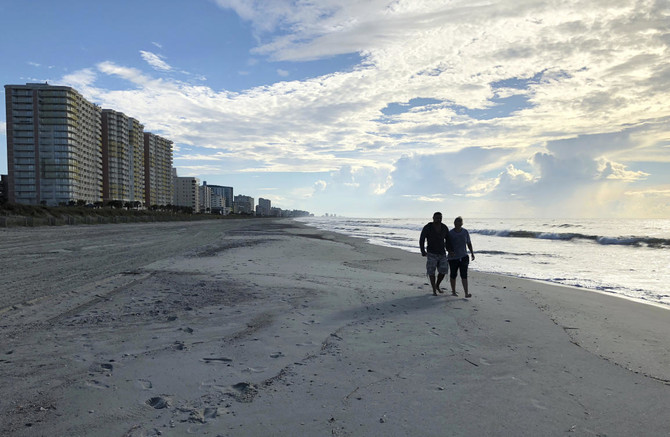
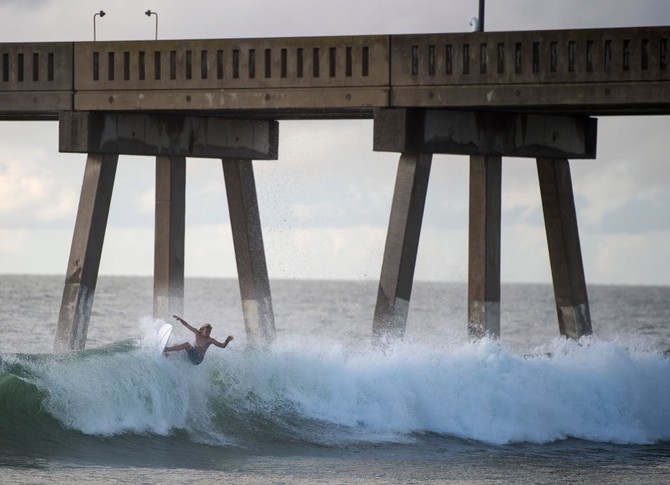
WRIGHTSVILLE BEACH, USA: People fleeing North and South Carolina clogged coastal highways early Wednesday as Hurricane Florence, a monster Category 4 storm, bore down on the US east coast for a direct hit in a low-lying region dense with beachfront vacation homes.
President Donald Trump, warning residents to get out of the way, said the federal government was “ready for the big one that is coming.”
While coastal residents frantically boarded up homes and businesses and hit the road, others chose to ride out a storm that is forecast to dump up to three feet (almost a meter) of rain in some areas.
Flash floods and storm surges — in some cases up to 13 feet high — are expected to send water gushing over miles of vulnerable coastal areas and river banks further inland.
North Carolina Governor Roy Cooper warned that staying put would be a grave mistake. He urged people to leave immediately rather than face the wrath of the “once in a lifetime” storm.
Up to 1.7 million people in North Carolina, South Carolina and Virginia have been given voluntary or mandatory evacuation orders, according to emergency management officials, as the storm churned across the Atlantic Ocean toward the coast.
The eastbound lanes of several major highways have been shut down to allow traffic to flow inland, but the exodus was slow along roads jammed with outward-bound vehicles.
“We are already experiencing heavily impacted traffic on some of the evacuation routes,” said Jeff Byard, the associate administrator for response and recovery at the Federal Emergency Management Agency (FEMA).
Forecasters are predicting that Florence will make landfall in the Carolinas late Thursday or early Friday as a slightly weakened but still dangerous Category 3 hurricane.
As of 8:00 am (1200 GMT), it was packing sustained winds of 130 miles (210 kilometers) per hour, the Miami-based National Hurricane Center (NHC) said.
The eye was about 530 miles southeast of Cape Fear, North Carolina, moving west-northwest at 17 miles per hour.
“Get out of its way, don’t play games with it, it’s a big one, maybe as big as they’ve seen, and tremendous amounts of water,” Trump said in a video posted on Twitter.
“We’ll handle it. We’re ready, we’re able, we’ve got the finest people I think anywhere in the world.”
FEMA Administrator Brock Long urged people to prepare for a “very devastating storm,” with possibly weeks-long power outages.
Byard, the FEMA official, said “this storm is not going to be a glancing blow.”
“This storm is going to be a direct hit,” he added.
“Hurricane Florence is the strongest storm to target the Carolinas and this part of our country in decades.”
Predictions now have the storm stalling and making a slight southward turn after it makes landfall.
A state of emergency has been declared in Maryland, North Carolina, South Carolina, Virginia and Washington amid concern over potential torrential rain and flooding.
In Charleston, South Carolina, streets were quiet with schools and many offices and businesses closed.
Michael Kennedy, an engineer at Boeing, said he planned to leave for his parents’ home in Atlanta, Georgia.
But his partner, Emily Whisler, said she will stay at the university where she is a resident in the psychiatry program.
“They told me to bring a pillow and blanket,” Whisler said. “I’ll be living there for a few days.”
Charleston resident William Belli said he would not be among those joining the exodus.
“Been through it!” Belli said, referring to Hurricane Hugo, which caused widespread damage in South Carolina in 1989. “Not worried in the least.”
Walking his dog along empty streets, Belli said he’s well stocked with food and water.
“I will enjoy the quiet,” he said.
South Carolina Governor Henry McMaster ordered the mandatory evacuation of one million coastal residents. Schools in 26 of the state’s 46 counties were ordered closed.
Authorities in neighboring North Carolina ordered an evacuation of the Outer Banks, barrier islands that are a popular tourist destination, and parts of coastal Dare County.
In Virginia, 245,000 coastal residents were ordered to evacuate, including from the Eastern Shore, another popular beachfront destination.
In neighboring Maryland, Governor Larry Hogan said his state was readying for potentially “historic and catastrophic rainfall, life-threatening flooding, and high winds.”
By Saturday, total rainfall could accumulate to 30 inches (76 centimeters) — or even 40 inches in places — in parts of the Carolinas and Virginia, the NHC said.
The Virginia National Guard is planning to initially bring up to 1,500 soldiers and airmen to offer help in the state’s response operations.
Some 7,000 guard members are ready to mobilize in North Carolina, while 1,100 will be activated in South Carolina.
At this height of the Atlantic hurricane season, Florence was being trailed on east-to-west paths by two other storms, Hurricane Helene and Tropical Storm Isaac, but neither packs the deadly punch of Florence.


