


ISLAMABAD: Assuming office as Pakistan’s 13th head of state on Sunday, Dr. Arif Alvi said that he would fulfill all responsibilities toward the development of the country and not be a “silent president.”
“I will play my role to improve education and health sectors of the country, (and ensure the) provision of basic facilities to the common man while remaining within the constitution’s ambit,” he said after being sworn in on Sunday.
Outgoing President Mamnoon Hussain’s five-year term ended on Saturday.
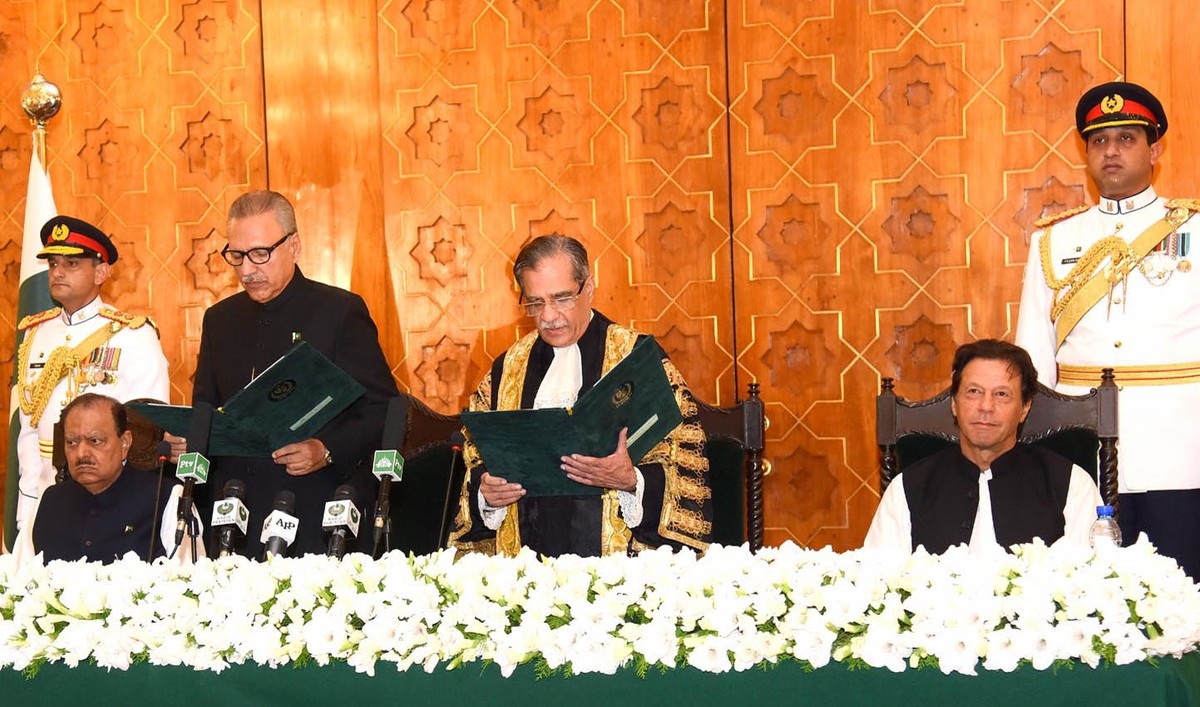
Dr. Arif Alvi being administered the oath as President of Pakistan by Chief Justice Mian Saqib Nisar at the Aiwan-e-Sadr, Islamabad on Sept. 9, 2018.
Alvi, a founding member of the ruling Pakistan Tehreek-e-Insaf party, was administered the oath of office by Chief Justice Mian Saqib Nisar, in a simple ceremony at the President House, in Islamabad.
Prime Minister Imran Khan attended the ceremony along with Army Chief Gen Qamar Bajwa, Saudi and Chinese diplomats — including Saudi Arabia’s Minister of Media Dr. Awwad Al-Awwad.
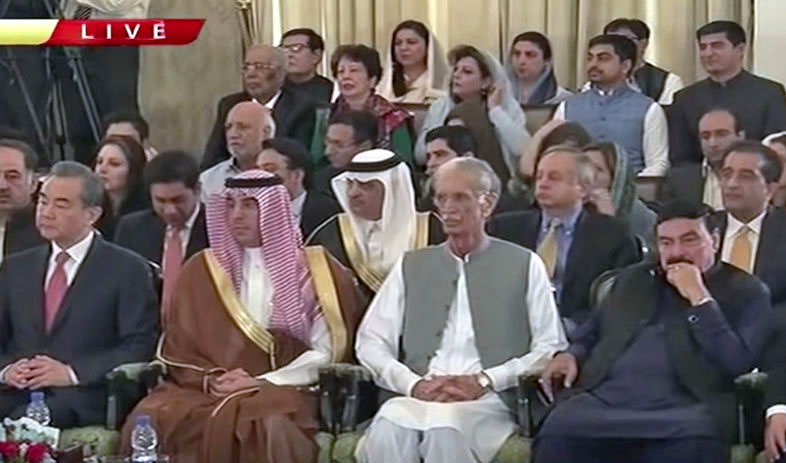
Front row from left; Chinese foreign minister Wang Yi, Saudi Arabia’s Minister of Media Dr. Awwad Al-Awwad, Pakistan’s Minister of Defence Pervez Khattak, and Federal Minister for Railways Sheikh Rashid Ahmad. (Photo courtesy: Screen grab/24 News)
Pitched against two challengers from the opposition parties, Alvi won the presidential election on Sept. 4 by securing 352 votes.
Political analysts said that while the role of the president is limited, Alvi can make his presence felt in the democratic setup.
“Pakistan is a vibrant democracy and in the parliamentary form of government, the president of the country has a limited constitutional role to play,” Professor Tahir Malik, an academic and a political analyst, told Arab News.
Malik said that as the founding member of the ruling party and a strong ally of Prime Minister Imran Khan, Alvi could “try to play a role for the unity of the nation on important issues like terrorism, sectarianism and water scarcity.”
Zaigham Khan, another political analyst, said that while he agrees with Malik, Alvi can still play a critical role by projecting a positive image of the country on the international stage.
“He is a vibrant and dynamic personality, and we hope he will utilize the public resources for the betterment of the people and this country,” Khan told Arab News.
In Pakistan, the president holds a symbolic place — the entire administrative authority lies with the prime minister and the president exercises his powers upon recommendations of the prime minister.
The president has, however, constitutional powers to grant pardon, reprieve and respite, and to remit, suspend or commute any sentence passed by any court, tribunal or other authority.
The prime minister is also bound under the constitution to keep the president informed on all matters of internal and foreign policy and on all legislative proposals that the federal government intends to bring before the Parliament.
Being head of the state, the president cannot interfere in administrative matters of the government but can advise the Cabinet on matters of policy.


