

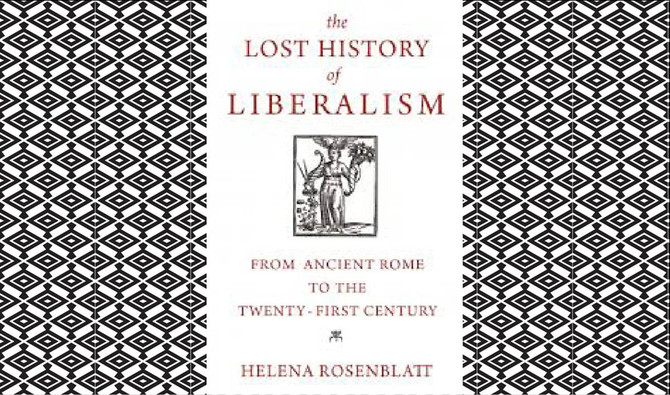
What We Are Reading Today: The Lost History of Liberalism

Updated 09 September 2018
Follow

What We Are Reading Today: The Lost History of Liberalism

AUTHOR: Helena Rosenblatt


The Lost History of Liberalism challenges our most basic assumptions about a political creed that has become a rallying cry — and a term of derision — in today’s increasingly divided public square.

Taking readers from ancient Rome to today, Helena Rosenblatt traces the evolution of the words “liberal” and “liberalism,” revealing the heated debates that have taken place over their meaning.

Rosenblatt debunks the popular myth of liberalism as a uniquely Anglo-American tradition centered on individual rights, says a review on the Princeton University Press website.

She shows that it was the French Revolution that gave birth to liberalism and Germans who transformed it. Only in the mid-20th century did the concept become widely known in the US—and then, as now, its meaning was hotly debated. 

Liberals were originally moralists at heart. They believed in the power of religion to reform society, emphasized the sanctity of the family, and never spoke of rights without speaking of duties. 


Saja Kilani shines at BAFTAs 2026

Updated 23 February 2026
Follow

Saja Kilani shines at BAFTAs 2026

DUBAI: Palestinian-Jordanian-Canadian actress Saja Kilani, one of the stars of “The Voice of Hind Rajab,” stepped onto the BAFTA Film Awards 2026 red carpet in a sculptural look from Bottega Veneta’s Spring 2026 collection.

Nominated for Best Film Not in the English Language, Kaouther Ben Hania’s “Voice of Hind Rajab” tells the story of Hind Rajab Hamada, who was fleeing the Israeli military in Gaza City with six relatives last year when their car came under fire.

The sole survivor of the Israeli attack, who was then shot and killed, her desperate calls recorded with the Red Crescent rescue service caused international outrage.

Kilani plays Rana Faqih, the real-life Palestine Red Crescent Society volunteer who spoke to Hamada in the final hours of her life as she waited, surrounded by the bodies of her family, for help to come. 

Meanwhile, politically charged thriller “One Battle After Another” won six prizes, including Best Picture, at the British Academy Film Awards on Sunday, building momentum ahead of Hollywood’s Academy Awards next month.

Blues-steeped vampire epic “Sinners” and gothic horror story “Frankenstein” won three awards each, while Shakespearean family tragedy “Hamnet” won two, including Best British Film.

“One Battle After Another,” Paul Thomas Anderson’s explosive film about a group of revolutionaries in chaotic conflict with the state, won awards for directing, adapted screenplay, cinematography and editing, as well as for Sean Penn’s supporting performance as an obsessed military officer.

“This is very overwhelming and wonderful,” Anderson said as he accepted the directing prize. He paid tribute to his longstanding assistant director, Adam Somner, who died of cancer in November 2024, a few weeks into production.

“We have a line from Nina Simone that we used in our film, ‘I know what freedom is: It’s no fear,’” the director said. “Let’s keep making things without fear. It’s a good idea.”

Bookies’ favorite Jessie Buckley won the Best Actress prize for her portrayal of grieving mother Agnes Hathaway, wife of William Shakespeare, in “Hamnet.” Buckley, 36, is the first Irish performer to win the Best Actress prize at the awards.

She dedicated her award “to the women past, present and future who taught me and continue to teach me how to do it differently.”

Horror film “Sinners” took home trophies for director Ryan Coogler’s original screenplay, the film’s musical score and for Wunmi Mosaku’s supporting actress performance as herbalist and healer Annie.

The British-Nigerian actor said that in the role she found “a part of my hopes, my ancestral power and my connection, parts I thought I had lost or tried to dim as an immigrant trying to fit in.”