US, India in ‘very detailed’ talks about halting Iran oil imports

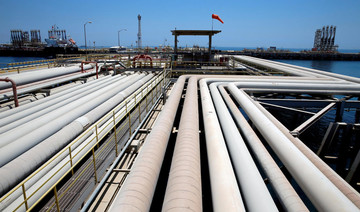
India is a big buyer of oil from Iran, a target of US sanctions. (AFP)
Updated 06 September 2018
Follow

US, India in ‘very detailed’ talks about halting Iran oil imports

NEW DELHI: The US and India are engaged in “very detailed conversations” over Washington’s request to completely stop India’s oil imports from Iran, a senior US State Department official said on Thursday.
US President Donald Trump this year ordered the reimposition of economic curbs on Iran after withdrawing his country from a 2015 nuclear deal between Tehran and six world powers. The US has since been trying to persuade countries to economically isolate Iran.
“We’re asking all of our partners, not just India, to reduce to zero oil imports from Iran and so I’m confident that will be part of our conversation with India,” the official told reporters, as the foreign and defense heads of the two countries met in the Indian capital.
“There are very detailed conversations taking place between the US and India on just the technical issues related to going to zero and those conversations will continue.”
Despite Trump’s efforts, government officials in India, the world’s third biggest oil importer and Iran’s top oil client after China, have been talking about wanting to continue trade ties, especially for oil, with Iran.
To lure Indian buyers, the Islamic nation has been offering extended credit terms and almost free shipping.
India would not stop Iranian imports but would finalize its strategy on crude buys after this week’s high-level meeting of US state and defense secretaries, Mike Pompeo and Jim Mattis, and India’s foreign and defense ministers, Sushma Swaraj and Nirmala Sitharaman, an Indian official told Reuters last month.
In another sign of New Delhi’s desire to keep buying Iranian oil, Reuters reported this week that India had allowed its state refiners to use Tehran’s tanker and insurance cover after western and Indian shippers started winding down their Iran operations ahead of a Nov. 4 deadline.
Nevertheless, India’s August oil imports from Iran plunged by a third as the state refiners waited for government permission to buy oil using Iranian tankers and cover.


Saudi Aramco achieves significant progress in its gas production plan

Updated 26 February 2026
Follow

Saudi Aramco achieves significant progress in its gas production plan

RIYADH: Saudi Aramco has announced the achievement of significant progress in its plan to expand gas production, with the start of production at the Jafurah field, the largest unconventional gas field in the Middle East, and the commencement of operational activities at the Tanajib Gas Plant, one of the largest gas plants in the world.

The oil giant aims to increase its sales gas production capacity by approximately 80 percent by 2030 compared to 2021 production levels, reaching nearly 6 million barrels of oil equivalent per day from total gas and associated liquids production, according to the Saudi Press Agency.

This is expected to generate additional operating cash flows ranging between $12 billion and $15 billion in 2030, subject to future demand for sales gas and liquids prices.

President and CEO of Saudi Aramco, Amin Al-Nasser, said: “We are proud to commence production at the Jafurah field and begin operations at the Tanajib Gas Plant. These are major achievements for Saudi Aramco and the future of energy in the Kingdom. Our ambitious gas program is expected to become a key source of profitability.”

He affirmed that these mega-projects contribute to meeting the growing domestic demand for gas, supporting industrialization and development in several key sectors, in addition to producing significant quantities of high-value liquids.

Al-Nasser expressed his gratitude for the support, trust, and attention that Saudi Aramco receives from the Custodian of the Two Holy Mosques, King Salman bin Abdulaziz Al Saud, and His Royal Highness Prince Mohammed bin Salman bin Abdulaziz Al Saud, crown prince and prime minister, noting that this has had the most profound impact on the company’s achievements and distinguished projects that serve the Kingdom’s Vision 2030.

The gas extracted from the Jafurah field is expected to support the Kingdom’s growth targets in key sectors such as energy, artificial intelligence, major industries, and petrochemicals, potentially providing a major boost to the Kingdom’s economy and strengthening its position among the world’s top ten gas producers.

Saudi Aramco began first producing unconventional shale gas from the Jafurah field in December 2025, with technology playing a pivotal role in unlocking the potential of the Jafurah field and establishing it as a global benchmark for unconventional gas development. 

Since its inception, the project has leveraged technology to help reduce drilling and stimulation costs and enhance well productivity, contributing to its strong economic prospects.

The Jafurah area covers 17,000 sq. km and is estimated to contain 229 trillion standard cubic feet of raw gas and 75 billion barrels of condensates. The Jafurah field project aims to produce 2 billion standard cubic feet per day of sales gas, 420 million standard cubic feet per day of ethane, and approximately 630,00 barrels per day of gas liquids and condensates by 2030.

The Tanajib Gas Plant is a key pillar in Aramco’s strategy to increase gas processing capacities and diversify its energy product portfolio, helping to foster long-term economic growth. 

Operations began in December 2025, and its raw gas processing capacity is expected to reach 2.6 billion standard cubic feet per day in 2026. The start of operations at the Tanajib Plant coincided with the commencement of production from the Marjan field expansion and development program. 

The plant is distinguished by its digital integration, enhanced operational efficiency, capability to execute complex projects, and optimal use of resources. It processes raw gas associated with crude oil production from the offshore Marjan and Zuluf fields.

Aramco’s gas expansion is expected to create thousands of direct and indirect job opportunities, generating significant added value and strengthening its position as a reliable energy provider. 

It also helps meet the growing demand for natural gas and enhances its supply to national industries. 

The expansion strategy supports efforts aimed at achieving the optimal energy mix for local electricity generation, advancing the Kingdom’s liquid fuel displacement program, which will have a positive environmental impact, supporting the Kingdom’s ambition to achieve net-zero emissions by 2060, enhancing energy security, and contributing to building a more diversified national economy.