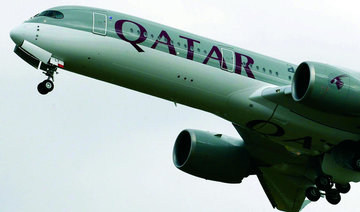
Qatar Airways rethinks Indian plans due to foreign ownership rules

Enquiries to start the application process in India were rejected over QIA’s ownership of Qatar Airways, Qatar Airways CEO Akbar Al-Baker said. (Reuters)
Updated 05 September 2018
Follow

Qatar Airways rethinks Indian plans due to foreign ownership rules

  • India now allows 100 percent ownership of India-based airlines, up from 49 percent, but only with government approval
  • Qatar Airways has been interested in investing in IndiGo for several years, though never bought into the airline

NEW DELHI: Qatar Airways is reviewing plans for its own domestic Indian airline due to “confusing” foreign ownership rules and could work with a partner in India or take a stake in IndiGo instead, its chief executive said on Tuesday.
The state-owned Gulf carrier has long coveted the Indian aviation market, which is the fastest growing in the world, and in 2017 said it would set up a domestic airline, a year after India eased foreign investment rules for the sector.
“We are really very interested to launch an airline in India, but the regulation is a little bit confusing to us,” Qatar Airways CEO Akbar Al-Baker told reporters in New Delhi.
India now allows 100 percent ownership of India-based airlines, up from 49 percent, but only with government approval. Meanwhile, foreign airlines continue to be limited to 49 percent ownership.
Qatar Airways planned to own a minority stake of the domestic airline with sovereign wealth fund Qatar Investment Authority (QIA) being the majority owner.
However, enquiries to start the application process in India were rejected over QIA’s ownership of Qatar Airways, Baker said.
“We really don’t know what is allowed,” he said.
Qatar Airways could now work with an Indian partner for the domestic airline or alternatively seek a 15 to 25 percent stake in low cost airline IndiGo. If both of those failed then the airline would have to forget about the domestic market, Baker said.
Qatar Airways has been interested in investing in IndiGo for several years, though never bought into the airline.
Qatar Airways would be interested in buying Air India which the government wants to sell a 76 percent stake in, Baker said, adding it would only want the core airline assets and not other parts of the business such as ground handling services.
Any bid for Air India would be dependent on working with a strong Indian partner, Baker said, adding that the airline’s debt was not an issue. India wants to offload about $5.1 billion of Air India’s debt.
“The (Air India) debt can be taken and restructured. The issue is with whom we will partner.”
Qatar Airways expects to release its annual results in two weeks’ time, Baker said. He has previously said the airline made a “substantial” loss, which it blamed on a regional dispute that has banned the airline from four Arab countries.


Up to $600m in additional tariffs on Saudi exports to the US

Updated 23 February 2026
Follow

Up to $600m in additional tariffs on Saudi exports to the US

RIYADH: Gulf exports have become targets of US President Donald Trump’s tariffs, which he raised from 10 percent to 15 percent on all countries.

The increase comes after the US Supreme Court ruled that the legal basis Trump had used to impose earlier tariffs was unlawful.

Previously, Gulf countries were among the few that had not raised their tariffs above 10 percent, while many other countries, most notably China, had already been subject to higher tariffs. However, with this latest increase, the Gulf states will be among those affected.

According to the financial analysis unit of Al-Eqtisadiah newspaper, Gulf exports to the US in 2024 amounted to about $26.2 billion, with Saudi Arabia accounting for roughly half of that, at $12.7 billion. These exports are subject to potential additional tariffs of SR637 million ($169 million).

It is likely that tariffs on Saudi exports will grow from $1.3 billion annually to $1.9 billion, a rise of 50 percent, following Trump’s recent increase.

Customs duties on Gulf exports will also increase, from $2.6 billion annually to $3.9 billion.

In 2024, Gulf exports are distributed as follows: $7.5 billion from the UAE, $1.8 billion from Qatar, and $1.6 billion from Kuwait, as well as $1.3 billion from Oman, and finally, $1.2 billion from Bahrain.

Gulf trade with the US in 2024 reached approximately $86 billion, comprised of $26.2 billion in exports and approximately $60 billion in imports, resulting in a Gulf trade deficit of $33.5 billion.

Trump responds to Supreme Court ruling

US President Donald Trump raised the global tariffs from 10 percent to 15 percent in response to the US Supreme Court ruling that his previous tariff implementation mechanism was unlawful.

Trump said in a post on his Truth Social account today: “As President of the US, I will, effective immediately, raise the global tariffs imposed on countries that have been taking advantage of the US for decades with impunity (until I took over!) to the legally permitted and tested level of 15 percent.”

Hours after the Supreme Court ruling on Feb. 20, Trump imposed a 10 percent global tariff on foreign goods, a move aimed at maintaining his trade agenda.

Trump had expressed his displeasure with the Supreme Court’s decision to overturn the tariffs imposed by his administration, asserting that the ruling would not restrict him. He vowed to impose tariffs far exceeding those struck down by the court, indicating that he had stronger alternatives to tariffs, raising questions about his future trade strategy.

The US Supreme Court struck down Trump’s sweeping global tariffs, undermining his signature economic policy and inflicting his biggest legal defeat since returning to the White House.

By a six-three vote, the court ruled that Trump exceeded his authority by invoking the federal emergency powers law to impose his reciprocal tariffs worldwide, in addition to targeted import duties that the administration claims are intended to combat fentanyl smuggling.