

Strongest typhoon in quarter century hits Japan

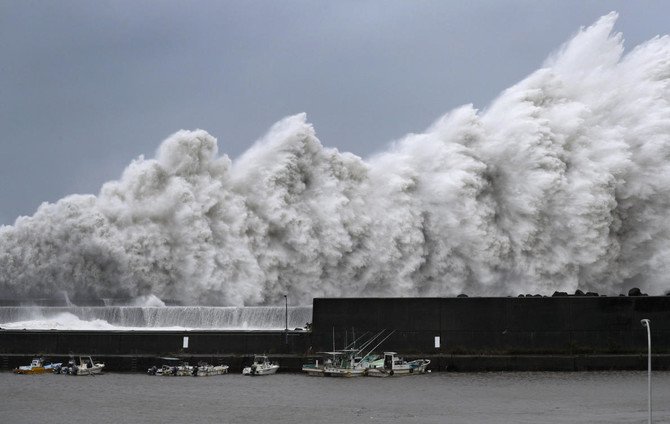
Japan’s weather agency has issued warnings about possible landslides, flooding and violent winds, as well as high tides, lightning and tornadoes in a swath of western Japan including the major cities of Osaka and Kyoto. (Kyodo News via AP)
Updated 04 September 2018
Follow

Strongest typhoon in quarter century hits Japan

  • Prime Minister Shinzo Abe urged people to ‘evacuate early’ and ordered his government to take all necessary measures to protect residents.
  • Abe instructed his cabinet to ‘take all measures possible’

TOKYO: The strongest typhoon to hit Japan in 25 years made landfall Tuesday, the country’s weather agency said, bringing violent winds and heavy rainfall that prompted evacuation warnings.
Typhoon Jebi, packing winds of up to 216 kilometers (135 miles) per hour, made landfall around midday in western Japan near areas still recovering from deadly record rains earlier this summer.
Prime Minister Shinzo Abe urged people to “evacuate early” and ordered his government to take all necessary measures to protect residents.
Japan’s weather agency has issued warnings about possible landslides, flooding and violent winds, as well as high tides, lightning and tornadoes in a swath of western Japan including the major cities of Osaka and Kyoto.
With winds of up to 162 kilometers (100 miles) per hour at its center, Jebi is classed as a “very strong” typhoon, the weather agency’s chief forecaster Ryuta Kurora said.
“This is (the strongest) since 1993.”
In the hours before the storm made landfall, Shikoku, one of four Japanese main islands, was already experiencing “violent storms and the storms will get stronger and stronger,” he added.
As the storm approached, Abe called a disaster response meeting and canceled a trip to western Japan.

“I urge the Japanese people to take action to protect your lives, including preparing and evacuating early,” he said.
He instructed his cabinet to “take all measures possible.”
Local media warned that the wind speeds Jebi is packing are strong enough to bring down traditional-style wooden houses and power poles, and urged people in affected areas to avoid non-essential travel.
Evacuation advisories have been issued for more than 300,000 people in western Japan — including 280,000 in the port city of Kobe — with local officials setting up some 1,500 shelters, the central and local governments said in statements.
Primary and middle schools in affected areas are closed for safety reasons, while regional businesses also reacted quickly, with a major railway firm and Universal Studios Japan in Osaka shutting down for Tuesday.
Nearly 600 flights were canceled, including several international flights departing and arriving at Nagoya and Osaka, along with ferries connecting ports in western Japan.
Jebi has a similar trajectory to Typhoon Cimaron, which made landfall on August 23, disrupting transport links but causing limited damage and few injuries.
Japan is currently in its annual typhoon season, and is regularly struck by major storm systems during the summer and autumn.
The country has been sweating through a record, deadly heatwave that was preceded by record rainfall in parts of western and central Japan that killed over 200 people.

Afghanistan says it thwarted Pakistani airstrike on Bagram Air Base as fighting enters fourth day

Updated 01 March 2026
Follow

Afghanistan says it thwarted Pakistani airstrike on Bagram Air Base as fighting enters fourth day

  • The fighting has been the most severe between the neighbors for years
  • Pakistan accuses Taliban government of harboring militant groups that stage attacks against it

KABUL: Afghanistan thwarted attempted airstrikes on Bagram Air Base, the former US military base north of Kabul, authorities said Sunday, while cross-border fighting between Pakistan and Afghanistan stretched into a fourth day.
The fighting has been the most severe between the neighbors for years, with Pakistan declaring that it’s in “open war” with Afghanistan.
The conflict has alarmed the international community, particularly as the area is one where other militant organizations, including Al-Qaeda and the Daesh group, still have a presence and have been trying to resurface.
Pakistan accuses Afghanistan’s Taliban government of harboring militant groups that stage attacks against it and also of allying with its archrival India.
Border clashes in October killed dozens of soldiers, civilians and suspected militants until a Qatari-mediated ceasefire ended the intense fighting. But several rounds of peace talks in Turkiye in November failed to produce a lasting agreement, and the two sides have occasionally traded fire since then.
On Sunday, the police headquarters of Parwan province, where Bagram is located, said in a statement that several Pakistani military jets had entered Afghan airspace “and attempted to bomb Bagram Air Base” at around 5 a.m.
The statement said Afghan forces responded with “anti-aircraft and missile defense systems” and had managed to thwart the attack.
There was no immediate response from Pakistan’s military or government regarding Kabul’s claim of attempted airstrikes on Bagram or the ongoing fighting.
Bagram was the United States’ largest military base in Afghanistan. It was taken over by the Taliban as they swept across the country and took control in the wake of the chaotic US withdrawal from the country in 2021. Last year, US President Donald Trump suggested he wanted to reestablish a US presence at the base.
The current fighting began when Afghanistan launched a broad cross-border attack on Thursday night, saying it was in retaliation for Pakistani airstrikes the previous Sunday.
Pakistan had said its airstrike had targeted the outlawed Pakistani Taliban, also known as Tehreek-e-Taliban Pakistan, or TTP. Afghanistan had said only civilians were killed.
The TTP militant group, which is separate but closely allied with Afghanistan’s ruling Taliban, operates inside Pakistan, where it has been blamed for hundreds of deaths in bombings and other attacks over the years.
Pakistan accuses Afghanistan’s Taliban government of providing a safe haven within Afghanistan for the TTP, an accusation that Afghanistan denies.
After Thursday’s Afghan attack, Pakistani Defense Minister Khawaja Mohammad Asif declared that “our patience has now run out. Now it is open war between us.”
In the ongoing fighting, each side claims to have killed hundreds of the other side’s forces — and both governments put their own casualties at drastically lower numbers.
Two Pakistani security officials said that Pakistani ground forces were still in control on Sunday of a key Afghan post and a 32-square-kilometer area in the southern Zhob sector near Kandahar province, after having seized it during fighting Friday. The captured post and surrounding area remain under Pakistani control, they added. The officials spoke on condition of anonymity, because they weren’t authorized to speak publicly.
In Kabul, the Afghan government rejected Pakistan’s claims. Deputy government spokesman Hamdullah Fitrat called the reports “baseless.”
Afghan officials said that fighting had continued overnight and into Sunday in the border areas.
The police command spokesman for Nangarhar province, Said Tayyeb Hammad, said that anti-aircraft missiles were used from the provincial capital, Jalalabad, and surrounding areas on Pakistani fighter jets flying overhead Sunday morning.
Defense Ministry spokesman Enayatulah Khowarazmi said that Afghan forces had launched counterattacks with snipers across the border from Nangarhar, Paktia, Khost and Kandahar provinces overnight. He said that two Pakistani drones had been shot down and dozens of Pakistani soldiers had been killed.
Fitrat said that Pakistani drone attacks hit civilian homes in Nangarhar province late Saturday, killing a woman and a child, while mortar fire killed another civilian when it hit a home in Paktia province.
There was no immediate response to the claims from Pakistani officials.