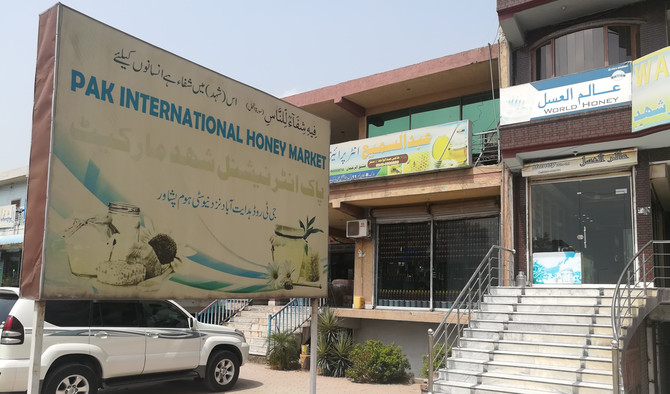
PESHAWAR: Peshawar’s Tarnab Farm is home to Pakistan’s biggest honey market, which exports about 4,000 tons of the commodity worth nearly Rs 2.8 billion ($0.023 billion) to Arab countries every year.
Senior Vice President of the All Pakistan Beekeepers Exporters and Honey Traders Association, Sheikh Gul Bacha, told Arab News on Sunday that about 200 containers, each carrying about 20 tons of honey, are exported to various Arab states, mostly to Saudi Arabia.
“We export bair (jujube) honey, which is produced in September and October, to Saudi Arabia and other Arab countries in huge quantities. Most people in that region like the product since it does not solidify. Arabs also use honey more frequently because Islamic teachings emphasize its medicinal properties,” he added.
Hajji Nauroz Khan, a honey trader, claimed that while the Arab countries also imported the commodity from other parts of the world, most of their residents preferred honey produced in Pakistan because of its superior quality and taste.
“The honey produced in this country is pure. Arabs like bair honey, and Pakistan supplies it in its purest form. Other countries produce a mix of bair and other plants,” he said.
Khan also informed that honey produced in Punjab, Azad Kashmir, Sindh and Balochistan was also brought to the Tarnab Farm market for sale.
“Although honey is also produced in other parts of the country, nearly 85 percent of the people associated with this business are Pashtuns.”
He recalled how the Tarnab Farm market was initially set up with the funding of international donor organizations that were working for Afghan refugees who had migrated to Peshawar after the Soviet invasion of their country. Back then, the market could boast only of a few shops. However, the business expanded and there are hundreds of shops in this vicinity now.
Talking to Arab News, Sher Zaman, a honey exporter, said the government should also help honey traders to export their product to Central Asian markets.
“We don’t have a proper market in Central Asia,” he said. “This is despite the fact that our palusa (rosemary) honey can make a huge impact in the region. This variety of honey is usually people’s first choice in cold countries.”
Zaman said there were four main kinds of honey sold in the market: “bair honey, orange honey, palusa honey and clover honey.” The types of honey varied since honeybees gathered nectar from a variety of different plants in different parts of the country.
Assistant Director of the Trade Development Authority, Zahid Khan, told Arab News that his department periodically organizes workshops and exhibitions for the promotion of local products. “We are not responsible for regulating the honey business,” he added, “but we facilitate the traders.”
He pointed out that the honey business was owned and operated mostly by Afghans, adding: “The ongoing repatriation of Afghans to their native land has also affected this trade in Pakistan. However, local traders have now taken control of the situation and stabilized the honey business.”


![]()
![]()
![]()

Peshawar’s honey market sweetens the lives of millions in the Arab world

Peshawar’s honey market sweetens the lives of millions in the Arab world
- Every year, the market exports honey worth Rs 2.8 billion to Arab countries
- Exporters claim the honey produced in Pakistan is preferred by people in the Middle East because of its taste and quality


Latest updates



© 2026 SAUDI RESEARCH & PUBLISHING COMPANY, All Rights Reserved And subject to Terms of Use Agreement.