

Pakistan, UAE hold talks on migratory birds

In this file photo, a houbara bustard flies during a falconry competition in Hameem, 150km west of Abu Dhabi, on Dec. 9, 2014. (AFP)
Updated 01 September 2018
Follow

Pakistan, UAE hold talks on migratory birds

  • Discuss issues of Houbara Bustard hunting and impact of climate change on the environment
  • Several wildlife sanctuaries already in place in Sindh

ISLAMABAD: UAE’s deputy head of mission Abdul Aziz Al-Neiyadi on Friday said that the UAE was ready to sign an MOU with Pakistan following discussions on climate change and the hunting of the Houbara Bustard.
In the meeting with Malik Amin Aslam, Pakistan’s adviser on climate change, Al-Neiyadi stressed upon areas of “mutual cooperation between Pakistan and UAE including [the hunting of the] Houbara Bustard and the environment”, while appreciating the pro-environmental initiatives undertaken by the current government, a statement released by the ministry read.
“We are ready to sign an MOU in this regard,” he said, adding that the UAE extended its invaluable support to Pakistan to utilize the huge economic potential in the area.
Aslam, on his part, reiterated the fact that Pakistan “attaches high value to its friendly relations with the UAE and wishes to take them to new heights, especially in the area of environment”.
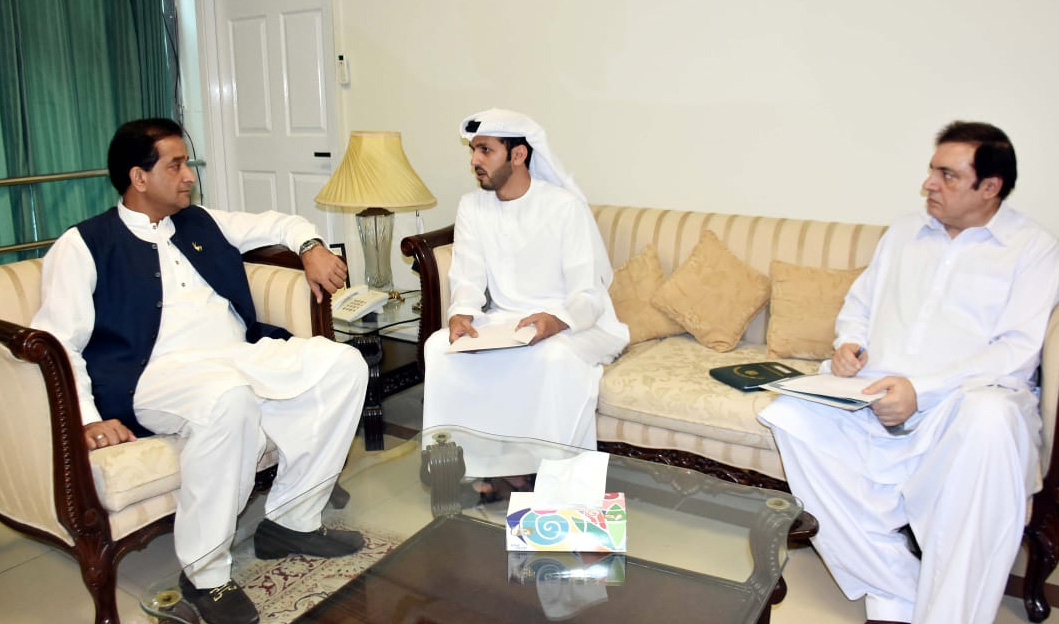


UAE Deputy head of mission Abdul Aziz Al-Neiyadi met with Prime Minister Imran Khan’s Advisor on climate change Malik Amin Aslam (Photo courtesy: Ministry of Climate Change)

There are several wildlife sanctuaries in place for the migratory birds in Pakistan’s eastern province of Sindh.
In December last year, Sindh’s provincial wildlife department registered a case against a member of the Qatari royal family for hunting without proper permission.
In 2015, environment authorities in Pakistan’s northwestern province of Khyber Pakhtunkhwa also fined a Qatari prince for hunting the rare birds without a permit.
The International Union for Conservation of Nature has classified the Houbara Bustard as a vulnerable species. “Pakistan is located along the Central Asian Flyway (CAF) connecting central Asia to the Indian Ocean. The CAF falls in the Indus Plains and is frequented by a number of birds from central Asia and the subcontinent during their migration period,” Mohammad Saleem, Deputy Director of Media and Communications at the ministry of climate change, told Arab News.
Every year, Royal Arab hunting expeditions travel to Pakistan during the winter season in pursuit of the Houbara Bustard with Pakistan’s authorities issuing special permits for the same.


Pakistan finance chief calls for change to population-based revenue-sharing formula

Updated 6 sec ago
Follow

Pakistan finance chief calls for change to population-based revenue-sharing formula

  • Muhammad Aurangzeb criticizes current NFC formula, says it is holding back development
  • Minister says Pakistan to repay $1.3 billion debt in April as economic indicators improve

ISLAMABAD: Pakistan’s Finance Minister Muhammad Aurangzeb said on Saturday the country’s revenue-sharing formula between the federal and provincial governments “has to change,” arguing that allocating the bulk of funds on the basis of population was holding back long-term development.

The revenue-sharing is done under the National Finance Commission (NFC) Award that determines how federally collected taxes are divided between the center and the provinces. Under the current formula, much of the distribution weight is based on population, with smaller weightages assigned to factors such as poverty, revenue generation and inverse population density.

“Under the NFC award, 82 percent allocation is done on the basis of population,” Aurangzeb said while addressing the Federation of Pakistan Chambers of Commerce & Industry’s regional office in Lahore. “This has to change. This is one area which is going to hold us back from realizing the full potential of this country.”

Economists and policy analysts have long suggested broadening the NFC criteria to give greater weight to tax effort, human development indicators and environmental risk, though any change would require political consensus among provinces, making reform politically sensitive.

Aurangzeb also highlighted the economic achievements of the country in recent years, saying Pakistan’s import cover had improved from roughly two weeks just a few years ago to about 2.5 months currently, adding that the government had repaid a $500 million Eurobond last year.

“The next repayment is of $1.3 billion in April,” he continued, adding that “we will pay these obligations, which are the obligations of Pakistan, as we go forward.”

The minister also noted that unlike in 2022, when devastating floods forced Pakistan to seek international pledges at a Geneva conference, the government did not issue an international appeal during more recent flooding, arguing that fiscal buffers had strengthened.

“This time, the prime minister and the cabinet decided that we do not need to go for international appeal because we have the means,” he said.

He reiterated the government was pursuing export-led growth to avoid repeating past boom-and-bust cycles driven by import-led expansion that quickly depleted foreign exchange reserves and pushed Pakistan back into International Monetary Fund programs.