

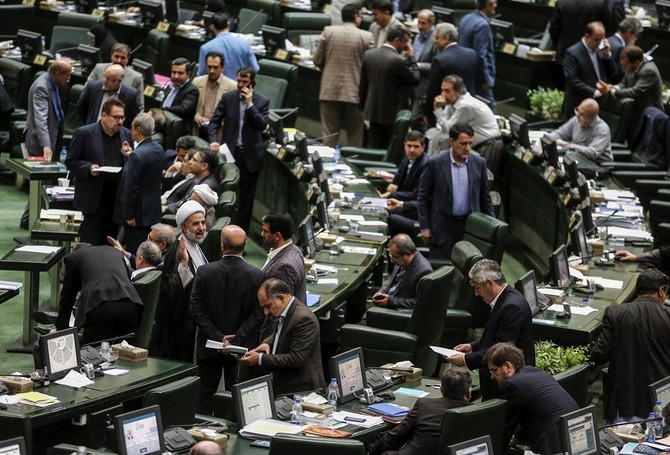
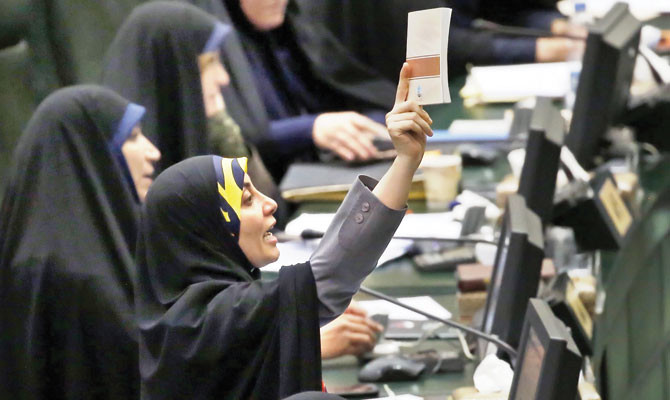

LONDON: Iran’s Parliament voted on Tuesday to reject President Hassan Rouhani’s explanations for economic hardship after a dramatic grilling on live TV, a sign his pragmatic faction is losing sway to hard-line rivals as new US sanctions begin to bite.
The vote in Parliament came two days after lawmakers sacked the minister of economy and finance and weeks after they sacked the labor minister, blaming them for the collapse of the rial currency and surging inflation.
Rouhani won two landslide elections on a platform of economic reform and opening Iran up to the outside world, and his pragmatic supporters have a majority in Parliament. But his reputation and political influence have taken a sharp hit as his promised economic gains have failed to materialize.
His highest profile achievement was to negotiate the lifting of financial sanctions on Iran in a 2015 deal with world powers over its nuclear program, but US President Donald Trump pulled out in May and Washington has re-imposed sanctions.
Rouhani spoke out in Parliament in defense of his economic record, blaming the country’s woes on the US sanctions rather than his team’s management. But a majority of lawmakers voted to reject his explanation in four out of five areas.
There were conflicting reports about what would follow from the vote: Several Iranian news agencies said Rouhani’s case would now be referred to the judiciary, although the spokesman for the parliamentary leadership, Behrouz Nemati, said lawmakers must hold further discussion before that would take place.
The action in Parliament is a further sign of how the Trump administration’s decision to re-impose sanctions could affect Iran’s leadership and its relationship with the outside world, potentially for decades to come.
Iran’s rulers have been divided between a pragmatic faction that aims for better international relations, and hard-liners who are wary of reforms. Trump’s decision to abandon the nuclear deal was opposed by US allies in Europe, who argued that he undermined Rouhani and strengthened the hands of the hard-liners.
While Rouhani and his Cabinet run Iran’s day-to-day affairs, ultimate authority lies with the Supreme Leader, 79-year-old Ayatollah Ali Khamenei, in power since 1989. Weakening the pragmatists now could affect the choice of Khamenei’s successor.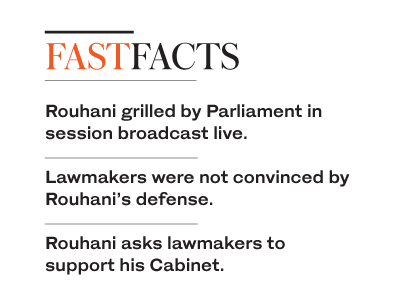
For now, Rouhani’s own position appears safe. The judiciary could determine that he broke the law and Parliament has the power to impeach him, but experts on Iranian politics say power struggles are more likely to play out indirectly.
“Parliament’s move is politically motivated and indicates that tensions would increase in the Islamic Republic in coming months,” Saeed Laylaz, an Iranian economist, told Reuters by telephone from Tehran.
“Iranian political factions have always used international issues to pursue their domestic gains,” he added.
After the sacking of the two ministers this month, Tasnim news agency reported that 70 lawmakers had signed a motion to impeach a third: The Minister of Industry, Mines and Business.
Rouhani has bowed to pressure and fired the head of the central bank. A deputy central bank governor was arrested by the judiciary on corruption charges in a crackdown that also saw foreign exchange dealers rounded up.
The lawmakers asked Rouhani on Tuesday about five subjects: Unemployment, slow economic growth, the fall of the rial, cross-border smuggling, and the lack of access by Iranian banks to global financial services. The parliament found only Rouhani’s answer about banks satisfactory.
“I want to assure the Iranian nation that we will not allow the US plot against the Islamic Republic to succeed,” Rouhani told Parliament. “We will not let this bunch of anti-Iranians in the White House be able to plot against us.”
Iran’s official unemployment rate is 12 percent, with youth unemployment as high as 25 percent in a country where 60 percent of the 80 million population is under 30. The rial has lost more than two-thirds of its value in a year.
Iran’s economy has suffered not only from sanctions but also from pervasive corruption and the concentration of its wealth and trade in the hands of big firms controlled by the hard-line Revolutionary Guards military force.
Washington imposed a new round of sanctions in August targeting Iran’s trade in gold and other precious metals, its purchases of US dollars and its car industry. Worse is yet to come, with a new round of sanctions to be imposed in November that Washington says aims to cut Iran’s oil exports to zero.
The plunge in the currency and soaring inflation have sparked sporadic demonstrations against profiteering and corruption, with many protesters chanting slogans against both the government and Supreme Leader Khamenei.
Rouhani said such anti-government protests had encouraged Trump to try to provoke more unrest by harming Iran’s economy.
“The protests tempted Trump to withdraw from the nuclear deal,” he said, asking lawmakers to support his cabinet and not add to anti-government sentiment.
Although the economic problems were critical, Rouhani said: “More important than that is that many people have lost their faith in the future of the Islamic Republic and are in doubt about its power.”


