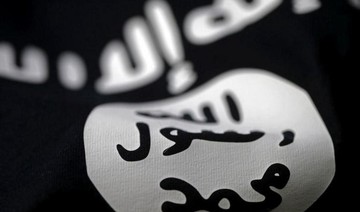
US strike kills Daesh commander in Afghanistan

A large amount of heavy and light weapons and ammunition were destroyed during raids on two Daesh hideouts. (File photo: AP)
Updated 27 August 2018
Follow

US strike kills Daesh commander in Afghanistan

  • Abu Sayeed Orakzai, a senior leader in the extremist group, was killed along with other militants
  • The group has developed a stronghold in Nangarhar and become one of the country’s most dangerous militant groups

KABUL: Afghan and US officials say a US strike in eastern Afghanistan has killed a senior Daesh commander.
Shah Hussain Martazawi, deputy spokesman for the Afghan presidency, said Sunday that the strike in the eastern Nangarhar province killed Abu Sayeed Orakzai, a senior leader in the extremist group.
Lt. Col. Martin O’Donnell, a spokesman for US forces in Afghanistan, said American forces launched a counterterrorism strike in eastern Afghanistan on Saturday that targeted a “senior leader of a designated terrorist organization.” He did not provide further details.
Government officials on Sunday said another Daesh leader was killed by airstrikes over the weekend along with 10 other people.
The intelligence agency said Saad Arhabi died in a joint operation with coalition forces late Saturday in the group's eastern stronghold in Nangarhar province near the border with Pakistan.
"The Emir of Daesh in Afghanistan along with 10 others was killed," said a statement by the National Directorate of Security, calling the group by an Arabic acronym.
Arhabi is the fourth leader of Daesh's Afghan branch to be killed since the group first emerged in the country around 2014.
The agency also said a large number of weapons, ammunition and explosives were destroyed by the air attacks.
Provincial governor's spokesman Attaullah Khogyani confirmed the leader's death, also citing a joint operation involving strikes.
US forces in Afghanistan confirmed they had conducted a strike in the location described by Afghan officials, which "targeted a senior leader of a designated terrorist organisation".
Daesh has a relatively small but potent presence in Afghanistan, mainly in Nangarhar but more recently in the northern province of Jowzjan.
Hours before the raid the group claimed a deadly suicide attack which appeared to target a sit-in protest outside an election commission office in the city of Jalalabad. Two people were killed.
The bombing followed a number of bloody attacks claimed by Daesh in recent weeks, including assaults on several government installations in Kabul and a bombing at a school that killed at least 37 people.
The group, however, has suffered repeated setbacks in the latest fighting season amid a bloody turf war with the much larger Taliban.
Estimates of their numbers in the country run as high as around 2,000.
More than Daesh 150 fighters surrendered to Afghan forces in Jowzjan on August 1, a move which troops and the Taliban hailed as the end of the group's foothold in the north of the country.

(With AFP)


Portugal heads for presidential vote, fretting over storms and far-right

Updated 4 sec ago
Follow

Portugal heads for presidential vote, fretting over storms and far-right

LISBON: Portugal ended campaigning on Friday for a presidential election this weekend amidst a battering by storms and fretting about the political whirlwind created by outspoken far-right leader Andre Ventura.
Ventura is almost certain to be beaten by Socialist candidate Antonio José Seguro in Sunday’s election but the far-right score will be watched almost as much as the latest of a series of fierce gales that have swept in off the Atlantic since the start of the year.
Voting has been delayed by a week in some municipalities because of the storms, which have killed at least five people, triggered flooding and caused widespread damage.
A new storm is forecast for Saturday.
But Ventura’s call to postpone the whole vote was rejected.
Prime Minister Luis Montenegro said the storms had caused a “devastating crisis” but that the threats to voting could be overcome. The electoral law only allows for a postponement in individual localities.
- Government attacks -

Seguro and Ventura have drastically rewritten their election scripts and appearances to focus on the towns and villages worst hit by floods, where the storm has torn down buildings and pylons.
Ventura, whose Chega (Enough) party was only created in 2019 but is now the biggest single opposition party in parliament, has attacked the response to the storm given by Montenegro’s center-right minority government.
Seguro has cast off his stance as a unifying candidate and also criticized the government.
The 63-year-old former Socialist party leader said he was “shocked” by the state’s efforts to get the country back on its feet.
Seguro has the advantage in the divisions caused by the rise of Chega in recent years.
An opinion poll published by the Publico daily on Wednesday gave Seguro 67 percent of voter support and Ventura 33 percent.
Seguro led the first round of the presidential election in January with 31 percent of votes and he is now backed by a host of political figures from the far left to the mainstream right.
Montenegro, whose government relies on the goodwill of the Socialists and Chega to survive, has not publicly backed any candidate, however.
His own party’s candidate obtained only 11 percent in the first round and dropped out.
Ventura, 43, took 23 percent of the vote in the first round.
The Portuguese establishment and analysts will be closely watching Ventura’s final score on Sunday to see whether his support is “stagnating” or whether he is “conquerering a new public,” said Joao Cancela, political science professor at Lisbon’s Nova University.
But the weather could have the final word in the debate as the storms and Seguro’s predicted win may lower voter turnout.