BEIJING/TAIPEI: China expects self-ruled Taiwan’s last diplomatic ally in Africa, the Kingdom of eSwatini, will switch to Beijing soon, a senior Chinese diplomat said on Wednesday, a day after China won over the third Taipei ally in a year.
Taiwan, which China claims as a wayward province with no right to state-to-state relations, now has formal ties with only 17 countries, many of them small, less developed nations in Central America and the Pacific, including Belize and Nauru.
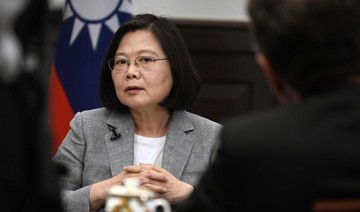
Taiwan President Tsai Ing-wen, who has vowed not to bow to Chinese pressure, came under opposition criticism on Wednesday amid calls for a more friendlier policy toward Beijing.
Taiwan vowed on Tuesday to fight China’s “increasingly out of control” behavior after Taipei lost another ally to Beijing when El Salvador became the third country to switch allegiances to China this year.
Ahead of next month’s summit between China and African leaders in Beijing, China has been upping the pressure on Taiwan’s last remaining ally on the continent, eSwatini, formerly known as Swaziland, to come over to China’s side, diplomatic sources say.
Speaking to reporters in Beijing about the summit, Chinese Assistant Foreign Minister Chen Xiaodong that eSwatini did not have relations with China “for reasons that everyone knows.”
“We look forward to and hope that all African nations, with none left behind, can take part in positive China-Africa cooperation, and become a member of the largest family get together,” Chen said.
“I believe that this is not just the pursuit of China, it is also a widespread shared expectation of African nations. I believe that this target can in the not too distant future be realized,” he added, without elaborating.
Taiwan President Tsai Ing-wen has vowed not to bow to Chinese pressure, Taipei has accused Beijing of offering generous aid and loan packages to lure its allies across, charges China denies.
The island’s biggest opposition group, the China-friendly Kuomintang (KMT), urged for a “better alternative” following what it described as “enormous mistakes” in Tsai’s cross-strait policy.
“The ruling party has the responsibility to think of a better cross-strait policy ...The relations with China have turned stagnant and were frozen,” KMT’s spokesman Mong-kai Hung said.
Yu-fang Lin, a KMT lawmaker who leads the diplomacy and defense committee in the Taiwan parliament, urged Tsai to recognize the “one China” principle, an agreement reached between Beijing and then-ruling KMT in 1992, under which both agreed there is only one China, with each having their own interpretation of what that means.
“She should bravely tell her supporters they need a friendlier policy to China, this way there would be more support for her,” Lin said.
China’s hostility to Taiwan has grown since Tsai’s election as Beijing fears she wishes to push for the island’s formal independence, a red line for China. She says she wants to maintain the status quo but will defend Taiwan’s democracy.
State-run Chinese newspaper the Global Times said in a Wednesday editorial that China did not have to “pay a fortune to steal Taiwan’s ‘allies’.”
“Many of the island’s ‘allies’ have a larger trade volume with China than with Taiwan. Their establishment of diplomatic ties with the Chinese mainland is an irresistible trend. It is only a matter of time before Taiwan has zero ‘allies.’”

China expects Taiwan’s last Africa ally will switch to Beijing soon
- Taiwan, which China claims as a wayward province with no right to state-to-state relations, now has formal ties with only 17 countries
- China’s hostility to Taiwan has grown since President Tsai Ing-wen’s election
China is the real threat, Taiwan says in rebuff to Munich speech
- China views democratically governed Taiwan as its own territory, a view the government in Taipei rejects
TAIPEI: China is the real threat to security and is hypocritically claiming to uphold UN principles of peace, Taiwan Foreign Minister Lin Chia-lung said on Sunday in a rebuff to comments by China’s top diplomat at the Munich Security Conference.
China views democratically governed Taiwan as its own territory, a view the government in Taipei rejects, saying only Taiwan’s people can decide their future.
Chinese Foreign Minister Wang Yi, addressing the annual security conference on Saturday, warned that some countries were “trying to split Taiwan from China,” blamed Japan for tensions over the island and underscored the importance of upholding the United Nations Charter.
Taiwan’s Lin said in a statement that whether viewed from historical facts, objective reality or under international law, Taiwan’s sovereignty has never belonged to the People’s Republic of China.
Lin said that Wang had “boasted” of upholding the purposes of the UN Charter and had blamed other countries for regional tensions.
“In fact, China has recently engaged in military provocations in surrounding areas and has repeatedly and openly violated UN Charter principles on refraining from the use of force or the threat of force,” Lin said. This “once again exposes a hegemonic mindset that does not match its words with its actions.”
China’s military, which operates daily around Taiwan, staged its latest round of mass war games near Taiwan in December.
Senior Taiwanese officials like Lin are not invited to attend the Munich conference.
China says Taiwan was “returned” to Chinese rule by Japan at the end of World War Two in 1945 and that to challenge that is to challenge the postwar international order and Chinese sovereignty.
The government in Taipei says the island was handed over to the Republic of China, not the People’s Republic, which did not yet exist, and hence Beijing has no right to claim sovereignty.
The republican government fled to Taiwan in 1949 after losing a civil war with Mao Zedong’s communists, and the Republic of China remains the island’s formal name.
China views democratically governed Taiwan as its own territory, a view the government in Taipei rejects, saying only Taiwan’s people can decide their future.
Chinese Foreign Minister Wang Yi, addressing the annual security conference on Saturday, warned that some countries were “trying to split Taiwan from China,” blamed Japan for tensions over the island and underscored the importance of upholding the United Nations Charter.
Taiwan’s Lin said in a statement that whether viewed from historical facts, objective reality or under international law, Taiwan’s sovereignty has never belonged to the People’s Republic of China.
Lin said that Wang had “boasted” of upholding the purposes of the UN Charter and had blamed other countries for regional tensions.
“In fact, China has recently engaged in military provocations in surrounding areas and has repeatedly and openly violated UN Charter principles on refraining from the use of force or the threat of force,” Lin said. This “once again exposes a hegemonic mindset that does not match its words with its actions.”
China’s military, which operates daily around Taiwan, staged its latest round of mass war games near Taiwan in December.
Senior Taiwanese officials like Lin are not invited to attend the Munich conference.
China says Taiwan was “returned” to Chinese rule by Japan at the end of World War Two in 1945 and that to challenge that is to challenge the postwar international order and Chinese sovereignty.
The government in Taipei says the island was handed over to the Republic of China, not the People’s Republic, which did not yet exist, and hence Beijing has no right to claim sovereignty.
The republican government fled to Taiwan in 1949 after losing a civil war with Mao Zedong’s communists, and the Republic of China remains the island’s formal name.
© 2026 SAUDI RESEARCH & PUBLISHING COMPANY, All Rights Reserved And subject to Terms of Use Agreement.


