

‘Blast fishing’ thrives in Libya’s chaos

1 / 4
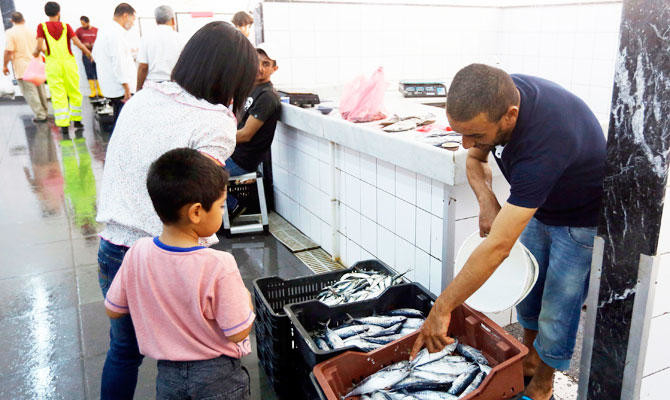
A Libyan fishmonger speaks with a customer at the Fish market in Tripoli on August 4, 2018. (AFP)
2 / 4
A Libyan fishmonger displays the catch of the day at the Fish market in Tripoli on August 4, 2018. Residents of Tripoli's seafront wake up most weekends to loud blasts: fishermen casting dynamite to maximise their catch with impunity and oblivious of the damage they are causing to marine life. / AFP / Mahmud TURKIA
3 / 4
A Libyan fisherman prepares his net before heading out to sea in the town of Qarabuli on the Mediterranean coast, 60 kilometres (35 miles) east of the capital Tripoli on August 4, 2018. (AFP)
4 / 4
A Libyan man buys fish from a fishmonger at the Fish market in Tripoli on August 4, 2018. (AFP)
Updated 20 August 2018
Follow

‘Blast fishing’ thrives in Libya’s chaos

  • There is still hope as long as some good fishermen respect the trade and go out at night with nets
  • The practice has its critics, including marine biologists, fishermen, and even religious leaders

TRIPOLI: Residents of Tripoli’s seafront wake up most weekends to loud blasts: fishermen using dynamite to maximize their catch, regardless of the damage they are causing to marine life.
Dynamite fishing, or “blast fishing,” has flourished — with impunity — since Libya’s 2011 uprising that left the country awash with weapons and explosives.
The Mediterranean country has since descended into chaos and violence, with two rival administrations struggling to impose the law and a myriad of militias vying for control of its oil wealth.
As a result, protecting fish stock and the environment are not a priority for the authorities, experts and officials say.
Haytham Ali, a newly-married teacher, lives less than 50 meters (yards) from the beach in the capital’s residential suburb of Hay Al-Andalous.
“My wife and I enjoy the peace and quiet of Friday mornings in our garden by the sea, but the explosions... as early as 7 am remind us of all that is wrong in this country,” he said.
Mariam, a 64-year-old widow, said the blasts frighten her grandchildren when they come to visit her home near the water.
“My whole house and my old windows shake with every blast... and I have to reassure my grandchildren that it’s only people fishing, not NATO bombs all over again,” she said, referring to the uprising that was backed by the Western alliance.
Dynamite fishing and the use of explosives without a permit are both officially against the law, but dynamite fishermen appear to be immune.
They even post anonymous videos online of sea water being propelled high into the sky and dozens of dazed or dead fish left behind on the surface.
“We hear (the blasts) but no one can do anything about it,” said Bannour Abu Kahal, head of the fisheries department in Garaboulli, east of Tripoli.

Some marine biologists, fishermen and fishmongers, and even religious leaders have tried to speak out against blast fishing but to no avail.
Using dynamite to catch fish “depletes the fish stock in the sea,” said Mokhtar, a fishmonger in central Tripoli, who declined to give his surname.
“This practice is not correct or healthy for the consumer” because it stuns the fish and shreds its skin, he said.
The explosives, known as “gelatine” in Libya, “kills the fish, the fish roe, larvae and sea plants,” said Fathi Al-Zaytuni, a fishmonger who uses nets for his catch.
The explosive devices used in Libya are mostly home-made and have caused dozens of deaths and injuries, according to media reports.
Lana news agency reported in March that three men from the same family died in a blast in the eastern city of Sirte as they were preparing bombs for blast fishing.

Sheikh Sadek Al-Ghariani, the country’s disputed top religious figure, has also waded into the controversy.
“If this type of fishing is banned by laws that regulate fishing, or if it is prejudicial to man and the environment, then it should not be practiced,” he said in a fatwa, religious edict, issued in 2013.
Abu Kahal, the fishing director in Garaboulli, urged “concerned authorities, especially the coast guard, to do their job and put an end to this kind of fishing.”
On a warm and humid August evening, retired fisherman Abdelrazag Al-Bahri, 72, sat at Tripoli port counting the few fishing boats heading out to sea to catch sardines.
“There is still hope as long as some good fishermen respect the trade” and go out at night to haul a catch the traditional way with nets, he said.
He said traditional fishing in Libya had mostly been the work of Egyptians and Tunisians but they had fled the country, with few Libyans now willing to replace them.


Arts festival’s decision to exclude Palestinian author spurs boycott

Randa Abdel Fattah. (Photo/Wikipedia)
Updated 12 January 2026
Follow

Arts festival’s decision to exclude Palestinian author spurs boycott

  • A Macquarie University academic who researches Islamophobia and Palestine, Abdel-Fattah responded saying it was “a blatant and shameless act of anti-Palestinian racism and censorship,” with her lawyers issuing a letter to the festival

SYDENY: A top Australian arts festival has seen ​the withdrawal of dozens of writers in a backlash against its decision to bar an Australian Palestinian author after the Bondi Beach mass shooting, as moves to curb antisemitism spur free speech concerns.
The shooting which killed 15 people at a Jewish Hanukkah celebration at Sydney’s Bondi Beach on Dec. 14 sparked nationwide calls to tackle antisemitism. Police say the alleged gunmen were inspired by Daesh.
The Adelaide Festival board said last Thursday it would disinvite Randa ‌Abdel-Fattah from February’s ‌Writers Week in the state of South Australia because “it ‌would not ​be ‌culturally sensitive to continue to program her at this unprecedented time so soon after Bondi.”

FASTFACTS

• Abdel-Fattah responded, saying it was ‘a blatant and shameless act of anti-Palestinian racism and censorship.’

• Around 50 authors have since withdrawn from the festival in protest, leaving it in doubt, local media reported.

A Macquarie University academic who researches Islamophobia and Palestine, Abdel-Fattah responded saying it was “a blatant and shameless act of anti-Palestinian racism and censorship,” with her lawyers issuing a letter to the festival.
Around 50 authors have since withdrawn from the festival in protest, leaving it in doubt, local media reported.
Among the boycotting authors, Kathy Lette wrote on social media the decision to bar Abdel-Fattah “sends a divisive and plainly discriminatory message that platforming Australian Palestinians is ‘culturally insensitive.'”
The Adelaide Festival ‌said in a statement on Monday that three board ‍members and the chairperson had resigned. The ‍festival’s executive director, Julian Hobba, said the arts body was “navigating a complex moment.”

 a complex and ‍unprecedented moment” after the “significant community response” to the board decision.
In the days after the Bondi Beach attack, Jewish community groups and the Israeli government criticized Prime Minister Anthony Albanese for failing to act on a rise in antisemitic attacks and criticized protest marches against Israel’s war in ​Gaza held since 2023.
Albanese said last week a Royal Commission will consider the events of the shooting as well as antisemitism and ⁠social cohesion in Australia. Albanese said on Monday he would recall parliament next week to pass tougher hate speech laws.
On Monday, New South Wales state premier Chris Minns announced new rules that would allow local councils to cut off power and water to illegally operating prayer halls.
Minns said the new rules were prompted by the difficulty in closing a prayer hall in Sydney linked to a cleric found by a court to have made statements intimidating Jewish Australians.
The mayor of the western Sydney suburb of Fairfield said the rules were ill-considered and councils should not be responsible for determining hate speech.
“Freedom ‌of speech is something that should always be allowed, as long as it is done in a peaceful way,” Mayor Frank Carbone told Reuters.