Rohingya ‘rights at risk’ after Myanmar ID move

1 / 4
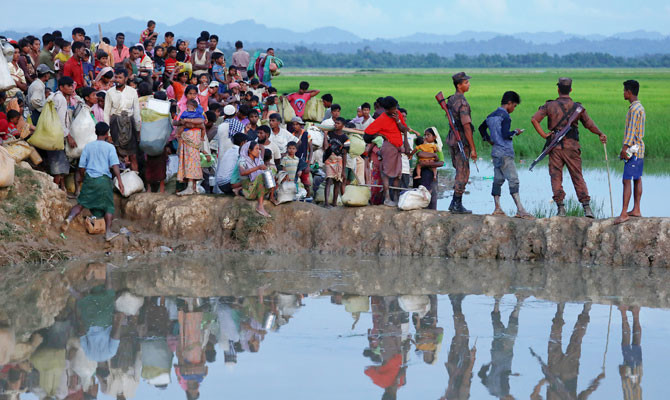
Rohingya refugees who fled from Myanmar wait in the rice field to be let through after after crossing the border in Palang Khali, Bangladesh October 9, 2017. (REUTERS)
2 / 4
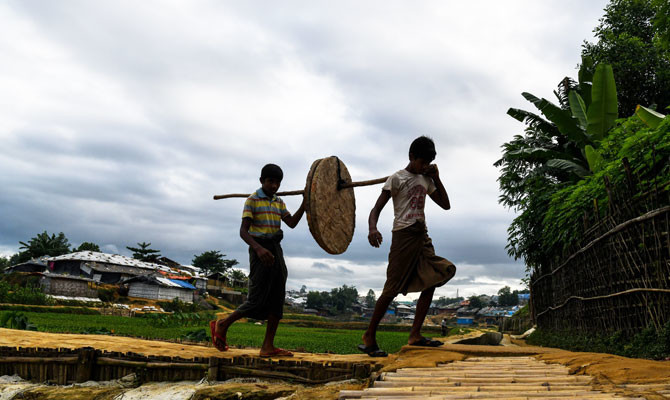
Rohingya refugee men carry a cemented structure for construction at the Kutupalong camp in Ukhia near Cox's Bazar on August 13, 2018. (AFP)
3 / 4
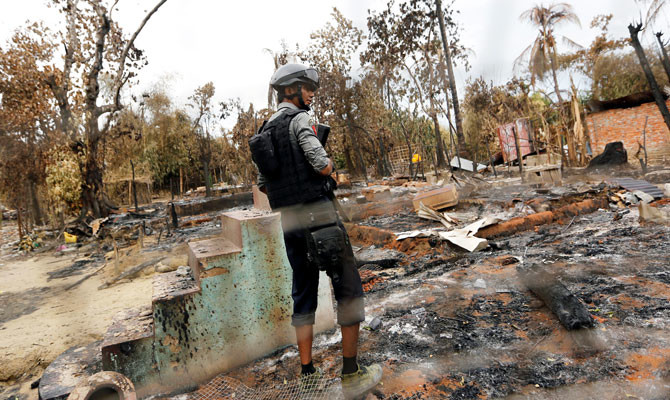
A police officer stands in a house that was burnt down during the days of violence in Maungdaw, Myanmar, August 30, 2017. (REUTERS)
4 / 4
The sun rises as thousands of Rohingya refugees who fled from Myanmar a day before wait by the road where they spent the night between refugee camps, near Cox's Bazar, Bangladesh, in this October 10, 2017 file photo. (REUTERS)
Updated 19 August 2018
Follow

Rohingya ‘rights at risk’ after Myanmar ID move

  • Whatever the language or term is, the Myanmar government is the ultimate authority to determine the citizenship issue of the Rohingyas
  • If Bangladesh opposes it strongly, then Myanmar may take the chance to disown the statement by saying that it was not at all official

DHAKA: Bangladesh has yet to decide whether it will replace its official description of Rohingya refugees — a move some claim will limit the Rohingyas’ rights as Myanmar citizens.
A Bangladesh Foreign Ministry spokesman told Arab News a decision over the replacement of the term “forcibly displaced Myanmar nationals” with “displaced persons from Rakhine state” was still under consideration.
“During last week’s discussion with the Bangladesh delegation, the Myanmar authority brought this up. We have listened to their points in this regard,” Delwar Hossain, director-general of the Foreign Ministry, said.
“Discussion is continuing among the ministry’s policy-makers, but the decision has yet to be taken,” he said.
Another Bangladeshi official present at the meeting at Nay Pe Daw said that Bangladesh has not given any consent to the proposal from Myanmar regarding the replacement of the term.
“I have not received any directive over the issue,” said Abul Kalam, of the Refugee, Relief and Repatriation Commission (RRRC), the main coordinating body looking after the Rohingyas in Cox’s Bazar.
However, experts believe that the replacement of the term “forcibly displaced Myanmar nationals” with “displaced persons from Rakhine state” will limit the Rohingyas’ ability to secure rights as Myanmar citizens.
“Whatever the language or term is, the Myanmar government is the ultimate authority to determine the citizenship issue of the Rohingyas. We want the (Rohingyas) to live in Rakhine with honor and dignity,” said Humayun Kabir, former Bangladesh ambassador to the US.
“We want to see developments on the ground for the repatriation of the refugees, and that is the prime concern at the moment.”
Independent migration expert Asif Munir said that Myanmar posted the statement on its state counsellor’s Facebook page, which is not an official channel.
He described the Myanmar approach as “very provocative.”
“Although Bangladesh authorities have not yet officially agreed with the Myanmar proposal, they (Myanmar) have issued a statement through an informal channel to see the response of the Bangladeshis. If Bangladesh opposes it strongly, then Myanmar may take the chance to disown the statement by saying that it was not at all official,” Munir said.
“This proposal will hamper the Rohingyas’ identity and citizenship of Myanmar.”


Ethiopia’s prime minister accuses Eritrea of mass killings during Tigray war

Updated 03 February 2026
Follow

Ethiopia’s prime minister accuses Eritrea of mass killings during Tigray war

  • Landlocked Ethiopia says that Eritrea is arming rebel groups, while Eritrea says Ethiopia’s aspiration is to gain access to a seaport
  • Ethiopia lost sovereign access to the Red Sea when Eritrea seceded in 1993 after decades of guerrilla warfare

ADDIS ABABA: Ethiopia’s government Tuesday for the first time acknowledged the involvement of troops from neighboring Eritrea in the war in the Tigray region that ended in 2022, accusing them of mass killings, amid reports of renewed fighting in the region.
Ethiopian Prime Minister Abiy Ahmed, while addressing parliament Tuesday, accused Eritrean troops fighting alongside Ethiopian forces of mass killings in the war, during which more than 400,000 people are estimated to have died.
Eritrean and Ethiopian troops fought against regional forces in the northern Tigray region in a war that ended in 2022 with the signing of a peace agreement.
Eritrea’s Information Minister Yemane Gebremeskel told The Associated Press that Ahmed’s comments were “cheap and despicable lies” and did not merit a response.
Both nations have been accusing each other of provoking a potential civil war, with landlocked Ethiopia saying that Eritrea is arming and funding rebel groups, while Eritrea says Ethiopia’s aspiration is to gain access to a seaport.
“The rift did not begin with the Red Sea issue, as many people think,” Ahmed told parliamentarians. “It started in the first round of the war in Tigray, when the Eritrean army followed us into Shire and began demolishing houses, massacred our youth in Axum, looted factories in Adwa, and uprooted our factories.”
“The Red Sea and Ethiopia cannot remain separated forever,” he added.
Ethiopia lost sovereign access to the Red Sea when Eritrea seceded in 1993 after decades of guerrilla warfare.
Gebremeskel said the prime minister has only recently changed his tune in his push for access to the Red Sea.
Ahmed “and his top military brass were profusely showering praises and State Medals on the Eritrea army and its senior officers. … But when he later developed the delusional malaise of ‘sovereignty access to the sea’ and an agenda of war against Eritrea, he began to sing to a different chorus,” he said.
Eritrea and Ethiopia initially made peace after Abiy came to power in 2018, with Abiy winning a Nobel Peace Prize for his efforts toward reconciliation.
In June, Eritrea accused Ethiopia of having a “long-brewing war agenda” aimed at seizing its Red Sea ports. Ethiopia recently said that Eritrea was “actively preparing to wage war against it.”
Analysts say an alliance between Eritrea and regional forces in the troubled Tigray region may be forming, as fighting has been reported in recent weeks. Flights by the national carrier to the region were canceled last week over the renewed clashes.