

‘New beginning’: Khan brings hope of stronger ties with India

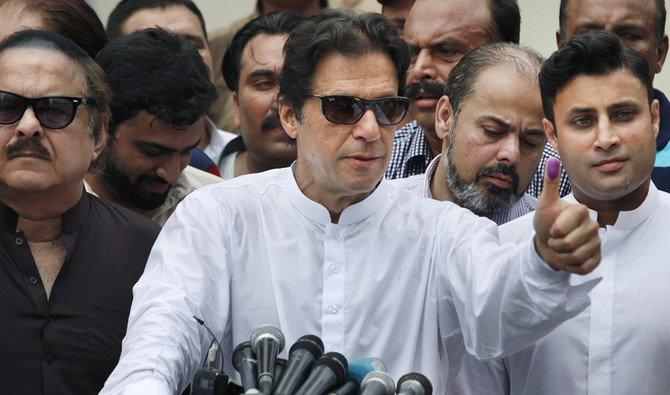
India has expressed cautious optimism about an improvement in the country’s relationship with Pakistan following Imran Khan’s rise to power. (AP/photo)
Updated 19 August 2018
Follow

‘New beginning’: Khan brings hope of stronger ties with India

  • Cautious optimism in India as Imran Khan becomes PM in Pakistan
  • Indian experts say stable government in Pakistan will determine the course of India-Pakistan relations

NEW DELHI: Indian foreign policy experts have expressed cautious optimism about an improvement in the country’s relationship with Pakistan following Imran Khan’s rise to power.

Former India ambassador to Pakistan TCA Raghavan said that if Pakistan’s new prime minister was able to provide stable government internally and address the nation’s numerous domestic issues, it “will create the basis for better relations with India.”

Raghavan, author of “The People Next Door: The Curious History of India-Pakistan Relations,” said: “It’s difficult to make predictions about India-Pakistan relations at any time. But in my view the internal situation in Pakistan has a great role to play in determining the course of the relationship.”

Sudheendra Kulkarni, a peace activist and adviser to the former prime minister Atal Behari Vajppayee, described Khan’s leadership as a “new beginning for Pakistan and the Indian subcontinent.”

“The past four years have been a wasted opportunity in taking the India-Pakistan relationship forward,” he said. “Nawaz Sharif was a leader with a thorough commitment to a better relationship with New Delhi, but the Narendra Modi regime could not sustain the initial hopes when it invited the leader of the Islamic republic to a swearing in ceremony in 2014.”

However, Kulkarni cautioned that “we should not expect marked improvement in relations in the next eight to nine months as India is going to have elections early next year.”

Professor Happymon Jacob, of the Center for International Politics, Organization and Disarmament at New Delhi’s Jawaharlal Nehru University, said: “I am positive about Imran Khan. If the Pakistan army and the political establishment are on board, and there is no difference between the two elites, then it becomes easier for India to navigate.

“Under Nawaz Sharif, both the elites were not on the same page regarding India. The present regime in Delhi will not reach out to Pakistan when elections in India are around the corner. If anything wrong goes so far as peace process is concerned, then it will have electoral ramifications. Any revival of peace talks will happen only after the elections.”

India’s leadership reached out to Khan after his election victory with the Ministry of External Affairs saying: “Prime Minister Narendra Modi expresses hope that democracy will take deeper roots in Pakistan and reiterates his vision of peace and development in the entire neighborhood.”

In his victory speech, Khan also said that “Pakistan is ready to improve its ties with India.”

He said that his government hoped the leaders of the two nations can resolve all disputes, including the core issue of Kashmir, through talks.

“If they take one step toward us, we will take two,” he said.

Meanwhile, India cricketer-turned-politician Navjot Singh Sidhu, a guest at Khan’s swearing in on Saturday, has called for peace on the subcontinent.

“It’s in the interest of both countries that peace prevails. I have come to Pakistan despite all the criticism back home with a message of peace and friendship. We have the same culture, the same way of thinking and, therefore, it is important that we should have a strong bond.” 


Afghanistan says it thwarted Pakistani airstrike on Bagram Air Base as fighting enters fourth day

Updated 01 March 2026
Follow

Afghanistan says it thwarted Pakistani airstrike on Bagram Air Base as fighting enters fourth day

  • The fighting has been the most severe between the neighbors for years
  • Pakistan accuses Taliban government of harboring militant groups that stage attacks against it

KABUL: Afghanistan thwarted attempted airstrikes on Bagram Air Base, the former US military base north of Kabul, authorities said Sunday, while cross-border fighting between Pakistan and Afghanistan stretched into a fourth day.
The fighting has been the most severe between the neighbors for years, with Pakistan declaring that it’s in “open war” with Afghanistan.
The conflict has alarmed the international community, particularly as the area is one where other militant organizations, including Al-Qaeda and the Daesh group, still have a presence and have been trying to resurface.
Pakistan accuses Afghanistan’s Taliban government of harboring militant groups that stage attacks against it and also of allying with its archrival India.
Border clashes in October killed dozens of soldiers, civilians and suspected militants until a Qatari-mediated ceasefire ended the intense fighting. But several rounds of peace talks in Turkiye in November failed to produce a lasting agreement, and the two sides have occasionally traded fire since then.
On Sunday, the police headquarters of Parwan province, where Bagram is located, said in a statement that several Pakistani military jets had entered Afghan airspace “and attempted to bomb Bagram Air Base” at around 5 a.m.
The statement said Afghan forces responded with “anti-aircraft and missile defense systems” and had managed to thwart the attack.
There was no immediate response from Pakistan’s military or government regarding Kabul’s claim of attempted airstrikes on Bagram or the ongoing fighting.
Bagram was the United States’ largest military base in Afghanistan. It was taken over by the Taliban as they swept across the country and took control in the wake of the chaotic US withdrawal from the country in 2021. Last year, US President Donald Trump suggested he wanted to reestablish a US presence at the base.
The current fighting began when Afghanistan launched a broad cross-border attack on Thursday night, saying it was in retaliation for Pakistani airstrikes the previous Sunday.
Pakistan had said its airstrike had targeted the outlawed Pakistani Taliban, also known as Tehreek-e-Taliban Pakistan, or TTP. Afghanistan had said only civilians were killed.
The TTP militant group, which is separate but closely allied with Afghanistan’s ruling Taliban, operates inside Pakistan, where it has been blamed for hundreds of deaths in bombings and other attacks over the years.
Pakistan accuses Afghanistan’s Taliban government of providing a safe haven within Afghanistan for the TTP, an accusation that Afghanistan denies.
After Thursday’s Afghan attack, Pakistani Defense Minister Khawaja Mohammad Asif declared that “our patience has now run out. Now it is open war between us.”
In the ongoing fighting, each side claims to have killed hundreds of the other side’s forces — and both governments put their own casualties at drastically lower numbers.
Two Pakistani security officials said that Pakistani ground forces were still in control on Sunday of a key Afghan post and a 32-square-kilometer area in the southern Zhob sector near Kandahar province, after having seized it during fighting Friday. The captured post and surrounding area remain under Pakistani control, they added. The officials spoke on condition of anonymity, because they weren’t authorized to speak publicly.
In Kabul, the Afghan government rejected Pakistan’s claims. Deputy government spokesman Hamdullah Fitrat called the reports “baseless.”
Afghan officials said that fighting had continued overnight and into Sunday in the border areas.
The police command spokesman for Nangarhar province, Said Tayyeb Hammad, said that anti-aircraft missiles were used from the provincial capital, Jalalabad, and surrounding areas on Pakistani fighter jets flying overhead Sunday morning.
Defense Ministry spokesman Enayatulah Khowarazmi said that Afghan forces had launched counterattacks with snipers across the border from Nangarhar, Paktia, Khost and Kandahar provinces overnight. He said that two Pakistani drones had been shot down and dozens of Pakistani soldiers had been killed.
Fitrat said that Pakistani drone attacks hit civilian homes in Nangarhar province late Saturday, killing a woman and a child, while mortar fire killed another civilian when it hit a home in Paktia province.
There was no immediate response to the claims from Pakistani officials.