

Reminder to Saudi citizens, expats: No Hajj without permit

Intensive security checks at the entry points to Makkah have reduced the number of illegal pilgrims without Hajj permits from entering the holy city. (SPA)
Updated 12 August 2018
Follow

Reminder to Saudi citizens, expats: No Hajj without permit

  • Government measure has successfully tackled the issue of illegal pilgrims
  • Having a large number of pilgrims without permits in the past have led to chaos and randomness, and the gathering of pilgrims on the sidewalks, roads and under bridges

JEDDAH: Hajj “permits” have always been one of the issues that pilgrims worry about, whether they are in Saudi Arabia or from any other country in the world.

In 2008, a campaign for organizing the pilgrims of the Kingdom was launched under the title “No Hajj Without Permission.” It aimed to reduce the number of pilgrims from Saudi Arabia who used to go to Hajj every year without permission by allowing them to perform Hajj once every five years to give a chance to other pilgrims.

Having a large number of pilgrims without permits led to chaos and randomness, and the gathering of pilgrims on the sidewalks, roads and under bridges. Over the past 10 years the campaign authorized individuals to reach the holy mosques easily, to pass through the checkpoints without violations, and to enjoy the services provided to pilgrims by the Kingdom.
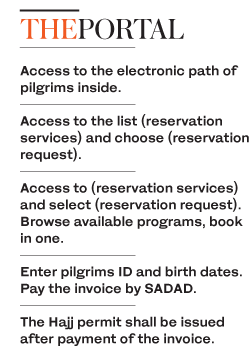
The Ministry of Interior has been working hard every year to make Hajj successful and easy by using technology to facilitate Hajj permits with a number of very creative applications.

The National Media Campaign for pilgrims’ awareness during Hajj tweeted on Aug. 9: “Make sure to have your Hajj permit to enjoy a legal Hajj that preserves your rights, allows you to select the suitable service and price and does not expose you to legal liability.”

The campaign also tweeted: “Failure to possess a permit for Hajj may result in you being turned back by the security authorities.”

Security forces tweeted in a video that according to the instructions issued for Hajj, “pilgrims won’t be allowed entry to the holy capital without the appropriate permission, as security checkpoints at all entrances to the city will apply procedures of investigation, verification and seizure of violators, referring them to the appropriate authorities to apply regulations against them.”

It was also clarified by a post on the security forces’ Twitter page that no one can access the holy capital from “citizens and residences” unless they have Hajj permits or proof that they are working in the city.

The Ministry of Interior provides electronic permits which enable the registration and definition of Hajj convoys in the system. This service allows registered convoys to receive Hajj permits electronically, and enables regulators to verify issued permits; in addition, the service allows permits to be issued for government convoys.

The service also allows the option of adding trips, and assigning passengers for each trip, according to the Absher website, in addition to the possibility of issuing permits for government campaigns.

This service allows Saudis and non-Saudis to apply for pilgrimage permission through the ministry portal without having to make a physical visit to the ministry.

The director-general of passports in the Makkah region, Abdul Rahman Al-Harbi, on Wednesday said that the number of electronic permits issued had reached 52,000.
The service is accessed from the “Muqeem” portal for companies and institutions or through the link https://portal.elm.sa by Absher.

@AljawazatKSA also tweeted. “Residents can cancel their Hajj permits.” 

Year after year, Hajj has witnessed many improvements in the system of projects and services provided by the Kingdom to the pilgrims, in particular the continuation of the project of expanding the Haram to accommodate a larger number of pilgrims and the completion of important projects that have contributed effectively to facilitate Hajj.

The number of pilgrims increases annually which is a good sign of a successful Hajj. In 2017 the number of pilgrims increased 32 percent from the previous year.

During last year’s Hajj, Saudi Arabia received more than 2.35 million pilgrims from around the world, according to official statistics. 

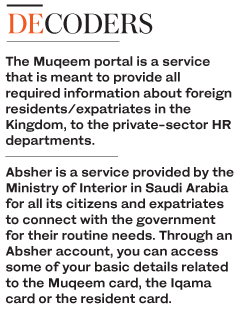
Decoder

What are Muqeem and Absher?

The Muqeem portal is a service that is meant to provide all required information about foreign residents/expatriates in the Kingdom, to the private-sector HR departments. Absher is a service provided by the Ministry of Interior in Saudi Arabia for all its citizens and expatriates to connect with the government for their routine needs. Through an Absher account, you can access some of your basic details related to the Muqeem card, the Iqama card or the resident card.


Riyadh takes shape at Tuwaiq Sculpture Symposium 2026

Updated 16 January 2026
Follow

Riyadh takes shape at Tuwaiq Sculpture Symposium 2026

RIYADH: This season, one of Riyadh’s busiest streets has taken on an unexpected role.

Under the theme “Traces of What Will Be,”sculptors are carving granite and shaping reclaimed metal at the seventh Tuwaiq Sculpture Symposium, running from Jan. 10 to Feb. 22.

The symposium is unfolding along Prince Mohammed bin Abdulaziz Road, known locally as Al‑Tahlia, a name that translates to desalination. The choice of location is deliberate.

The area is historically linked to Riyadh’s early desalination infrastructure, a turning point that helped to shift the city from water scarcity toward long‑term urban growth.

Twenty‑five artists from 18 countries are participating in this year’s event, producing large‑scale works in an open‑air setting embedded within the city.

The site serves as both workplace and eventual exhibition space, with sculptures remaining in progress throughout the symposium’s duration.

In her opening remarks, Sarah Al-Ruwayti, director of the Tuwaiq Sculpture Symposium, said that this year new materials had been introduced, including recycled iron, reflecting a focus on sustainability and renewal.

She added that the live-sculpting format allowed visitors to witness the transformation of raw stone and metal into finished artworks.

Working primarily with local stone and reclaimed metal, the participating artists are responding to both the material and the place.

For Saudi sculptor Wafaa Al‑Qunaibet, that relationship is central to her work, which draws on the physical and symbolic journey of water.

“My work … presents the connection from the salted water to sweet water,” Al‑Qunaibet told Arab News.

Using five pieces of granite and two bronze elements, she explained that the bronze components represented pipes, structures that carry saline water and allow it to be transformed into something usable.

The sculpture reflected movement through resistance, using stone to convey the difficulty of that transition, and water as a force that enables life to continue.

“I throw the stone through the difficult to show how life is easy with the water,” she said, pointing to water’s role in sustaining trees, environments and daily life.

Formally, the work relies on circular elements, a choice Al‑Qunaibet described as both technically demanding and socially resonant.

“The circle usually engages the people, engages the culture,” she said. Repeated circular forms extend through the work, linking together into a long, pipe‑like structure that reinforces the idea of connection.

Sculpting on site also shaped the scale of the piece. The space and materials provided during the symposium allowed Al‑Qunaibet to expand the work beyond her initial plans.

The openness of the site pushed the sculpture toward a six‑part configuration rather than a smaller arrangement.

Working across stone, steel, bronze and cement, American sculptor Carole Turner brings a public‑art perspective to the symposium, responding to the site’s historical and symbolic ties to desalination.

“My work is actually called New Future,” Turner told Arab News. “As the groundwater comes up, it meets at the top, where the desalination would take place, and fresh water comes down the other side.”

Her sculpture engages directly with the symposium’s theme by addressing systems that often go unseen. “Desalination does not leave a trace,” she said. “But it affects the future.”

Turner has been sculpting for more than two decades, though she describes making objects as something she has done since childhood. Over time, she transitioned into sculpture as a full‑time practice, drawn to its ability to communicate across age and background.

Public interaction remains central to her approach. “Curiosity is always something that makes you curious, and you want to explore it,” she said. Turner added that this sense of discovery is especially important for children encountering art in public spaces.

Saudi sculptor Mohammed Al‑Thagafi’s work for this year’s symposium reflects ideas of coexistence within Riyadh’s evolving urban landscape, focusing on the relationships between long‑standing traditions and a rapidly changing society.

The sculpture is composed of seven elements made from granite and stainless steel.

“Granite is a national material we are proud of. It represents authenticity, the foundation, and the roots of Saudi society,” Al‑Thagafi told Arab News.

“It talks about the openness happening in society, with other communities and other cultures.”

That dialogue between materials mirrors broader social shifts shaping the capital, particularly in how public space is shared and experienced.

Because the sculpture will be installed in parks and public squares, Al‑Thagafi emphasized the importance of creating multi‑part works that invite engagement.

Encountering art in everyday environments, he said, encouraged people to question meaning, placement, simplicity and abstraction, helping to build visual‑arts awareness across society.

For Al‑Thagafi, this year marked his fifth appearance at the symposium. “I have produced more than 2,600 sculptures, and here in Riyadh alone, I have more than 30 field works.”

Because the works are still underway, visitors can also view a small on‑site gallery displaying scaled models of the final sculptures.

These miniature models offer insight into each artist’s planning process, revealing how monumental forms are conceived before being executed at full scale.

As the symposium moves toward its conclusion, the completed sculptures will remain on site, allowing the public to encounter them in the environment that shaped their creation.