LONDON: The British Museum said Thursday it is returning to Iraq a collection of looted antiquities up to 5,000 years old, after identifying the exact temple they came from in a unique piece of archaeological detective work.
The eight objects were confiscated by British police in May 2003, a few months after the US-led invasion of Iraq, from a now defunct dealer in London who failed to provide any paperwork.
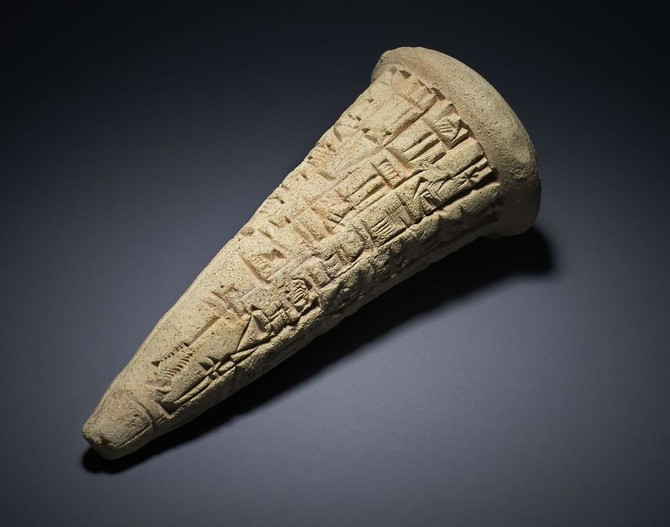
Normally the detailed provenance of such items would be hard to establish, but three of them, fired clay cones, carried Sumerian inscriptions that gave a clue to their origins.
In a remarkable coincidence, they were identical to cones found on a site in the ancient city of Girsu, now known as Tello, in southern Iraq, where the British Museum has been training Iraqi archaeologists since 2016.
“The broken objects the robbers left next to the looting holes were broken cones with exactly the same inscription that we have on the cones that were seized,” said the team’s lead archaeologist, Sebastien Rey.
Identical cones were also found in the walls of a site at the Eninnu temple — pinpointing the looted items’ source with a level of accuracy that Rey said was “completely unique.”
“We could have an idea that maybe these objects came from southern Iraq, but to be able to narrow it down to the particular site, and even to the particular holes — this is extremely rare,” he told AFP.
He added: “If we don’t have any information on the objects, you can’t identify their provenance, and that’s the main problem in combating the illicit trade.”
The looting at the site is not as extensive at other places in southern Iraq, suggesting the objects that ended up in London were taken at night, possibly by a small number of people.
The objects will be handed to the Iraqi embassy on Friday during a private ceremony at the museum, from where they will return to Iraq and eventually, Rey hopes, will go on public display.
Iraq’s ambassador, Salih Husain Ali, praised the museum’s staff for their “exceptional efforts” in identifying the antiquities.
“Such collaboration between Iraq and the United Kingdom is vital for the preservation and the protection of the Iraqi heritage,” he said in a statement issued by the museum.
“The protection of antiquities is an international responsibility and in Iraq we aspire to the global cooperation to protect the heritage of Iraq and to restore its looted objects.”
The three cones each have an identical cuneiform inscription which references the god the temple was built for and the king who built it, and date back to around 2,200 BC.
Similar cones have been found in many other sites but Rey said that until the Tello excavation began in 2016, no one really knew what they were for.
Finding them in their original positions inside temple walls led experts to conclude they were votive objects, dedicated to the gods by Mesopotamian kings.
The British Museum collection also includes a polished, yellowish river pebble and a fragmentary white gypsum mace-head, both of them inscribed.
There is also a white marble amulet pendant in the form of a reclining bull or buffalo, and a red marble square stamp seal or amulet depicting two similar animals facing in opposite directions, which both date back to 3,000 BC.
The final item in the collection is a white chalcedony stamp seal with a flat oval face engraved with the design of a reclining sphinx.


![]()
![]()

British Museum identifies looted Iraqi antiquities, sends them home
British Museum identifies looted Iraqi antiquities, sends them home
- The eight objects were confiscated by British police in May 2003, a few months after the US-led invasion of Iraq
- The fired clay cones carried Sumerian inscriptions that gave a clue to their origins

Latest updates


© 2026 SAUDI RESEARCH & PUBLISHING COMPANY, All Rights Reserved And subject to Terms of Use Agreement.