


BAGHDAD: The election commission in Iraq on Monday announced the end of a partial recount of ballots from parliamentary elections in May after complaints of vote rigging.
The preliminary results showed losses for many prominent Shiite and Sunni parties and figures, prompting them to question the results and claim widespread fraud.
An investigation committee formed by the cabinet suggested the voting process had been rigged and in response, the Iraqi parliament voted to amend the electoral law to allow the manual re-counting of all polling stations and centers
The Federal Supreme Court, however, allowed just a partial recount, limited to polling stations and centers where the complaints were made.
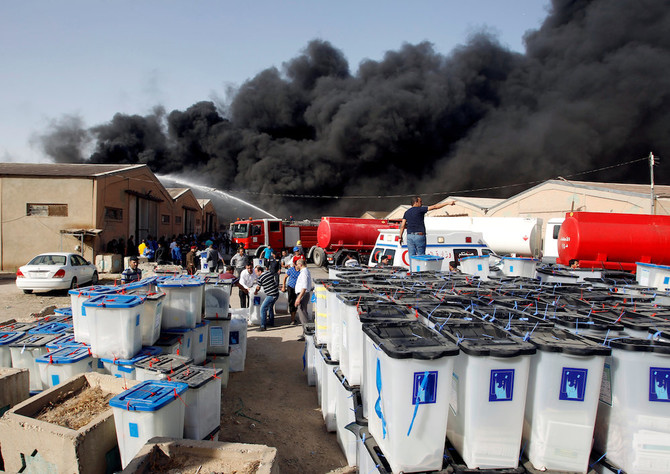
No final election results were announced on Monday but the Independent High Electoral Commission, IHEC, said counting had been canceled at the Baghdad-Russafa election office because all the devices used to verify the results and the ballot boxes themselves, were severely damaged by a fire in June. This made it “impossible to conduct the process of manual counting,” Judge Laith Jabr, an IHEC spokesman said.
The Tigris River divides Baghdad into two parts: Russafa and Karkh. Russafa, which lies east of the river is the largest one that hosts the biggest Shiite communities in the capital.
The preliminary results showed a big victory in Baghdad for the Saeiroon List, which was formed and sponsored by Muqtada Al-Sadr, the influential Shiite cleric, and the Fattah List which includes members of the pro-Iranian Shiite armed factions such as Badr Organization and Assaib Ahl Al-Haq.
The State of Law Coalition headed by Nuri Al-Maliki, the former Iraqi prime minister, also performed well.
The biggest surprise result in Baghdad was made by Saddiqoon, the political wing of Assaib Ahl Al-Haq, which won six out of the nine seats for Fattah. Most of the votes were gained in Russafa, IHEC, security officials and Shiite political leaders within Fattah told Arab News.
The sudden rise by Sadiqqoon to win 15 seats in nationwide compared to one seat in 2014, has raised many questions and doubts over their results by both rivals and allies.
Many Shiite leaders have suggested in private conversations that Assaib Ahl Al-Haq have manipulated and falsified results for the benefit of their candidates, especially in Baghdad.
The fire which tore through the warehouses where the IHEC had stored its equipment and ballot boxes for Russafa in June, has only strengthened these doubts.
The IHEC did not make clear on Monday how it will deal with the results of Russafa. There has been no word from the investigation into the fire about who may have been responsible.
“Their (Assaib) results were unreasonable and there is no legal way to achieve such success in this very short time,” a senior Shiite Fattah leader told Arab News.
“We are almost sure that they (Assaib) had manipulated the results in favor of their candidates.”
Iraq has been in political limbo since the election with efforts to forma a coalition large enough to form a government stalled as tensions between the rival factions and their international backers heightened.


