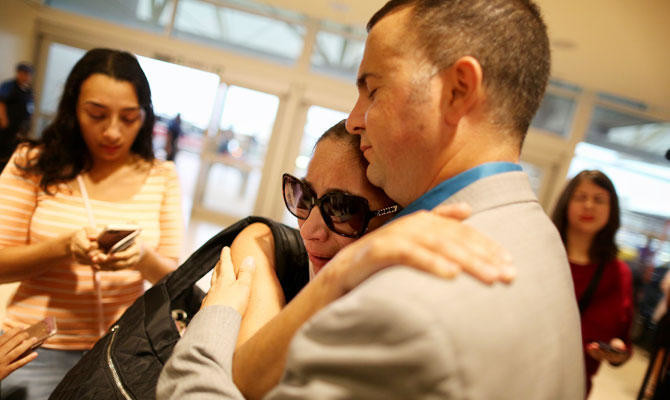
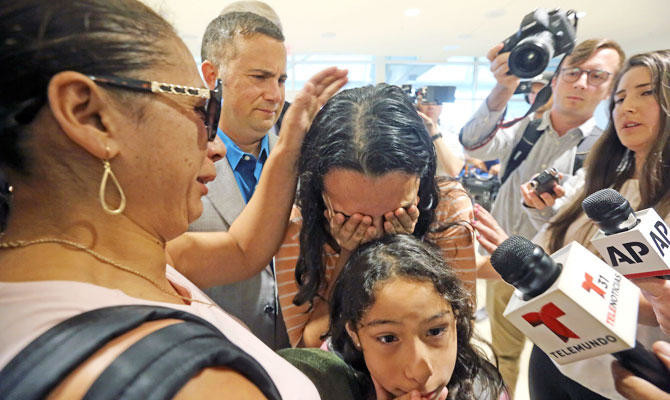
ORLANDO, Florida: The 16-year-old American daughter of a US Marine held back tears as long as she could Friday before her family was split in two.
Her mother, Alejandra Juarez, was finally leaving for Mexico, rather than be sent off in handcuffs, after exhausting all options to stop her deportation.
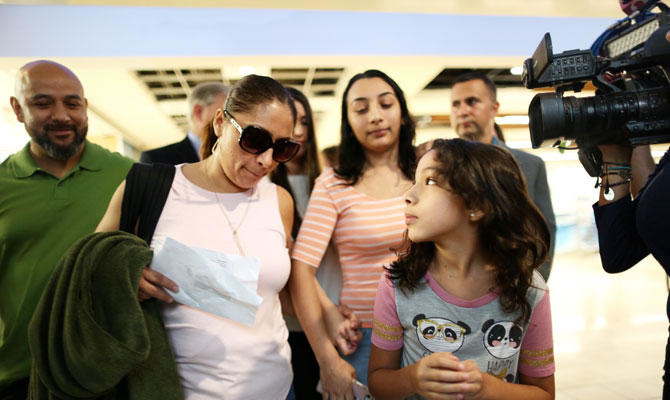
“My mom is a good person. She’s not a criminal,” Pamela said, cursing at the immigration agency before her mother checked in for her flight from Orlando International Airport.
Alejandra and Temo Juarez, a naturalized citizen who runs a roofing business, quietly raised Pamela and their 9-year-old daughter, Estela, in the central Florida town of Davenport until a 2013 traffic stop exposed her legal status.
Afterward, she regularly checked in with US Immigration and Customs officials, which typically went after higher-priority targets like people with criminal records.
Temo didn’t figure his vote for President Donald Trump would affect them personally. That was before the enforcement of Trump’s “zero tolerance” policy toward illegal immigration.
Now, the Juarez family will be divided in two: Estela will join her mother in Mexico after she gets settled, while Temo cares for Pamela and pays the bills.
Alejandra, 39, petitioned to become a citizen in 2001 but was rejected because she was accused of making a false statement at the border when she sought asylum in 1998, attorney Richard Maney said. He said she was asked about her citizenship and told authorities she had been a student in Memphis, Tennessee for a short time, so border officials apparently thought she was falsely claiming to be an American citizen.
“This is not going to be the last case like this,” Maney said. “This is potentially the first of many. There are many military spouses in the same situation.”
US Rep. Darren Soto, D-Fla., who couldn’t get the votes in Congress for legislation to allow Juarez to remain, called her situation disgraceful.
“We’re not going to give up,” he told her with a hug at the airport.
“It’s an absolute disgrace by the Trump administration to be deporting a patriotic spouse,” Soto said. “Her husband, Temo, served in the Marines ... while she was at home on the home-front, raising two young women. What justice does this serve?“
Alejandra ultimately decided to “self-deport” to Mexico, rather than turn herself in to be detained and then deported. After 20 years in the United States, she no longer has family or friends in the country, so she chose Merida, a city in the Yucatan where a small community of deported military spouses might help her.
Emotionally spent, she wiped her own tears behind sunglasses and stroked Pamela’s hair while gripping Estela, who stood by her side. Temo said he preferred not to talk before they were all escorted through security for their final goodbyes.
A reporter asked what she would say to the president. Alejandra said she’d ask how Trump could let this happen, since he “always says he loves the military and he’s doing everything for the military.”
“My husband fought for this country three times. The administration, yourself, you think you are punishing me. You’re not just punishing me,” she said, referring to her family. “I hope this make him happy. And I really pray that God will forgive him.”

Facing deportation, US Marine’s wife leaves for Mexico
- It’s an absolute disgrace by the Trump administration to be deporting a patriotic spouse
- "My husband fought for this country three times"
Left homeless by blaze, Muslims in southernmost Philippines observe Ramadan as month of trial
- Thousands lost their homes when parts of Bongao in Tawi-Tawi were burnt to ashes
- Many trying to fully observe the fasting month say they are grateful to be alive
Manila: As Annalexis Abdulla Dabbang was looking forward to observing the month of Ramadan with her family, just days before it began they lost everything when an enormous fire tore through whole neighborhoods of their city in the southernmost province of the Philippines.
Bongao is the capital of Tawi-Tawi, an island province, forming part of the country’s Muslim minority heartland in the Bangsamoro region. The city experienced its worst fire in years in early February, when flames swept through the coastal community, leaving more than 5,000 people homeless.
“We were swimming for our lives. We had to swim to escape from the fire ... We swam in darkness, and (even) the sea was already hot because of the fire,” Dabbang, a 27-year-old teacher, told Arab News.
“Everything we owned was gone in just a few hours — our home, our memories, the things we worked hard for, everything turned to ashes.”
Trying to save their 2-year-old daughter and themselves, she and her husband left everything behind — as did hundreds of other families that together with them have since taken shelter at the Mindanao State University gymnasium — one of the evacuation centers.
Unable to secure a tent, Dabbang’s family has been sleeping on the bleachers, sharing a single mat as their bed. When Ramadan arrived a few days after they moved to the makeshift shelter, they welcomed it in a different, more solemn way. There is no family privacy for suhoor, no room or means to welcome guests for iftar.
“Ramadan feels different now. It’s painful but at the same time more real. When we lost our home, we began to understand what sacrifice really means. When you sleep in an evacuation center, you understand hunger, discomfort in a deeper way,” Dabbang said.
“We don’t prepare special dishes. We prepare our hearts.”
While she and thousands of others have lost everything they have ever owned, she has not lost her faith.
“Our dreams may have turned to ashes, but our prayers are still alive,” she said.
“This Ramadan my prayers are more emotional than ever. I pray for strength, not just for myself, but for my family and for every neighbor who also lost their family home. I pray for healing from the trauma of fire. I pray that Allah will replace what we lost with something better. I pray for the chance to rebuild not just our house, but our sense of security.”
Juraij Dayan Hussin, a volunteer helping the Bongao fire victims, observed that many of them were traumatized and the need to cleanse the heart and mind during Ramadan was what kept many of them going, because they are “thankful that even though they lost their property, they are still alive.”
But the religious observance related to the fasting month is not easy in a cramped shelter.
“It’s hard for Muslims to perform their prayers when they do not have their proper attire because they usually have specific clothes for prayer,” he said. “Sanitation in the area is also an issue ... when you fast and when you pray, cleanliness is essential.”
For Abdulkail Jani, who is staying at a basketball court with his brother and more than 70 other families, this Ramadan will be spent apart from their parents, whom they managed to move to relatives.
“The month of Ramadan this year is a month of trial ... there will be a huge change from how we observed Ramadan in the past, but we will adjust to it and try to comfort ourselves and our family. The most important thing is that we can perform the fasting,” he told Arab News.
“Despite our situation now, despite everything, as long as we’re alive, we will observe Ramadan. We’ll try to observe it well, without missing anything.”