

Iran death penalty charges in economic crisis ‘breach international law’: Amnesty

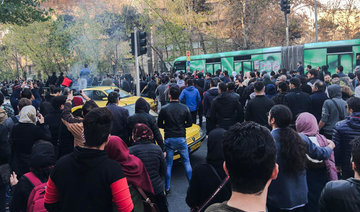
Amnesty International on Wednesday expressed “alarm” over arrests of protestors, saying that the application of the death penalty for non-violent crimes would be “in direct breach of international law.” (AFP File Photo)
Updated 01 August 2018
Follow

Iran death penalty charges in economic crisis ‘breach international law’: Amnesty

  • At least 29 people have been arrested for “economic disruption,” Iranian officials announced last weekend
  • The plunging value of the Iranian currency and worsening economic situation has prompted a string of public protests this year

LONDON: Iran’s application of the death penalty to individuals arrested during the country’s economic crisis would be in “direct breach of international law,” the world’s leading human-rights organization has said.
At least 29 people have been arrested for “economic disruption,” Iranian officials announced last weekend, with many facing charges that carry the death penalty.
Amnesty International on Wednesday expressed “alarm” over the arrests, saying that the application of the death penalty for non-violent crimes would be “in direct breach of international law.”
The plunging value of the Iranian currency and worsening economic situation has prompted a string of public protests this year. In an apparent attempt to be seen to be tackling the crisis, officials announced dozens of arrests and blamed unnamed “enemies” for the rial’s decline.
“Amnesty International is alarmed at the judiciary’s announcement that it has charged individuals arrested in relation to the country’s economy and currency crisis with ‘corruption on earth’ (efsad-e fel arz), which incurs the death penalty,” an Amnesty spokesperson told Arab News.


“This would be in direct breach of international law, which restricts the use of the death penalty to only the ‘most serious crimes’ — those involving intentional killing. Amnesty International’s research has shown that basic fair trial guarantees are absent in death penalty cases in Iran.”
The statement follows warnings from other campaign groups over the human-rights situation in Iran.
“In recent weeks and months we’ve had many protests,” Mahmood Amiry-Moghaddam, spokesman for the Oslo-based Iran Human Rights group, told Arab News on Tuesday.
“Human rights are suffering … and every day they suffer more. Iran is among the biggest violators of human rights in the world today.”


Harvard scholar and Iranian affairs expert Dr. Majid Rafizadeh said that the arrests connected to the economic crisis amounted to a PR exercise by the Iranian government.
“The arrests by the regime are mostly cosmetic actions aimed at projecting that the Islamic Republic is taking actions to address corruption and address people’s grievances,” he said.
“The regime is also trying to point (the) finger at some individuals rather than on the systematic financial corruption within the political establishment.”
Amid widespread public anger, demonstrations spread to the historic city of Isfahan on Tuesday, with protesters demanding an end to the Iranian regime’s costly interference in the affairs of neighboring countries in the region.
Video footage showed hundreds of protesters shouting: “No to Gaza, no to Lebanon, my soul is Iran’s redemption.” The slogan refers to Tehran’s military adventures in Syria, Iraq and Lebanon, at the expense of the domestic economy.
“The protests in Isfahan are significant because they highlight people’s ongoing and growing outrage and frustration with the theocratic establishment, as the economy is in shambles,” said Rafizadeh. “Despite the regime’s crackdown, people continue to take to streets as they can’t make ends meet.”


Gaza teen’s chances of walking again depend on Rafah reopening

Updated 35 min 44 sec ago
Follow

Gaza teen’s chances of walking again depend on Rafah reopening

  • Rimas Abu Lehia was wounded five months ago when Israeli troops opened fired toward a crowd mobbing an aid truck
  • Israel’s campaign in Gaza after the Hamas October 2023 attack has decimated the territory’s health sector

DEIR AL-BALAH, Gaza Strip: Rimas Abu Lehia was wounded five months ago when Israeli troops opened fired toward a crowd of hungry people mobbing an aid truck for food in Gaza and a bullet shattered the 15-year-old Palestinian girl’s left knee.
Now her best chance of walking again is surgery abroad. She is on a long list of more than 20,000 Palestinians, including 4,500 children, who have been waiting — some more than a year — for evacuation to get treatment for war wounds or chronic medical conditions, according to the Gaza Health Ministry.
Their hopes hinge on the reopening of the crucial Rafah border crossing between Gaza and Egypt, a key point under the nearly 4-month-old ceasefire between Israel and Hamas. Israel has announced the crossing would open in both directions on Sunday.
The Israeli military body in charge of coordinating aid to Gaza said Friday that “limited movement of people only” would be allowed. Earlier, Prime Minister Benjamin Netanyahu had said Israel will allow 50 patients a day to leave; others have spoken of up to 150 a day.
That’s a large jump from about 25 patients a week allowed to leave since the ceasefire began, according to UN figures. But it would still take anywhere from 130 to 400 days of crossings to get everyone in need out.
Abu Lehia said her life depends on the crossing opening.
“I wish I didn’t have to sit in this chair,” she said, crying as she pointed at the wheelchair she relies on to move. “I need help to stand, to dress, to go to the bathroom.”
Evacuations are critical as Gaza hospitals are decimated
Israel’s campaign in Gaza after the Hamas October 2023 attack on southern Israel that triggered the war has decimated the territory’s health sector — the few hospitals still working were overwhelmed by casualties. There are shortages of medical supplies and Israel has restricted aid entry.
Hospitals are unable to perform complicated surgeries for many of the wounded, including thousands of amputees, or treat many chronic conditions. Gaza’s single specialized cancer hospital shut down early in the war, and Israeli troops blew it up in early 2025. Without giving evidence, the military said Hamas militants were using it, though it was located in an area under Israeli control for most of the war.
More than 10,000 patients have left Gaza for treatment abroad since the war began, according to the World Health Organization.
After Israeli troops seized and closed the Rafah crossing in May 2024 and until the ceasefire, only around 17 patients a week were evacuated from Gaza, except for a brief surge of more than 200 patients a week during a two-month ceasefire in early 2025, according to WHO figures.
About 440 of those seeking evacuation have life-threatening injuries or diseases, according to the Health Ministry. More than 1,200 patients have died while waiting for evacuation, the ministry said Tuesday.
A UN official said one reason for the slow pace of evacuations has been that many countries are reluctant to accept the patients because Israel would not guarantee they would be allowed to return to the Gaza Strip. The official spoke on condition of anonymity because he was not authorized to discuss the issue. The majority of evacuees have gone to Egypt, the United Arab Emirates, Qatar and Turkiye.
He said it wasn’t clear if that would change with Rafah’s opening. Even with “daily or almost daily evacuations,” he said, the number is not very high. Also, Israel has said it will only allow around 50 Palestinians a day to enter Gaza while tens of thousands of Palestinians hope to go back.
Israel has also banned sending patients to hospitals in the Israeli-occupied West Bank and east Jerusalem since the war began, the official said — a move that cut off what was previously the main outlet for Palestinians needing treatment unavailable in Gaza.
Five human rights groups have petitioned Israel’s High Court of Justice to remove the ban. The court has not ruled. Still, one cancer patient in Gaza was allowed to travel to the West Bank for treatment on Jan. 11, after the Jerusalem District Court accepted a petition in his case by the Israeli rights group Gisha.
Thousands of cancer patients need evacuation
Gaza has more than 11,000 cancer patients and some 75 percent of the necessary chemotherapy drugs are not available, the Health Ministry said. At least 4,000 cancer patients need urgent treatment abroad, it added.
Ahmed Barham, a 22-year-old university student, has been battling leukemia. He underwent two lymph node removal surgeries in June but the disease is continuing to spread “at an alarming rate,” his father, Mohamed Barham, said.
“There is no treatment available here,” the elder Barham said.
His son, who has lost 35 kilograms (77 pounds), got on the urgent list for referral abroad this past week but still doesn’t have a confirmation of travel.
“My son is dying before my eyes,” the father said.
Desperate for Rafah to open
Mahmoud Abu Ishaq, a 14-year-old, has been waiting for more than a year on the referral list for treatment abroad.
The roof of his family home collapsed when an Israeli strike hit nearby in the southern town of Beni Suhaila. The boy was injured and suffered a retinal detachment.
“Now he is completely blind,” his father, Fawaz Abu Ishaq said. “We are waiting for the crossing to open.”
Abu Lehia was wounded in August, when she went out from her family tent in the southern city of Khan Younis, looking for her younger brother, Muhannad, she said. The boy had gone out earlier that morning, hoping to get some food off entering aid trucks.
At the time, when Gaza was near famine, large crowds regularly waited for trucks and pulled food boxes off them, and Israeli troops often opened fire on the crowds. The Israeli military said its forces were firing warning shots, but hundreds were killed over the course of several months, according to Gaza health officials.
When Abu Lehia arrived at the edge of a military-held zone from which the trucks were passing, dozens of people were fleeing as Israeli troops fired. A bullet hit Abu Lehia in the knee, and she fell to the ground screaming, she said.
At the nearby Nasser Hospital, she underwent multiple surgeries, but they were unable to repair her knee. Doctors told her she needs knee replacement surgery outside Gaza.
Officials told the family last month that she would be evacuated in January. But so far nothing has happened, said her father, Sarhan Abu Lehia.
“Her condition is getting worse day by day,” he said. “She sits alone and cries.”