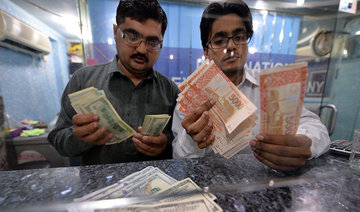
Pakistani rupee strengthens 5.4% on reports of China loan

It was the first significant strengthening in years for the Pakistani rupee, which has weakened more than 20 percent since December after four separate devaluations by the central bank. (AFP)
Updated 30 July 2018
Follow

Pakistani rupee strengthens 5.4% on reports of China loan

  • State Bank of Pakistan declines comments on reports
  • Rupee’s surge unlikely to be sustained — brokerage

KARACHI: The Pakistani rupee surged by 5.4 percent to 120.84/122.45 per dollar on Monday, following domestic media reports over the weekend that China had agreed to provide $2 billion in loans.
A State Bank of Pakistan spokesman declined to comment on Monday about the media reports, which could not be confirmed.
Monday brought the first significant strengthening in years for the rupee, which had weakened more than 20 percent since December after four separate devaluations by the central bank.
Karachi-based brokerage Intermarket Securities said weekend publication of full results of the July 25 election may have helped sentiment, as did media reports of possible inflows from Saudi Arabia.
Officials from Imran Khan’s Pakistan Tehreek-e-Insaf (PTI), or Pakistan Movement for Justice, party said they were in talks with independents and at least one other political party to form a coalition government.
But the rupee’s advance might be short-lived, given Pakistan’s economic problems, analysts said.
“Short-term flows aside, it is difficult to see the (rupee) sustaining its pullback for long,” Intermarket Securities said in a note.
Many analysts expect Pakistan to turn to the International Monetary Fund for a bailout, which is expected to be in excess of $10 billion, according to local media reports.
Fawad Khan, head of research at BMA Capital, said the rupee surge could also be due to steps by the interim government to curb imports and new rules on documentation for buying more than $500.
He agreed the election results added to optimism on lending and imports.
“The market needs political stability, and that’s what it sees right now,” Khan said.
He added that the central bank so far had not acted to discourage the rupee’s rise, “but it might step in by tomorrow by start buying dollars from open market.”
The State Bank of Pakistan is the most influential player in the thinly-traded local foreign exchange market and controls what is widely considered a managed float system. 


Saudi Arabia ranks 2nd globally in digital government, World Bank 2025 index shows


Updated 18 December 2025
Follow

Saudi Arabia ranks 2nd globally in digital government, World Bank 2025 index shows


WASHINGTON: Saudi Arabia has achieved a historic milestone by securing second place worldwide in the 2025 GovTech Maturity Index released by the World Bank.

The announcement was made on Thursday during a press conference in Washington, DC, which evaluated 197 countries.

The Kingdom excelled across all sub-indicators, earning a 99.64 percent overall score and placing it in the “Very Advanced” category.

It achieved a score of 99.92 percent in the Core Government Systems Index, 99.90 percent in the Public Service Delivery Index, 99.30 percent in the Digital Citizen Engagement Index, and 99.50 percent in the Government Digital Transformation Enablers Index, reflecting some of the highest global scores.

This includes outstanding performance in digital infrastructure, core government systems, digital service delivery, and citizen engagement, among the highest globally.

Ahmed bin Mohammed Al-Suwaiyan, governor of the Digital Government Authority, attributed this achievement to the unwavering support of the Saudi leadership, strong intergovernmental collaboration, and effective public-private partnerships.

He highlighted national efforts over recent years to re-engineer government services and build an advanced digital infrastructure, which enabled Saudi Arabia to reach this global standing.

Al-Suwaiyan emphasized that the Digital Government Authority continues to drive innovation and enhance the quality of digital services, in line with Saudi Vision 2030, supporting the national economy and consolidating the Kingdom’s transformation goals.

The 2025 GTMI data reflects Saudi Arabia’s excellence across key areas, including near-perfect scores in core government systems, public service delivery, digital citizen engagement, and government digital transformation enablers. This balanced performance places the Kingdom firmly in the “Grade A” classification for very advanced countries, demonstrating the maturity of its digital government ecosystem.

Saudi Arabia’s progress in the index has been remarkable: from 49th place in the 2020 edition, to third in 2022, and now second in 2025, confirming its status as a global leader in digital transformation and innovation.

The achievement also reflects the Kingdom’s focus on putting people at the center of digital transformation, enhancing user experience, improving government efficiency, and integrating artificial intelligence and emerging technologies across public services.