

Muslim survivors of Indian massacre shaken by citizenship test

1 / 4
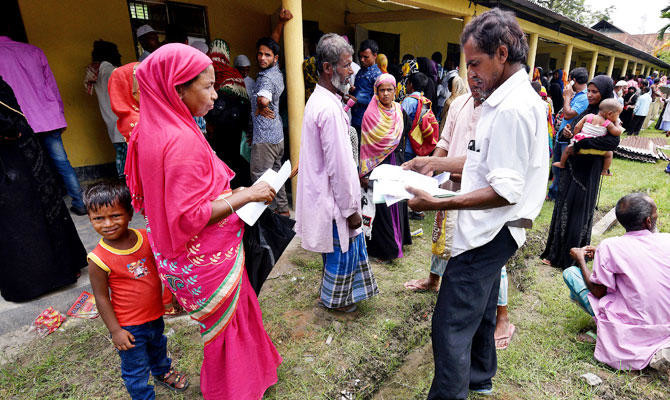
Villagers wait outside the National Register of Citizens (NRC) centre to get their documents verified by government officials, at Mayong Village in Morigaon district, in the northeastern state of Assam, India July 8, 2018. (REUTERS)
2 / 4
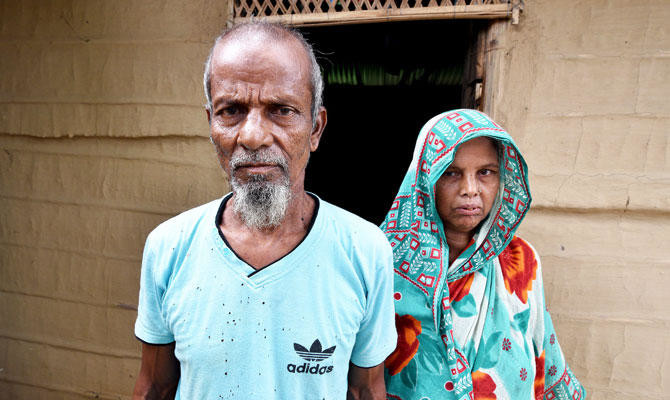
Abdul Suban, a farmer, and his wife pose for a photograph outside their home in Nellie village, in Morigaon district, in the northeastern state of Assam, India, in this July 25, 2018 photo. (REUTERS)
3 / 4
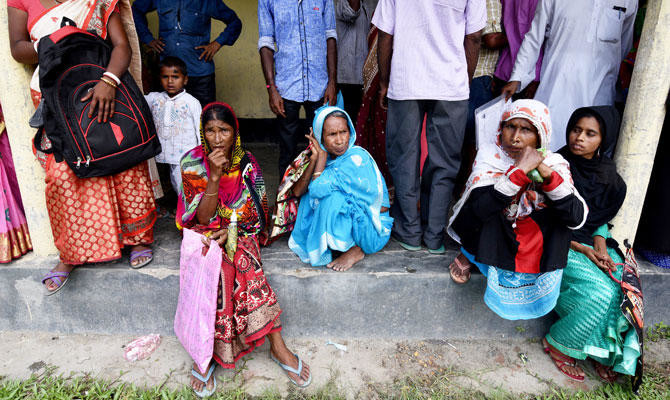
Villagers wait outside the National Register of Citizens (NRC) centre to get their documents verified by government officials, at Mayong Village in Morigaon district, in the northeastern state of Assam, India July 8, 2018. (REUTERS)
4 / 4
A woman carrying her son arrives to check her name on the draft list of the National Register of Citizens (NRC) at an NRC center in Chandamari village in Goalpara district in the northeastern state of Assam, India, January 2, 2018. (REUTERS)
Updated 29 July 2018
Follow

Muslim survivors of Indian massacre shaken by citizenship test

  • Most of Assam’s 126,000 so-called doubtful voters, and an estimated 150,000 of their descendants, would be excluded from the NRC in accordance with a court order
  • Hundreds of thousands of people fled to India from Bangladesh during its New Delhi-backed war of independence from Pakistan in the early 1970s

NELLIE, India: Thirty-six years after losing his parents, sister and a four-year-old daughter in one of India’s worst sectarian massacres, Abdul Suban says he is still trying to prove he’s a citizen of the Hindu-majority nation.
Suban is one of hundreds of thousands of Bengali-speaking Muslims categorized as “doubtful voters,” who will not find their names in a National Register of Citizens (NRC) the northeastern border state of Assam will release on Monday.
“If the government has decided to brand us foreigners what can we do?” said the 60-year-old. “NRC is trying to finish us off. Our people have died here, but we will not leave this place.”
Suban was seated with his wife at their house a few hundred meters from a vast paddy field where, in 1983, scores of people were chased down and killed by machete-armed mobs intent on hounding out Muslim immigrants. He survived by running as hard as he could and hiding behind a bush for days.
Work on the citizens’ register has accelerated under the government of Prime Minister Narendra Modi’s Hindu nationalist Bharatiya Janata Party (BJP).
With an eye on the 2019 national election, the BJP’s Hindu-first campaign has become more strident, critics say, playing to its core base with divisive programs such as the citizenship test in Assam, already a tinderbox of ethnic and religious tensions.
Elsewhere in the country’s northern heartland, lynchings of Muslim cattle traders have risen under Modi in the country where many Hindus consider cows sacred, further deepening social divides.
The BJP has denied the lynchings have any connection with it being in power. Modi has at least twice publicly spoken out against cow vigilantes.

MASS GRAVE
Several other survivors of the “Nellie Massacre,” which killed around 2,000 people from more than a dozen villages, gave accounts of burying bodies in a mass grave now partly under water.
They said they hoped the release of the NCR list on Monday would not spark further violence. Security has been tightened across Assam.
The citizenship test is the culmination of years of often violent agitations by Assamese demanding the removal of outsiders they accuse of taking jobs and cornering resources in the state of 33 million, known for its tea estates and oil fields.
“The NRC is extremely important to make the Assamese people feel protected,” said Santanu Bharali, the legal adviser to the BJP chief minister of Assam.
“It’s a moral victory. The ethnic Assamese always maintained the presence of foreigners and this will prove that.”
But the opposition Congress party and rights activists say the government is misusing the register to target even legal Indian Muslim citizens who have traditionally voted for non-BJP parties. The BJP and NRC authorities have repeatedly denied the allegations.

“COMMUNAL POLITICS“
To be recognized as Indian citizens, all residents of Assam had to produce documents proving that they or their families lived in the country before March 24, 1971.
Suban said both he and his father were born in Assam, and showed Reuters a soiled yellow document that showed his father’s name in the list of voters in Assam for 1965, before the cut-off date. The local border police declined to discuss individual cases, but said not all documents furnished by suspected illegal immigrants were valid.
Hundreds of thousands of people fled to India from Bangladesh during its New Delhi-backed war of independence from Pakistan in the early 1970s. Most of them settled in Assam, which has a near-270 km (165-mile) border with Bangladesh.
The migrants included many Hindus, but Modi has issued orders stating that no Hindu or members of other minorities from Pakistan or Bangladesh would be considered an illegal immigrant even if they entered the country without valid documents before 2014.
“BJP’s only aim is to do communal politics, including through the NRC,” Congress lawmaker Ripun Bora said.
The BJP said the NRC was monitored by the country’s top court and there was no question of discriminating on the basis of religion.
Following an outcry from rights groups over possible harassment of Muslims in Assam, Interior Minister Rajnath Singh said that the NRC exercise was being carried out in an impartial and transparent manner.
Singh also reiterated that people finding their names missing from the list could raise objections and appeals, and said that they would not be thrown into detention centers.
Rivals say that as Modi’s government faces disillusionment for failing to deliver on jobs and prosperity, it will step up religious mobilization across the country.

FEAR IN THE COUNTRYSIDE
The first draft of the NRC, released on Dec. 31, confirmed the citizenship of 19 million people, leading to jubilation for some and heartbreak among others.
The NRC office, however, told the Supreme Court this month that 150,000 people from the first list, a third of them married women, would be dropped from the next one, mainly because they provided false information or gave inadmissible documents.
Political activists in Assam say most of those are Bengali-speaking Muslims. NRC chief Prateek Hajjela, whose office has processed 66 million documents and spent nearly $180 million in the whole NRC process, declined comment on the religion of people who would be removed from the register.
“We are doing an exercise that is unprecedented and if there are course corrections which are required to be done, we will need to do that,” said Hajjela, who is guarded round-the-clock by a team of police.
Hajjela said that most of Assam’s 126,000 so-called doubtful voters, and an estimated 150,000 of their descendants, would be excluded from the NRC in accordance with a court order.
One of them is Nellie farmer Suban’s son Nabi Hussain, 28, who said he has voted in two Indian elections but now fears arrests.
“We are scared,” said Hussain, his wife looking on from their mud-coated bamboo house, their nine-month-old daughter in her arms. “Terrible things happened to our family once, we don’t want a repeat.”


Congressional candidates slam AIPAC influence in US elections

Updated 7 sec ago
Follow

Congressional candidates slam AIPAC influence in US elections

  • Democrats Joseph Ruzevich, Kina Collins, Bushra Amiwala say pro-Israel lobby group interfering in their races
  • They represent districts with large and growing Arab and Muslim constituencies

CHICAGO: Candidates in three Illinois congressional districts denounced the American Israel Public Affairs Committee at a press conference attended by Arab News on Thursday.

Democrats Joseph Ruzevich in the 6th District, Kina Collins in the 7th District and Bushra Amiwala in the 9th District accused the powerful lobby group of corrupting US elections and interfering in their races.

The three candidates, all running in the March 17 Democratic primary, represent districts with large and growing Arab and Muslim constituencies.

They said AIPAC pours millions of dollars into election campaigns to defeat candidates who criticize Israel.

“AIPAC and PACs like it do only one thing, fund negative attack ads on candidates and opponents,” said Ruzevich, whose district in the western suburbs of Chicago represents one of the largest concentrations of Arab voters in the country.

“We’d like to educate voters and candidates, offer solutions, and implore current elected officials running for reelection, and current candidates, to reject this money,” he added.

“This money is suffocating the voice of the voters. All three of us are Democrats here. It’s no longer enough to vote blue no matter who. We must make sure that we’re electing candidates who are loyal only to the people of their district.”

Ruzevich said: “AIPAC money undermines the voting rights of Americans and empowers foreign interests over American interests.

“We urge Americans to only vote for candidates who don’t accept AIPAC donations to their election campaigns.”

He added: “Americans must remain sovereign in America, and AIPAC's influence over our elections threatens that sovereignty.”

Ruzevich accused the incumbent in the 6th District, Congressman Sean Casten, of ignoring the concerns of Arab Americans there.

Casten, elected to Congress in 2019, has received hundreds of thousands of dollars in AIPAC funds. He has not responded to repeated requests for comment from Arab News.

Collins said AIPAC spent more than $500,000 to prevent her from winning election to the 7th Congressional District seat two years ago, and made false accusations that distorted her policies “all because I criticized Israel.”

She added: “I’m not for sale and our community isn’t for lease … Let’s be clear about what that money is doing … It’s being used to silence any voice that dares to stand up for human rights, for peace, and for an independent foreign policy that prioritizes people over the weapons industry.”

AIPAC “money goes way deeper than this election,” she said. “This is about a democracy that’s fragile right now. And we have the opportunity to change it.”

Amiwala said AIPAC money undermines the public debate on local issues such as funding families in need, improving education, and holding the line on rising costs for groceries, insurance and healthcare, instead pushing officials to focus on the political and financial needs of Israel’s government.

“Instead of confronting that reality, we’re finding our political system allows powerful interests to … pour extraordinary sums of money to shape American elections and American policy in the service of a foreign government,” she added.

“When you challenge AIPAC they come after you, after your family and after your allies, so you have to decide what kind of leader you’re going to be. Are you here to serve the public or to protect your own position?

“Just yesterday, Congress approved another $3.3 billion in weapons funding for Israel. Shame. Shame.”

The influence of AIPAC money has become a major controversy in this election cycle, with even Republicans speaking out for the first time.

Niki Conforti, who is running in the Republican primary in the 6th District on March 17, last week publicly said she refuses to accept AIPAC money. 

Kentucky Republican Thomas Massie is among 20 members of Congress who have denounced AIPAC’s influence over elections.

Former Republican Congresswoman Marjorie Taylor Greene said recently: “The truth is AIPAC doesn’t like it because I unapologetically represent American. AIPAC needs to register as a foreign lobbyist by US law because they’re representing the secular government of nuclear-armed Israel 100 percent.”

She added: “I believe that political donations from any foreign entity or organization can corrupt our politicians and undermine our democracy. We need to stop foreign entities from dictating our policies and influencing our elections.”

Illinois Democrat Anabel Mendoza, also running for Congress in the 7th District, last week urged voters at a press conference attended by Arab News to “vote against” candidates who accept AIPAC funds.

In the 2022 election cycle, AIPAC endorsed 365 candidates, donating $17.5 million to their campaigns.

A total of 349 out of the 535 members in the current Congress received AIPAC funds, according to data compiled from OpenSecrets.org and TrackAIPAC.com.