Palestinian protest icon Tamimi released from Israeli prison

1 / 4
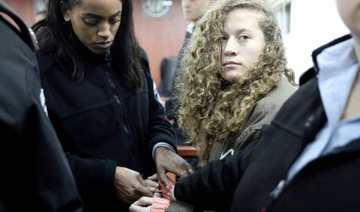
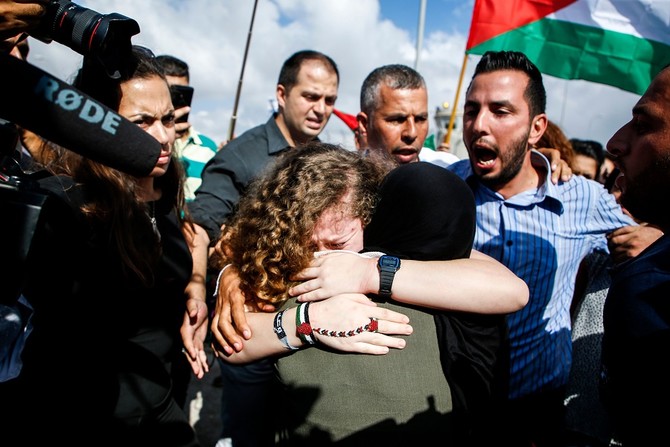
Palestinian teenager Ahed Tamimi and her mother Nareman walk out after they were released from an Israeli prison, at Nabi Saleh village in the occupied West Bank July 29, 2018. (Reuters/Mohamad Torokman)
2 / 4
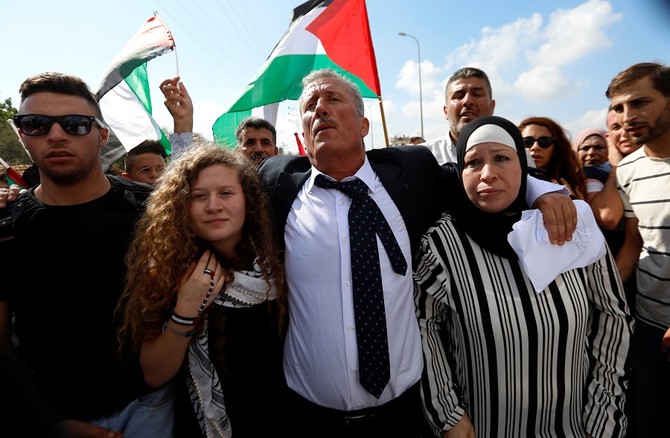
Palestinian teenager Ahed Tamimi is welcomed by relatives and supporters after she was released from an Israeli prison, at Nabi Saleh village in the occupied West Bank July 29, 2018. (Reuters/Mohamad Torokman)
3 / 4
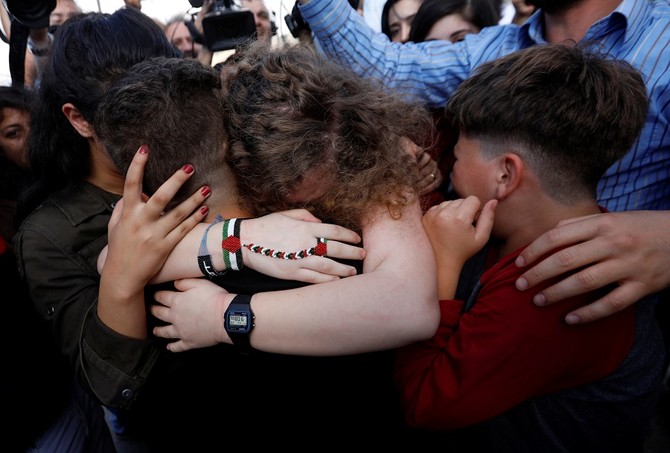
Palestinian activist and campaigner Ahed Tamimi (C) is seen upon he release from prison after an eight-month sentence for slapping two Israeli soldiers, in the West Bank village of Nabi Saleh on July 29, 2018. (AFP/Abbas Momani)
4 / 4
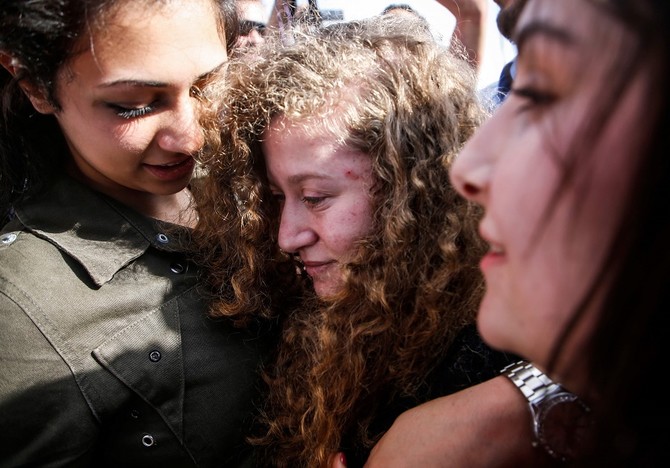
Palestinian activist and campaigner Ahed Tamimi (C) embraces a woman upon her release from prison after an eight-month sentence for slapping two Israeli soldiers, in the West Bank village of Nabi Saleh on July 29, 2018. (AFP/Abbas Momani)
Updated 29 July 2018
Follow

Palestinian protest icon Tamimi released from Israeli prison

  • She was refused bail throughout her detention and subsequent trial in an Israeli military court
  • For Palestinians she is a hero, jailed for standing up to soldiers occupying her land

NABI SALEH, West Bank: Palestinian protest icon Ahed Tamimi returned home to a hero's welcome in her West Bank village on Sunday after Israel released the 17-year-old from prison at the end of her eight-month sentence for slapping and kicking Israeli soldiers.
Ahed and her mother, Nariman Tamimi, were greeted with banners, cheers and Palestinian flags as they entered the home village of Nabi Saleh.
Ahed was arrested in December after she slapped two Israeli soldiers outside her family home. Her mother filmed the incident and posted it on Facebook, where it went viral and, for many, instantly turned Ahed into a symbol of resistance to Israel's half-century-old military rule over the Palestinians. With her unruly mop of curly light-colored hair, the Palestinian teen quickly became an icon and an internationally recognizable figure.
In Israel, however, she is seen by many as either as a provocateur, an irritation or a threat to the military's deterrence policy.
In Nabi Saleh, supporters welcomed Tamimi home with Palestinian flags planted on the roof of her home. Hundreds of chairs were set up for well-wishers in the courtyard.
"The resistance continues until the occupation is removed," Ahed said upon her return. "All the female prisoners are steadfast. I salute everyone who supported me and my case."
From her home, Ahed headed to a visit to the grave of the late Palestinian leader Yasser Arafat.
Her father, Bassem Tamimi, said he expects her to take a lead in the struggle against Israeli occupation but she is also weighing college options.
In a sign of her popularity, a pair of Italian artists painted a large mural of her on Israel's West Bank separation barrier ahead of her release. Israeli police say they were caught in the act along with another Palestinian and arrested for vandalism.
Ahed was 16 when she was arrested and turned 17 in custody. Her case has trained a spotlight on the detention of Palestinian minors by Israel, a practice that has been criticized by international rights groups. Some 300 minors are currently being held, according to Palestinian figures.
Israel captured the West Bank, Gaza and east Jerusalem in the 1967 Mideast war. Palestinians are increasingly disillusioned about efforts to establish a state in those territories, after more than two decades of failed negotiations with Israel.

NOW READ: Italians who painted portrait of Palestinian teen on Israel’s separation wall arrested

First responders enter devastated Aleppo neighborhood after days of deadly fighting

Updated 12 January 2026
Follow

First responders enter devastated Aleppo neighborhood after days of deadly fighting

  • The US-backed SDF, which have played a key role in combating the Daesh group in large swaths of eastern Syria, are the largest force yet to be absorbed into Syria’s national army

ALEPPO, Syria: First responders on Sunday entered a contested neighborhood in Syria’ s northern city of Aleppo after days of deadly clashes between government forces and Kurdish-led forces. Syrian state media said the military was deployed in large numbers.
The clashes broke out Tuesday in the predominantly Kurdish neighborhoods of Sheikh Maqsoud, Achrafieh and Bani Zaid after the government and the Syrian Democratic Forces, the main Kurdish-led force in the country, failed to make progress on how to merge the SDF into the national army. Security forces captured Achrafieh and Bani Zaid.
The fighting between the two sides was the most intense since the fall of then-President Bashar Assad to insurgents in December 2024. At least 23 people were killed in five days of clashes and more than 140,000 were displaced amid shelling and drone strikes.
The US-backed SDF, which have played a key role in combating the Daesh group in large swaths of eastern Syria, are the largest force yet to be absorbed into Syria’s national army. Some of the factions that make up the army, however, were previously Turkish-backed insurgent groups that have a long history of clashing with Kurdish forces.
The Kurdish fighters have now evacuated from the Sheikh Maqsoud neighborhood to northeastern Syria, which is under the control of the SDF. However, they said in a statement they will continue to fight now that the wounded and civilians have been evacuated, in what they called a “partial ceasefire.”
The neighborhood appeared calm Sunday. The United Nations said it was trying to dispatch more convoys to the neighborhoods with food, fuel, blankets and other urgent supplies.
Government security forces brought journalists to tour the devastated area, showing them the damaged Khalid Al-Fajer Hospital and a military position belonging to the SDF’s security forces that government forces had targeted.
The SDF statement accused the government of targeting the hospital “dozens of times” before patients were evacuated. Damascus accused the Kurdish-led group of using the hospital and other civilian facilities as military positions.
On one street, Syrian Red Crescent first responders spoke to a resident surrounded by charred cars and badly damaged residential buildings.
Some residents told The Associated Press that SDF forces did not allow their cars through checkpoints to leave.
“We lived a night of horror. I still cannot believe that I am right here standing on my own two feet,” said Ahmad Shaikho. “So far the situation has been calm. There hasn’t been any gunfire.”
Syrian Civil Defense first responders have been disarming improvised mines that they say were left by the Kurdish forces as booby traps.
Residents who fled are not being allowed back into the neighborhood until all the mines are cleared. Some were reminded of the displacement during Syria’s long civil war.
“I want to go back to my home, I beg you,” said Hoda Alnasiri.