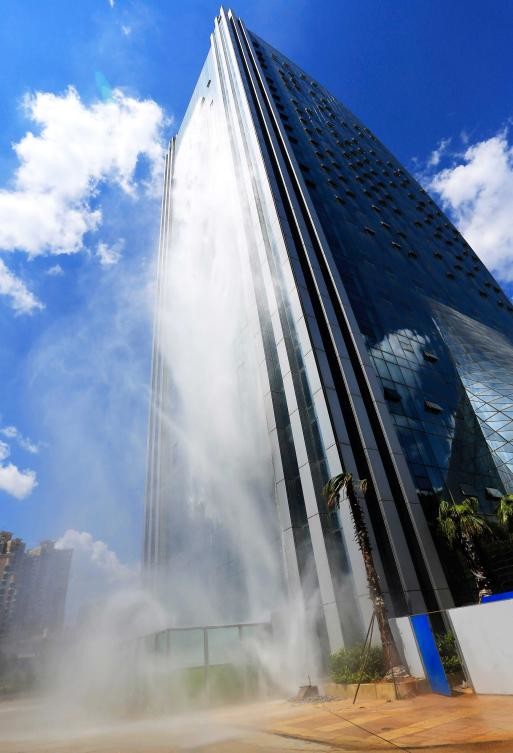
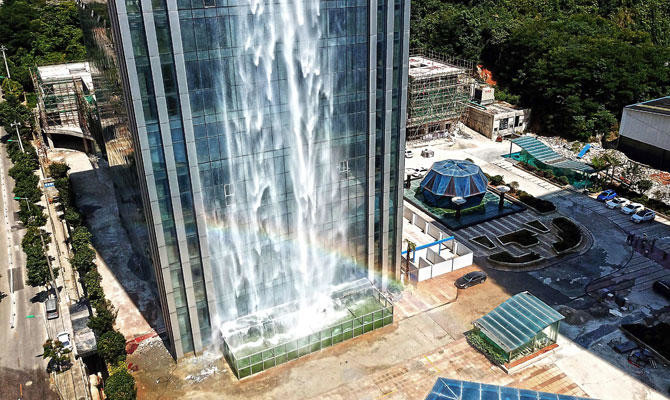
BEIJING: A skyscraper in southwest China that boasts what its owner calls the world’s largest man-made waterfall has become the latest example of over-the-top architecture to draw national ridicule.
The tower in the city of Guiyang was built with a spectacular 108-meter (350-feet) cascade tumbling down its face — but cash flow could prove a problem for the ostentatious design.
Although the Liebian International Building is not yet finished, the water feature was completed two years ago.
However it has only been turned on six times, with the owners blaming the high cost — 800 yuan ($120) per hour — of pumping water to the top of the 121-meter-high structure.
Constructed by the Ludi Industry Group, the building will house a shopping mall, offices and a luxury hotel.
Its signature artificial waterfall uses runoff, rainwater and groundwater collected in giant underground tanks.
The company says the feature pays homage to the local region’s rugged nature, but Chinese netizens have mocked the project as a waste of money.
“If they could just turn it on once every few months, the company would save on cleaning windows,” one user wrote on China’s Twitter-like social network Weibo.
China’s rapid economic growth has been accompanied by a construction boom, often including outlandish buildings that are criticized as a waste of public or shareholder funds.
The Beijing headquarters of state broadcaster China Central Television features a futuristic design now nicknamed “The Big Underpants” due to its resemblance to a giant pelvis.
Web users also noted the offices of the People’s Daily newspaper in the capital looked like a penis during construction, and last year a building on the campus of a water-resources university gained notoriety for resembling a toilet.
The issue prompted President Xi Jinping in 2014 to call for an end to what he called “weird architecture.”


China ‘waterfall’ skyscraper hit by torrent of ridicule


China ‘waterfall’ skyscraper hit by torrent of ridicule
- China’s rapid economic growth has been accompanied by a construction boom
- The company says the feature pays homage to the local region’s rugged nature, but Chinese netizens have mocked the project as a waste of money


Arts festival’s decision to exclude Palestinian author spurs boycott
- A Macquarie University academic who researches Islamophobia and Palestine, Abdel-Fattah responded saying it was “a blatant and shameless act of anti-Palestinian racism and censorship,” with her lawyers issuing a letter to the festival
SYDENY: A top Australian arts festival has seen the withdrawal of dozens of writers in a backlash against its decision to bar an Australian Palestinian author after the Bondi Beach mass shooting, as moves to curb antisemitism spur free speech concerns.
The shooting which killed 15 people at a Jewish Hanukkah celebration at Sydney’s Bondi Beach on Dec. 14 sparked nationwide calls to tackle antisemitism. Police say the alleged gunmen were inspired by Daesh.
The Adelaide Festival board said last Thursday it would disinvite Randa Abdel-Fattah from February’s Writers Week in the state of South Australia because “it would not be culturally sensitive to continue to program her at this unprecedented time so soon after Bondi.”
FASTFACTS
• Abdel-Fattah responded, saying it was ‘a blatant and shameless act of anti-Palestinian racism and censorship.’
• Around 50 authors have since withdrawn from the festival in protest, leaving it in doubt, local media reported.
A Macquarie University academic who researches Islamophobia and Palestine, Abdel-Fattah responded saying it was “a blatant and shameless act of anti-Palestinian racism and censorship,” with her lawyers issuing a letter to the festival.
Around 50 authors have since withdrawn from the festival in protest, leaving it in doubt, local media reported.
Among the boycotting authors, Kathy Lette wrote on social media the decision to bar Abdel-Fattah “sends a divisive and plainly discriminatory message that platforming Australian Palestinians is ‘culturally insensitive.'”
The Adelaide Festival said in a statement on Monday that three board members and the chairperson had resigned. The festival’s executive director, Julian Hobba, said the arts body was “navigating a complex moment.”
a complex and unprecedented moment” after the “significant community response” to the board decision.
In the days after the Bondi Beach attack, Jewish community groups and the Israeli government criticized Prime Minister Anthony Albanese for failing to act on a rise in antisemitic attacks and criticized protest marches against Israel’s war in Gaza held since 2023.
Albanese said last week a Royal Commission will consider the events of the shooting as well as antisemitism and social cohesion in Australia. Albanese said on Monday he would recall parliament next week to pass tougher hate speech laws.
On Monday, New South Wales state premier Chris Minns announced new rules that would allow local councils to cut off power and water to illegally operating prayer halls.
Minns said the new rules were prompted by the difficulty in closing a prayer hall in Sydney linked to a cleric found by a court to have made statements intimidating Jewish Australians.
The mayor of the western Sydney suburb of Fairfield said the rules were ill-considered and councils should not be responsible for determining hate speech.
“Freedom of speech is something that should always be allowed, as long as it is done in a peaceful way,” Mayor Frank Carbone told Reuters.


