

Saudi artist draws on her own life to create ‘inspiring’ studio

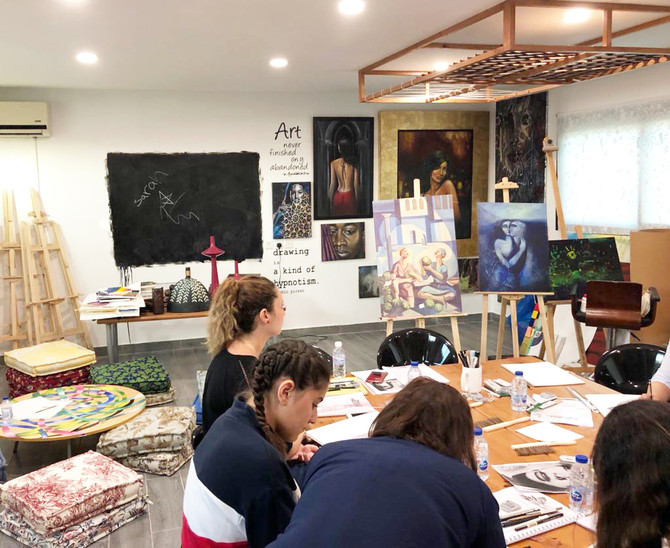
Students take to colors, paints and brushes to learn fine arts at the SK Art Studio in Jeddah. (Photo/Supplied)
Updated 25 July 2018
Follow

Saudi artist draws on her own life to create ‘inspiring’ studio

  • The young Saudi artist improved her talent and knowledge by studying art history and exploring the work of the great masters
  • She also studied at art institutes in Jeddah and at the Chelsea College of Art in London

JEDDAH: A Jeddah art studio is setting out to help people of all ages — from children to adults — unlock their artistic potential in a relaxed and inspiring environment.

Sarah Kutbi, founder of the SK Art Studio, believes art’s role is boundless and can even be a form of expressive therapy that allows people to express their emotions in a healthy way, improving their well-being.

“People are starting to realize and understand the value of art, and are investing more in the talents of the younger generation,” she told Arab News. Kutbi discovered her passion for art when she was only eight, and recalls experimenting with colors, paints and brushes.

The young Saudi artist improved her talent and knowledge by studying art history and exploring the work of the great masters. She also studied at art institutes in Jeddah and at the Chelsea College of Art in London.

Today she paints in her small studio, surrounded by art pieces created by herself and her students.

The studio opened two months ago, and now offers advanced workshops for adults and classes for beginners of all ages. The studio holds several workshops a month, with classes of two or three hours for adults and children aged 6 and above.

“I believe that art has no age, but I like to focus on younger talents as I believe they have potential that needs to be grasped and developed early,” Kutbi said.

She came up with the idea for the studio a few years ago and, with support from friends and family, was able to bring it to life.

“I tried to create a comfortable and inspiring space with all the necessary tools to help people learn and explore.” Kutbi produces paintings on canvas using oil, charcoal and acrylic paint. She said that her style is never constant and always changing.

“I haven’t reached the maturity level I’m aiming for. I believe, as the great Leonardo da Vinci said: ‘Art is never finished, only abandoned.’ Right now I find myself more fascinated with pop serialism.”

At the studio, Kutbi joins several professional trainers and art coaches to teach students different styles of art, such as portraits, abstracts and nature.

The creative scene in Saudi Arabia is witnessing a renaissance with new art galleries opening, and art events and exhibitions encouraging artists such as Kutbi to display their work.

The artist believes that there is a lot of hidden talent in the country that she hopes her studio can help uncover.

“This is the reason I opened the studio. I want to help people discover their talents from an early age. I recognize from personal experience that one needs to develop this gift by learning different techniques and approaches, which I don’t believe can be taught in school,” she said.

In the future, Kutbi hopes to expand the studio and create a hub for the artistic community, a place where people can meet and celebrate their creativity.


How science is reshaping early years education 

Updated 27 December 2025
Follow

How science is reshaping early years education 

DUBAI: As early years education comes under renewed scrutiny worldwide, one UAE-based provider is making the case that nurseries must align more closely with science.

Blossom Nursery & Preschool, which operates 32 locations across the UAE, is championing a science-backed model designed to close what it sees as a long-standing gap between research and classroom practice.

“For decades, early years education has been undervalued globally — even though science shows the first five years are the most critical for brain development,” said Lama Bechara-Jakins, CEO for the Middle East at Babilou Family and a founding figure behind Blossom’s regional growth, in an interview with Arab News.

Lama Bechara-Jakins is the CEO for the Middle East at Babilou Family and a founding figure behind Blossom’s regional growth. (Supplied)

She explained that the Sustainable Education Approach was created to address “a fundamental gap between what we know from science and what actually happens in nurseries.”

Developed by Babilou Family, the approach draws on independent analysis of research in neuroscience, epigenetics, and cognitive and social sciences, alongside established educational philosophies and feedback from educators and families across 10 countries. The result is a framework built around six pillars; emotional and physical security, natural curiosity, nature-based learning, inclusion, child rhythms, and partnering with parents.

Two research insights, Bechara-Jakins says, were particularly transformative. “Neuroscience shows that young children cannot learn until they feel safe,” she said, adding that stress and inconsistent caregiving can “literally alter the architecture of the developing brain.” 

Equally significant was evidence around child rhythms, which confirmed that “pushing children academically too early is not just unhelpful — it can be counterproductive.”

Feedback from families and educators reinforced these findings. Across regions, common concerns emerged around pressure on young children, limited outdoor time and weak emotional connections in classrooms. What surprised her most was that “parents all sensed that something was missing, even if they couldn’t articulate the science behind it.”

At classroom level, the strongest body of evidence centres on secure relationships. Research shows that “secure attachments drive healthy brain development” and that children learn through trusted adults. At Blossom, this translates into practices such as assigning each child “one primary educator,” prioritising calm environments, and viewing behaviour through “a neuroscience lens — as stress signals, not misbehaviour.”

Bechara-Jakins believes curiosity and nature remain overlooked in many early years settings, despite strong evidence that both accelerate learning and reduce stress. In urban centres such as Dubai, she argues, nature-based learning is “not a luxury. It is a developmental need.” 

For Blossom, this means daily outdoor time, natural materials, gardening, and sensory play — intentional choices aimed at giving children what science says they need to thrive.