FaceOf: Ridwaan Jadwat, Australian ambassador-designate to Saudi Arabia

Ridwaan Jadwat
Updated 23 July 2018
Follow

FaceOf: Ridwaan Jadwat, Australian ambassador-designate to Saudi Arabia

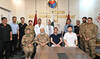
Ridwaan Jadwat is the Australian ambassador-designate to the Kingdom. On Monday, he called on Saudi Foreign Minister Adel Al-Jubeir and handed over copies of his credentials to him in preparation for presenting them to King Salman.

Jadwat is a senior career officer associated with Australia’s Department of Foreign Affairs and Trade (DFAT). According to his profile available of the Australian government website, he was most recently on secondment as assistant secretary and head of policy, ASEAN-Australia Summit 2018 Taskforce in the Department of the Prime Minister and Cabinet (PM&C).

Jadwat holds a Bachelor of Laws (Honors) and a Bachelor of Economics (Social Sciences) from the University of Sydney.

He has previously served overseas as the counselor, Australian High Commission, Kuala Lumpur; and deputy head of mission, Australian Embassy, Tehran. In Canberra, he has served as assistant secretary, South and Southeast Asia, Americas and Middle East Branch, PM&C; and director, ASEAN and EAS Section, DFAT.

Jadwat has earlier served as the second secretary at the Australian Embassy in Riyadh. In 2002, he represented Australia and its Muslim population at the washing of the Holy Kaaba ceremony in Makkah.

“It was the fourth time that I have been granted the privilege of entering the inner sanctum of the Kaaba and performing prayers inside Islam’s holiest site. It remains a vivid and deeply moving experience,” he wrote in an article published in Arab News on Oct. 27, 2002.

Saudi Arabia and Australia enjoy excellent ties. The two sides are working together to develop human resources. The Technical and Vocational Training Corp. of Saudi Arabia is working on several projects in collaboration Australian institutions to provide young Saudis with technical training.


National Center for Wildlife releases more than 60 wildlife species at King Khalid Royal Reserve

Updated 22 sec ago
Follow

National Center for Wildlife releases more than 60 wildlife species at King Khalid Royal Reserve

The Imam Abdulaziz bin Mohammed Royal Reserve Development Authority, in cooperation with the National Center for Wildlife, released more than 60 wildlife species at King Khalid Royal Reserve today near Riyadh, the Saudi Press Agency reported.

This initiative, according to the agency, is part of programs to reintroduce endangered species to their natural habitats, reflecting the integrated national efforts to protect wildlife and promote its sustainability.

“Releasing wildlife into the King Khalid Royal Reserve enhances biodiversity and restores natural habitats within the reserve. This contributes to providing a safe natural environment that supports the stability of wildlife and facilitates its adaptation to its natural habitats”, said the authority’s CEO, Talal Al-Hariqi.

He added that such efforts align with the National Strategy for Environmental Conservation and fulfill one of the objectives of the Kingdom’s Vision 2030, which aims to create an attractive environment that contributes to improving quality of life and promoting sustainability.

He also said that the collaboration with the National Center for Wildlife Development is a model for institutional integration in implementing reintroduction programs. This is achieved by unifying scientific and technical expertise and applying global best practices in wildlife conservation, thus ensuring the success of these programs and the long-term sustainability of their results.

Ziad bin Abdulaziz Al-Tuwaijri, director-general of projects and operations at the authority, said that the King Khalid Royal Reserve has released more than 60 wildlife species, including Arabian oryx, Arabian hares, and Arabian gazelles. This initiative aims to enrich the reserve’s biodiversity, contribute to restoring ecological balance through the reintroduction of endangered animals, promote sustainability, and support and revitalize ecotourism.

He said that over past years, the authority released more than 300 wild animals of different types, including reptiles, mammals, and local birds, all of which are classified on the International Union for Conservation of Nature Red List as species that are vulnerable or threatened with extinction.

He said that animals released in the King Khalid Royal Reserve are subject to periodic and continuous monitoring through field studies and modern monitoring techniques, such as surveillance cameras and tracking collars, where many natural births and herd growth have been recorded, reflecting the success of the release and reintroduction programs.