

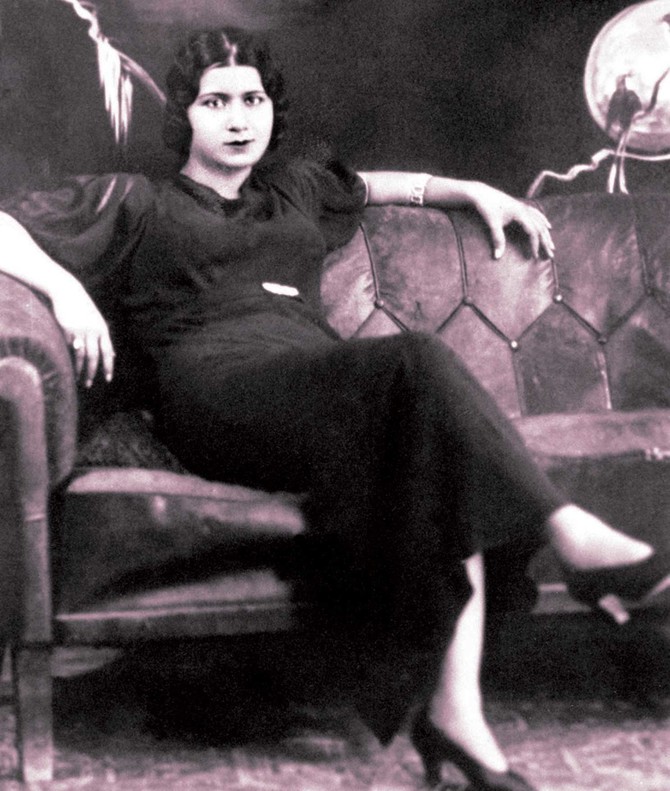
The enduring melodic magic of Umm Kulthum, Star of the Orient

1 / 3
Egyptian actress Umm Kulthum singing on Cairo’s Voice of Arabs radio show. (Getty Images)
2 / 3
The legendary Umm Kulthum during an interview in May 1970. This rare picture, along with four letters, were uncovered by Huda Al-Tabei, wife of the late Egyptian journalist Mohammed Al-Tabei, 24 years after his death. (AFP/Getty Images)
3 / 3
Umm Kulthum. This rare picture, along with four letters, were uncovered by Huda Al-Tabei, wife of the late Egyptian journalist Mohammed Al-Tabei, 24 years after his death. (AFP/Getty Images)
Updated 20 July 2018
Follow

The enduring melodic magic of Umm Kulthum, Star of the Orient

  • She was blessed with great range and virtuosity, and had the ability to link musical improvisation with the lyrics she was singing
  • For the Lebanese singer Tania Saleh, who has been a lifelong fan of Umm Kulthum, the Egyptian icon represents more than just artistic greatness

DUBAI: When the Egyptian singer Umm Kulthum took to the stage at Lebanon’s Baalbeck International Festival for the last time in 1970, she was at the end of a career that had enraptured the Arab world. Over the course of almost 50 years, her voice had captured the collective imagination, brought pleasure to millions, and become a powerful symbol of Arab nationalism.
Now, 48 years later, her music is to grace the festival’s stage once again, with this year’s program kicking off on Friday, July 20 with “Baalbeck Remembers Umm Kulthum,” a 90-minute homage to the ‘Star of the Orient.’
“Everything about Umm Kulthum stands out,” says the Egyptian composer and conductor Hisham Gabr, who is to lead the celebrations. “Her voice, her mastery, her ability to improvise, and the way that she uses this incredible array of nuances in her voice to express the tiniest and slightest details of the words that she’s singing. She reincarnates melody, reinvents it in so many ways that are quite stunning and amazing. And yet she never loses track of what those words mean and how she can convey and augment those meanings to her listeners.”
The music of Umm Kulthum was formed in what is now an unrecognizable era — a golden age of Arab musical endeavor epitomized by Umm Kulthum and other greats including Mohammed Abdel Wahab and Abdel Halim Hafez. She mesmerized audiences, singing songs such as “Enta Omri” and “Al Atlal” with such raw emotional power that they continue to hold sway over great swathes of the Arab world.
She was blessed with great range and virtuosity, and had the ability to link musical improvisation with the lyrics she was singing. During her live radio broadcasts, which traditionally took place on Thursday evenings, she would often sing the same melody in a variety of different ways, performing three or four songs over the course of a few hours and bringing cities to a standstill.

These songs covered universal themes of love, loss and desire, although it was her early religious training that enabled such immaculate and nuanced diction.
“I had a very distant admiration of Umm Kulthum and didn’t really connect to her and what she represents until later in life,” admits Gabr. “I was more of a normal Egyptian fan of Umm Kulthum who would listen to her in cafés and stuff like that.
“She didn’t become a part of my life until later on, when I started studying her work to orchestrate it. And I was completely blown away with my new finding — this Umm Kulthum and her music — and felt that she really talked to me, and talks about me. I think she owns her listeners in a way that no artist has ever achieved in their life.”
Despite his admiration for the singer, however, the fact that this year’s Baalbeck concert is happening at all is as much down to fate as anything else. As Gabr says, he “bumped into it” by chance, having met the festival’s deputy director, Maya Halabi, in China last November. Halabi told Gabr that the festival was looking to produce a tribute to Umm Kulthum, but in a way that had not been done before.
“I suggested that Umm Kulthum’s legacy has been dealt with in so many ways, but until today she has never been put into an orchestral form,” says Gabr. “Why don’t we try to do that?”
So they did. An array of talent has been assembled, including the Egyptian singers Mai Farouk and Marwa Nagy, and the Lebanese National Orchestra for Oriental-Arabic Music. They will perform two medleys of Umm Kulthum’s most famous songs, including “Aghadan Alkak,” “Inta El Hob” and “Alf Layla Wa Layla.”
Umm Kulthum was born in the village of Tamay e-Zahayra in the Nile Delta. The daughter of an Imam, she was taught to recite the Quran and sang with her father at village weddings before heading to Cairo, where she would find worldwide fame. Even Western singers such as Bob Dylan and Maria Callas have proclaimed to be admirers.
For the Lebanese singer Tania Saleh, who has been a lifelong fan of Umm Kulthum, the Egyptian icon represents more than just artistic greatness. She is a representative of female empowerment and revolution.

“Even though she was raised in an extremely poor family, she succeeded in imposing her talent in her native town (as a religious chants singer, accompanied by her father, who started her career disguised as a boy) and later in Cairo where she took matters into her own hands,” says Saleh. “She was self-taught, but very soon she had the ability to choose the poems of the best songwriters of her time, and of historical masters from the region, also discovering creative composers from her generation and the younger generations as well. 
“She and Abdel Wahab carried the legacy of Sayed Darwish, who gave Egyptian song a new dimension by making it about the real stories of people’s everyday realities, and by introducing the orchestra to the traditional unison of oud and voice. She put her listeners in a trance and kept them ‘msaltanin,’ as we say in Arabic, until her last breath in 1975.”
Umm Kulthum performed at Baalbeck on two other occasions, in 1966 and 1968. All three of her appearances were understandably sold out. This year’s concert is to be held on the steps of the Temple of Bacchus and limited-edition posters of her 1970 performance will be on sale at the event.
“Umm Kulthum’s is a timeless and eternal legacy,” says Gabr. “She was present, is present, and will always be present as long as there are people speaking Arabic. Her legacy is unique and unparalleled and I don’t think I would be exaggerating if I said that Umm Kulthum’s legacy alone, in so many ways, surpasses all other singers combined.”


How Netflix won Hollywood’s biggest prize, Warner Bros Discovery

Updated 06 December 2025
Follow

How Netflix won Hollywood’s biggest prize, Warner Bros Discovery

  • Board rejected Paramount’s $30 a share bid amid funding concerns, sources say
  • Warner Bros board met daily before accepting Netflix’s binding offer

LOS ANGELES/NEW YORK: What started as a fact-finding mission for Netflix culminated in one of the biggest media deals in the last decade and one that stands to reshape the global entertainment business landscape, people with direct knowledge of the deal told Reuters. Netflix announced on Friday it had reached a deal to buy Warner Bros Discovery’s TV, film studios and streaming division for $72 billion. Although Netflix had publicly downplayed speculation about buying a major Hollywood studio as recently as October, the streaming pioneer threw its hat in the ring when Warner Bros Discovery kicked off an auction on October 21, after rejecting a trio of unsolicited offers from Paramount Skydance .
Details of Netflix’s plan and the Warner Bros board’s deliberations, based on interviews with seven advisers and executives, are reported here for the first time.
Initially motivated by curiosity about its business, Netflix executives quickly recognized the opportunity presented by Warner Bros, beyond the ability to offer the century-old studio’s deep catalog of movies and television shows to Netflix subscribers. Library titles are valuable to streaming services as these movies and shows can account for 80 percent of viewing, according to one person familiar with the business.
Warner Bros’ business units — particularly its theatrical distribution and promotion unit and its studio — were complementary to Netflix. The HBO Max streaming service also would benefit from insights learned years ago by streaming leader Netflix that would accelerate HBO’s growth, according to one person familiar with the situation. Netflix began flirting with the idea of acquiring the studio and streaming assets, another source familiar with the process told Reuters, after WBD announced plans in June to split into two publicly traded companies, separating its fading but cash-generating cable television networks from the legendary Warner Bros studios, HBO and the HBO Max streaming service.
Netflix and Warner Bros did not reply to requests for comment.
The work intensified this autumn, as Netflix began vying for the assets against Paramount and NBCUniversal’s parent company, Comcast.
Warner Bros kicked off the public auction in October, after Paramount submitted the first of three escalating offers for the media company in September. Sources familiar with the offer said Paramount aimed to pre-empt the planned separation because the split would undercut its ability to combine the traditional television networks businesses and increase the risk of being outbid for the studio by the likes of Netflix.
Around that time, banker JPMorgan Chase & Co. was advising Warner Bros Discovery CEO David Zaslav to consider reversing the order of the planned spin, shedding the Discovery Global unit comprising the company’s cable television assets first. This would give the company more flexibility, including the option to sell the studio, streaming and content assets, which advisers believed would draw strong interest, according to sources familiar with the matter.
Executives for the streaming service and its advisory team, which included the investment banks Moelis & Company, Wells Fargo and the law firm Skadden, Arps, Slate, Meagher & Flom, had been holding daily morning calls for the past two months, sources said. The group worked throughout Thanksgiving week — including multiple calls on Thanksgiving Day — to prepare a bid by the December 1 deadline.
Warner Bros’ board similarly convened every day for the last eight days leading up to the decision on Thursday, when Netflix presented the final offer that sources described as the only offer they considered binding and complete, sources familiar with the deliberations said.
The board favored Netflix’s deal, which would yield more immediate benefits over one by Comcast. The NBCUniversal parent proposed merging its entertainment division with Warner Bros Discovery, creating a much larger unit that would rival Walt Disney. But it would have taken years to execute, the sources said.
Comcast declined to comment.
Although Paramount raised its offer to $30 per share on Thursday for the entire company, for an equity value of $78 billion, according to sources familiar with the deal, the Warner Bros board had concerns about the financing, other sources said.
Paramount declined comment.
To reassure the seller over what is expected to be a significant regulatory review, Netflix put forward one of the largest breakup fees in M&A history of $5.8 billion, a sign of its belief it would win regulatory approval, the sources said. “No one lights $6 billion on fire without that conviction,” one of the sources said.
Until the moment late on Thursday night when Netflix learned its offer had been accepted — news that was greeted by clapping and cheering on a group call — one Netflix executive confided that they thought they had only a 50-50 chance.