SoftBank’s Son says Japan is ‘stupid’ to disallow ride-sharing

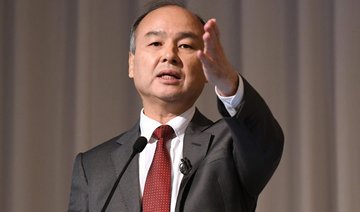
“A country that gives up on the future has no future,” SoftBank Group CEO Masayoshi Son told attendees at a SoftBank World event. (Reuters)
Updated 19 July 2018
Follow

SoftBank’s Son says Japan is ‘stupid’ to disallow ride-sharing

  • ‘Ride-sharing is prohibited by law in Japan. I can’t believe there is still such a stupid country’
  • SoftBank and its nearly $100 billion Vision Fund have invested in ride-sharing firms Uber, Didi, Ola and Grab, as well as in other technology companies

TOKYO: SoftBank Group Corp. Chief Executive Masayoshi Son blasted Japan on Thursday for not allowing ride-sharing services, calling it “stupid” and saying the country was lagging overseas rivals in areas such as artificial intelligence (AI).
“Ride-sharing is prohibited by law in Japan. I can’t believe there is still such a stupid country,” Son said at an annual company event aimed at customers and suppliers.
The comments reflect Son’s frustration with Japan where he built SoftBank’s domestic telecoms business, the cash engine that has powered his investments. The group has, however, focused its growing range of technology investments overseas.
Son has also been highly critical of the government previously when SoftBank was still a fledgling telecoms service trying to break up a cozy duopoly in Japan.
“A country that gives up on the future has no future,” Son told attendees at the SoftBank World event, saying Japanese business is lagging behind countries such as the United States and China in employing AI.
Japan outlaws non-professional drivers from transporting paying customers on safety grounds and the country’s taxi industry lobby has vigorously opposed deregulation.
Its strict rules have confined ride-sharing firms to providing limited services, with SoftBank and China’s Didi Chuxing saying on Thursday they will trial a taxi-hailing service — matching users to pre-existing taxi operators — in Osaka beginning autumn of 2019. Uber is also piloting a taxi-hailing service.
When asked for a response to Son’s comments, a spokesman for the Ministry of Land, Infrastructure, and Transport said that an issue with ride-sharing services was that while the driver was in charge of transporting passengers, it was unclear who was in charge of maintenance and operation.
“The ministry believes that offering these services for a fee poses problems from the points of both safety and user protection, and careful consideration is necessary,” he said.
Ride-sharing is not the only service in Japan feeling the impact of government restrictions. Strict new rules on home-sharing came into force last month that have radically reduced the number of lettings on sites such as Airbnb Inc.
The curbs on Japan’s nascent sharing economy come despite a rapid rise in the number of inbound tourists likely to access such sharing services, and at a time when Japan is wanting to show its international face ahead of hosting the Rugby World Cup next year and the Summer Olympics in 2020.
While Son, an ethnic Korean born in Japan, has at times criticized the Japanese government, he can also be politically suave. He has praised US President Donald Trump with warm words and pledged to invest billions of dollars and create thousands of jobs in the United States.
SoftBank and its nearly $100 billion Vision Fund have invested in ride-sharing firms Uber Technologies Inc, Didi, India’s Ola and Southeast Asia’s Grab, as well as in other technology companies.
The event on Thursday saw presentations from executives at portfolio companies including Didi, General Motors’ autonomous vehicle unit Cruise and India digital payments firm Paytm E-Commerce Pvt Ltd.
Artificial intelligence is the common thread linking these companies, Son said, with that technology in the future able drive vehicles, diagnose diseases and power financial services.


Saudi-French cooperation to localize veterinary vaccine manufacturing

Updated 16 sec ago
Follow

Saudi-French cooperation to localize veterinary vaccine manufacturing

RIYADH: In the presence of sector leaders, the National Livestock and Fisheries Development Program signed a memorandum of understanding with French company Ceva under the patronage of Minister of Environment, Water and Agriculture Abdulrahman bin Abdulmohsen Al-Fadhli, who also chairs the program’s board.

The agreement aims to localize vaccine manufacturing, transfer technology and technical expertise, and expand the industrial and commercial production of veterinary vaccines across the Kingdom.

According to the MoU, the two parties will work to achieve high efficiency in mass production scale-up and establish a clear path for sustainable commercial operation that meets the needs of the local and national market, as well as strengthen the biosecurity and food security system.

The MoU also includes the development and modernization of messenger RNA vaccine technologies, along with joint research and development of a Middle East Respiratory Syndrome vaccine for camels. This involves designing, evaluating, and developing vaccines specifically tailored to combat the virus.

The agreement also covers the development of a rabies vaccine and related solutions, as well as supporting national efforts to control the disease through vaccine provision, capacity building, and the implementation of integrated prevention strategies.

The collaboration between the program and Ceva aims to meet the needs of the poultry vaccine market in the Kingdom, currently estimated at around SR750 million ($199 million).

The company will work to cover approximately 30 percent of this market with an initial investment of around SR250 million.

With continued government support for poultry projects and increased production in the sector, the market is expected to grow at a rate exceeding 10 percent annually, reaching approximately SR1.25 billion by 2030.

The addition of the world’s leading poultry vaccine manufacturer to Biotech Park highlights the program’s key role in developing new industries within the livestock and fisheries sector.

It also highlights the program’s commitment to building international partnerships with global companies, organizations, research centers, and universities to support advanced biotechnology industries and attract high-quality investments. It also seeks to create new economic sectors based on biotechnology, enhance veterinary health security, and support the sustainable economic development of the livestock sector, as well as empower national and emerging companies and provide advanced research and industrial infrastructure.

This will solidify the Kingdom’s position as a global hub for biotechnology industries and the development of national capabilities.

Ceva is the first international partner to join Biotech Park, the future veterinary biotechnology city launched by the program in Dhurma Governorate. The city is the world’s first specialized and fully integrated hub for veterinary biotechnology, serving as a benchmark for sector development and a platform supporting markets across the Kingdom, the Gulf, the Middle East, Africa and beyond.

The signing of Ceva is a significant step, given its position as the world’s leading manufacturer of poultry vaccines and medicines, and one of the most prominent international companies in the field of biotechnology.

The MoU aims to localize the veterinary vaccine industry, ensuring its compatibility with the strains of poultry diseases prevalent in Saudi Arabia. This includes the transfer of technology and technical expertise from Ceva, along with the implementation of specialized training programs to guarantee that manufacturing facilities comply with international Good Manufacturing Practice standards.