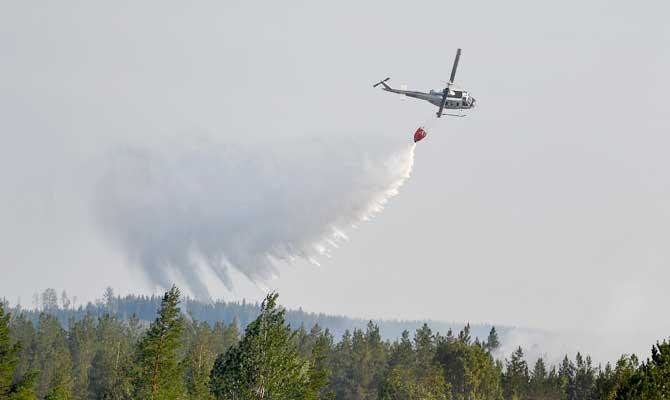
HELSINKI: Sweden says it has mobilized all available resources to put out dozens of wildfires raging across the country.
The Swedish Civil Contingencies Agency said Wednesday that two Canadair CL-415 water-bombing planes on loan from Italy joined the firefighting efforts that included helicopters from Norway.
Swedish public broadcaster SVT says an estimated 40 wildfires are burning mostly in Sweden, mostly in the central and western parts of the country, but also in the Arctic north.
Thousands of people have been warned to remain inside with the windows shut to avoid breathing smoky air.
The Nordic region of Europe has experienced an intense heat wave in the past week. Temperatures reached over 32 degrees Celsius (90 F) throughout Finland, Norway and Sweden. The weather also has been dry.

Dozens of wildfires rage in Sweden amid Nordic heat wave
- Thousands of people have been warned to remain inside with the windows shut to avoid breathing smoky air
Farmers block Paris streets to protest planned free trade agreement with South American nations
- The protest piles yet more pressure on President Emmanuel Macron and his government, a day before EU member states are expected to vote on the trade accord
PARIS: French farmers blocked roads into Paris and landmarks such as the Arc de Triomphe on Thursday, in protest against a sweeping trade deal the EU is due to sign with South American nations.
Farmers from the right-wing Coordination Rurale union called for the protests in Paris amid fears the planned free trade agreement with the Mercosur bloc will flood the EU with cheap food imports.
They also protested high costs and excessive local regulations and demanded an end to a government policy of culling herds of cows in response to a highly contagious cattle disease, which they consider unwarranted.
“We are between resentment and despair. We have a feeling of abandonment, with Mercosur being an example,” Stephane Pelletier, a senior member of the Coordination Rurale union, told Reuters beneath the Eiffel Tower.
The farmers overran police checkpoints to enter the city, driving along the Champs Elysees avenue and blocking the road around the Arc de Triomphe before dawn, before gathering in front of the National Assembly.
National Assembly President Yael Braun-Pivet was booed and jostled when she stepped outside of the assembly’s gates to talk with the Coordination Rurale protesters.
Dozens of tractors obstructed highways leading into the capital ahead of the morning rush hour, including the A13 leading into Paris from the western suburbs and Normandy, causing 150 km of traffic jams, the transport minister said.
Farmers from the FNSEA and young farmers’ unions joined them later at the Eiffel Tower in a calm demonstration.
“We’re going to import products from the rest of the world that don’t meet our standards — that’s not possible, that’s unacceptable. So we’re staying mobilized, we’re carrying on,” Arnaud Rousseau, president of the FNSEA farm union, told reporters, referring to the Mercosur deal.
The protest piles yet more pressure on President Emmanuel Macron and his government, a day before EU member states are expected to vote on the trade accord. Without a majority in parliament, any policy misstep by Macron risks a perilous vote of no confidence in the chamber.
France has long been a stiff opponent of the trade deal.
Even though Paris has won significant last-minute concessions, the trade deal is a political hot potato for the government, with municipal elections in March and the far-right polling strongly ahead of the 2027 elections to replace Macron.
“This treaty is still not acceptable,” government spokesperson Maud Bregeon told France Info radio.
French Farm Minister Annie Genevard said on Wednesday that, even if EU members backed the accord, France would continue to fight against it in the European Parliament, whose approval will also be required for the agreement to enter into force.
This week, the European Commission proposed making €45 billion of EU funding available to farmers earlier in the bloc’s next seven-year budget and agreed to cut import duties on some fertilizers in a bid to win over countries wavering in their support for Mercosur.
The deal is backed by countries such as Germany and Spain, and the Commission appeared closer to winning Italy’s backing.
Rome’s support for the deal would mean the EU had the votes needed to approve the trade accord even without French support.
A vote on the accord is expected on Friday.