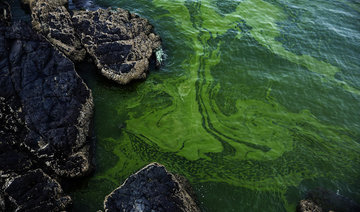
Expanding ‘dead zone’ in Arabian Sea raises climate change fears

Fishermen carry bluefin trevally fish locally known as Vatta as a cargo ship carrying containers moves in the Arabian Sea in Kochi, India, May 9, 2018. (File Photo: Sivaram V/Reuters)
Updated 17 July 2018
Follow

Expanding ‘dead zone’ in Arabian Sea raises climate change fears

  • Dead zones are areas of the sea where the lack of oxygen makes it difficult for fish to survive
  • The findings of the 2015 to 2016 study were released in April and showed the Arabian Sea dead zone had worsened in size and scope

ABU DHABI: In the waters of the Arabian Sea, a vast “dead zone” the size of Scotland is expanding and scientists say climate change may be to blame.
In his lab in Abu Dhabi, Zouhair Lachkar is laboring over a colorful computer model of the Gulf of Oman, showing changing temperatures, sea levels and oxygen concentrations.
His models and new research unveiled earlier this year show a worrying trend.
Dead zones are areas of the sea where the lack of oxygen makes it difficult for fish to survive and the one in the Arabian Sea is “is the most intense in the world,” says Lachkar, a senior scientist at NYU Abu Dhabi in the capital of the United Arab Emirates.
“It starts at about 100 meters and goes down to 1,500 meters, so almost the whole water column is completely depleted of oxygen,” he told AFP.
Dead zones are naturally occurring phenomena around the world, but this one appears to have mushroomed since it was last surveyed in the 1990s.
Lachkar and other researchers are worried that global warming is causing the zone to expand, raising concerns for local ecosystems and industries including fishing and tourism.
The discovery was made possible by the use of robotic divers, or “sea gliders,” deployed in areas researchers could not access — an undertaking by Britain’s University of East Anglia in collaboration with Oman’s Sultan Qaboos University.
The findings of the 2015 to 2016 study were released in April and showed the Arabian Sea dead zone had worsened in size and scope.
And unlike in the 1996 measurements, when the lowest levels were limited to the heart of the dead zone — midway between Yemen and India — now the dead zone extends across the sea.
“Now everywhere is the minimum, and it can’t go much lower,” the lead researcher Bastien Queste told AFP.
At NYU Abu Dhabi, Lachkar explains the Arabian Sea dead zone appears to be stuck in a cycle where warming seas are depleting the oxygen supply which in turn is reinforcing the warming.
This, he says, “can be very scary for climate.”
Ports from Mumbai to Muscat look out onto the Arabian Sea, making it a critical body of water.
These coastal hubs and the populations beyond them will be affected by further expansion of the dead zone.
Fish, a key source of sustenance in the region, may find their habitats compressed from deep underwater to just beneath the surface, putting them at risk of overfishing and extreme competition.
“When oxygen concentration drops below certain levels, fish cannot survive and you have massive death,” says Lachkar.
To carry out his data-heavy modelling, Lachkar relies on a sprawling supercomputer center which cost several million dollars to set up — a testament to local priorities to research climate change.
The UAE in 2016 renamed its Ministry of Environment and Water as the Ministry of Climate Change and Environment, further evidence of the regional desire to meet this global challenge head-on.
“I think it is an important topic for different reasons, not only scientific reasons, but also economic,” says Lachkar from his Center for Prototype and Climate Modelling.
“Fishing is an important source of revenue and it’s directly impacted by the oxygen,” he said.
Even coral reefs and, by extension, tourism could be affected.
Down the hall from his research facility is the complementary Center for Global Sea Level Change, where researchers like Diana Francis study the worldwide impact of the problem.
The issue was at the top of the global agenda in 2015, when the world hammered out a deal in Paris to cut carbon emissions.
But the landmark agreement received a blow last year, when President Donald Trump announced he would be pulling the United States out of the accord.
“It is very disappointing, because a major country is not putting effort in the same direction as the others,” says Francis of the decision.
“But our role is to stick to science, be pragmatic and try to advance our understanding of the climate,” she says.
“Politics change over time,” Francis tells AFP. “But science does not.”


Aoun reassures Lebanon that risk of war is ‘fading’ in year-end message

Addressing Internal Security officials, Aoun said that the “situation is among the best.”
Updated 10 sec ago
Follow

Aoun reassures Lebanon that risk of war is ‘fading’ in year-end message

BEIRUT: Lebanese President Joseph Aoun on Wednesday sought to reassure citizens in his year-end address, saying “the overall atmosphere remains positive and the risk of war is fading,” amid widespread concern over a possible Israeli escalation against Hezbollah.

Fear of renewed attacks followed Israeli criticism of a Lebanese Army weapons-confiscation operation that is set to enter its second phase at the start of the 2026. The plan include the expansion from areas north of the Litani River to the Awali River, after the first phase was completed south of the Litani.

President Aoun cautioned that this does not mean “completely eliminating the risk of war,” stressing that “work is underway with various friendly and brotherly countries to completely neutralize the threat of war.”

Addressing Internal Security officials, Aoun said that the “situation is among the best,” noting that this assessment has been echoed by foreign visitors to Lebanon, despite the strain caused by large numbers of Syrian and Palestinian refugees.

He added that security forces were fully carrying out their duties and solving crimes with notable speed, pointing to the successful visit of Pope Leo XIV earlier this year as further evidence of progress.

On Monday, Egyptian Ambassador to Lebanon Alaa Moussa stressed during a Beirut press conference that implementing “international agreements and resolutions, foremost among them the Nov. 27, 2014 agreement and Resolution 1701, constitutes the fundamental approach to sparing Lebanon further security tensions,” speaking of “dire consequences that could result from continued escalation.”

The Egyptian diplomat indicated that “there are no hidden warnings or threats directed at Lebanon, but rather a clear commitment to the agreements signed by the concerned parties, which must be fully implemented by everyone.”

The ambassador stated that his country, under the directives of President Abdel Fattah El-Sisi, is “exerting intensive efforts to reduce tensions in southern Lebanon and the region in general, through active diplomatic contacts led by the Minister of Foreign Affairs Badr Abdelatty with relevant regional and international parties.”

Israeli military spokesman Avichai Adraee published on Wednesday a summary of Israeli attacks on Hezbollah in Lebanon in 2025.

“The Army targeted approximately 380 armed operatives, including Ali Tabatabai (chief of staff), Hassan Kamal (responsible for anti-tank missiles on the southern front), Abbas Hassan Karky (logistics officer in the southern command), and Khodr Saeed Hashem (commander of the naval force in the Radwan Unit),” he said.

“It also attacked approximately 950 military targets, including 210 launch sites and weapons depots, 140 military buildings, and about 60 tunnel entrances,” Adraee added.

In the statement, he accused Hezbollah of committing about 1,920 ceasefire violations and said the military would continue its raids and targeting operations in the new year.

UNIFIL Com. Gen. Diodato Abagnara said in his end-of-the-year message that “UNIFIL will continue to support Lebanon and Israel in implementing their obligations under Resolution 1701, building on the stability achieved in 2025 and strengthening efforts toward a lasting peace.”

As part of the weapons restriction plan, on Tuesday, the Fatah movement — the Palestinian National Security Forces in Lebanon — handed over a new batch of heavy and medium weapons from the Ain Al-Hilweh Palestinian refugee camp to the Lebanese Army in four trucks, away from the media.

This is the second batch of weapons to be handed over from the camp, which is the largest Palestinian refugee camp in Lebanon. It represents the fifth phase of the Palestinian weapons handover process in the camps, four of which were completed between Aug. 21 and Sept. 13, 2025, encompassing nine camps, including Ain Al-Hilweh.

The handover follows and implements an agreement reached between Aoun and Palestinian President Mahmoud Abbas after the latter’s visit to Lebanon in May.

Abbas had announced “the Palestinian Authority’s support for the Lebanese state’s plan to extend its authority over all Lebanese territory, including the Palestinian camps.”

Hamas continues to refuse to hand over its weapons to the Lebanese Army, while Hezbollah maintains its weapons north of the Litani River.

The Lebanese Army implemented “exceptional security measures in various Lebanese regions on New Year’s Eve, with the aim of maintaining security.”

It called on citizens to “cooperate with the security measures taken to maintain public safety and prevent incidents,” warning of the consequences of firing weapons, which will be prosecuted as it poses a threat to public safety.

In another measure, authorities announced that gun licenses and traffic permits will be suspended until Jan. 2, 2026.

In Beirut’s southern suburbs, residents signed a pledge as part of an Internal Security Forces campaign against celebratory gunfire on New Year’s Eve, committing not to fire weapons in public and to report violations with photos or videos.