

How political forces fueled the spread of Iraq protests

iraqi security forces clash with protesters this week in front of the governor’s building in Basra province as anger erupts over the lack of basic services and frequent power outages. (Getty Images)
Updated 17 July 2018
Follow

How political forces fueled the spread of Iraq protests

  • Regional and local players blamed for spreading violent demonstrations across southern provinces
  • Analysts say that Iran has the most to gain from disrupting oil supplies from Iraq

BAGHDAD: Regional and local players have been blamed for spreading violent protests across southern provinces

Demonstrations that have spread through Iraq’s southern provinces against the lack of basic services, poverty and unemployment have been driven by multiple local and regional players to achieve their own political goals.

In the oil hub of Basra, where hundreds of foreign and Arab oil companies operate, the protesters called for jobs. In Najaf, they demanded an end to corruption, while in Sammawa, Ammara and Dhi Qar, demonstrations called for clean drinking water and regular electricity.

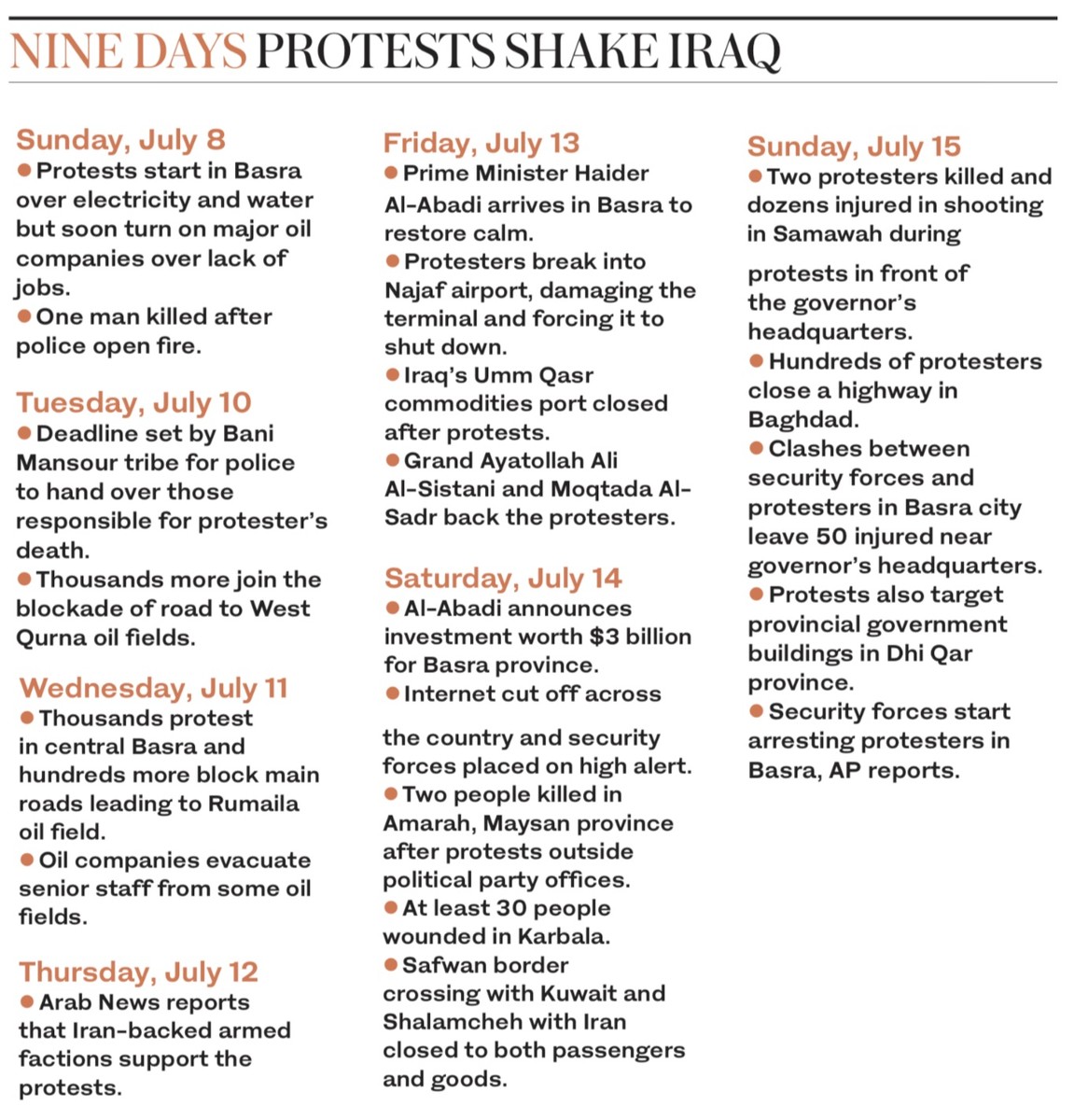
The protests, which entered a second week on Monday, started in Basra city with gatherings outside provincial government buildings and the blocking of roads to key oil fields.

But they escalated and turned increasingly violent over the weekend after large groups stormed oil sites in northern Basra and set fire to a number of government buildings in Nasiriyah, Amara and Diwaniya. 

On Friday, a mob stormed Iraq’s fourth busiest airport in Najaf and burned several headquarters belonging to some of the Shiite political forces.

In the nine days of unrest, eight protesters have been killed and hundreds wounded, half of whom were policemen, medics and security, sources told Arab News.

Iraqi security services arrested dozens of organizers of the demonstrations over the past two days to interrogate them “in an attempt to get an idea about the parties that guide the demonstrations and incited the demonstrators to attack and vandalize public facilities,” a security official told Arab News.


Basra


An intelligence official said that while the protests may have started organically, they have since been hijacked for political gain.

“No one denies that the services situation in Iraq is catastrophic and that the citizens suffer from a severe shortage of water and electricity at temperatures above 50C throughout the summer. This was the first spark that ignited these demonstrations,” the intelligence official told Arab News.

“But, later many local and regional sides have ridden the wave (of demonstrations).

“All I can reveal now is that a regional player was behind the demonstrations in Basra, but the rest were (stirred by) local players.”

While the official declined to name a regional player specifically, analysts said that Iran has the most to gain from disrupting oil supplies from Iraq.

Tehran, which wields significant influence in Iraq, particularly through paramilitary groups, faces suffocating economic sanctions imposed by the US administration after Donald Trump pulled America out of the Iran nuclear deal. The US has ordered all countries to stop buying Iranian oil from November.

Oil from Saudi Arabia and Iraq would be the main sources to compensate for the shortfall faced by the global oil markets.

“If you know who will be the beneficiary of stopping the export of Iraqi oil, you will know the regional player (behind the demonstrations in Basra),” the intelligent official said.

Rahman Al-Joubori, an Iraqi analyst based in Washington, told Arab News that Iran was sending a message to the international community.

“The message says that the Iraqi oil sector is not secure and you cannot rely on it,” he said.
Najaf

In Najaf, one of Iraq’s holiest cities and a center for pilgrimage, the story is different. Demonstrators stormed the air- powas responsible. Najaf airport, which opened in July 2008, is run by senior leaders of the Islamic Dawa Party.

Many complaints have been filed to Iraq’s Integrity Commission and the related government bodies suggesting the airport managers are corrupt and have not delivered the incomes of the airport to the government treasury.

The Iraqi cabinet led by Prime Minister Haider Al-Abadi, a Dawa member, last year issued a decision to dissolve the airport’s board and hand it over to the Civil Aviation Au- thority, but the directors refused to respond.

“The leaders of Dawa Party who do not benefit from the airport incomes have incited their followers against the leaders of Dawa Party who run the airport,” the Shiite leader said. “It is an internal fight,” he said, adding that Al-Abadi, was not involved in the protest and has been desperately trying to calm tensions.


The election

As the demonstrators left the airport, hundreds of others attacked and burned the headquarters of the most prominent paramilitary Shiite groups Najaf and Ammara. Buildings housing the Badr Organization, As-saib Ahl Al-Haq and Kataib Huzballah were all attacked.

Several security and political sources said that the followers of the influential Shiite cleric Moqtada Al-Sadr were behind the action.

Al-Sadr has emerged as kingmaker in Iraq since preliminary results of the May election showed that his alliance had won first place. He has been leading negotiations to form the biggest parliamentary bloc, which could then form a government.

His pro-Iranian arch Shiite rivals, who ran in the election under the Al-Fattah list, won second place and have been trying to block his way.

Fattah includes members of the Iran-backed paramilitaries, includ- ing Badr Organization and Assaib Ahl Al-Haq.

“We know that Sadrists (the followers of Al-Sadr) were behind the burning of our offices. It was an action and a reaction,” a senior Fattah leader told Arab News.

“Our guys (Badr, Assaib and Kattaib Huzballah) have set fire to the street in Basra and other provinces.”


High alert

Iraqi security forces are on high alert as more demonstrations are expected across the south of the country. Most foreign companies evacuated its senior staff from oil facilities in Basra province.

The demonstrators on Monday gathered in Al-Burjisiya town, southwestern Basra, threatening to attack the nearby giant pipeline that carries oil to the loading platforms for export. It marks a significant escalation compared to when the protests started on July 8 in Basra with a group of youths at the entrance of a foreign oil company in West Qurna — home of the biggest oil fields in Iraq.

The demonstrators had blocked the main road leading to the field and prevented employees of the compa- ny from reaching their work sites for two days. Police opened fire to dis-perse the demonstrators. A protester was killed and another three were wounded.

Bani Mansour, the tribe of the killed protester, asked the security forces to hand over the policemen responsible, but the government refused — sparking more anger.

By Wednesday, the 13 main Basra tribes said that they were backing the Bani Mansour and vowed “to paralyze” the oil companies.

Thousands of protesters took to the streets in Basra. All roads leading to the oil companies and fields were blocked either by protesters, dirt barriers or burning tires. 

Although the Iraqi government sought to absorb the anger and sent them a ministerial committee to negotiate with them, the situation rapidly deteriorated and the demonstrators started attacking the sites of oil companies and stormed the headquarters of the government owned-Basra Oil Company and the Russian power giant Lukoil Company.

On Saturday, Al-Abadi, who led the country through one of its many dark chapters with the defeat of Daesh, offered $3 billion in investment in the province.

But it is hard to see how money alone will appease the anger which is being fueled by increasingly complex political forces.


How 1,000 days of war pushed Sudan’s health system to the brink of collapse

Updated 35 min 18 sec ago
Follow

How 1,000 days of war pushed Sudan’s health system to the brink of collapse

  • After nearly three years of fighting, attacks on hospitals, mass displacement and disease outbreaks are crippling care nationwide
  • As humanitarian needs soar, doctors and aid agencies warn Sudan’s health system cannot survive without peace and access

LONDON: After more than 1,000 days of war, Sudan’s health system is buckling under the combined weight of violence, displacement, disease and hunger, pushing millions of civilians toward a crisis with few historical parallels.

What began as a power struggle between the Sudanese Armed Forces and the paramilitary Rapid Support Forces has evolved into what UN agencies now describe as the world’s largest humanitarian and health emergency.

According to the World Health Organization, more than 20 million people in Sudan now require health assistance, while an estimated 33.7 million — roughly two-thirds of the population — are expected to need humanitarian aid this year.

At least 21 million people face acute food insecurity, with famine already confirmed in parts of North Darfur and South Kordofan.

“One thousand days of conflict in Sudan have driven the health system to the brink of collapse,” Dr. Shible Sahbani, WHO’s representative in Sudan, said in a statement. “Under the strain of disease, hunger and a lack of access to basic services, people face a devastating situation.”

The health system’s deterioration has been swift and severe. Since the war began in April 2023, WHO has verified 201 attacks on health care, resulting in 1,858 deaths and 490 injuries.

More than one third of health facilities nationwide — 37 percent — are now non-functional, depriving millions of people of essential and lifesaving care.

“Healthcare facilities are being attacked, there is a shortage of medicines and supplies, and a lack of financial and human resources to operate health services,” Sahbani said. “This means that the system is on the verge of collapse.”

In the hardest-hit regions, particularly Darfur and Kordofan, the picture is even bleaker.

Aid groups estimate that in some areas up to 80 percent of health facilities are no longer operational, leaving overstretched clinics struggling to cope with outbreaks of cholera, malaria, dengue and measles.

“The weather and conditions in Sudan are conducive to the spread of malaria and dengue fever by mosquitoes,” Sahbani said. “Outbreaks of vaccine-preventable diseases, such as measles and polio, are also being reported in many states right now.”

Sudan is now the world’s largest displacement crisis. An estimated 13.6 million people have been forced from their homes — around 9.3 million internally displaced and a further 4.3 million seeking refuge in neighboring countries.

Overcrowded displacement sites, poor sanitation and the collapse of routine health and water services have created ideal conditions for disease outbreaks. Cholera has now been reported in all 18 states, dengue in 14 states, and malaria in 16.

“As the relentless conflict renders some areas inaccessible, particularly in the Darfur and Kordofan regions, the population’s health needs continue to increase,” Sahbani said.

“To meet these mounting needs and prevent the crisis from spiraling out of hand, WHO and humanitarian partners require safe and unimpeded access to all areas of Sudan, and increased financial resources.”

Children are bearing the heaviest burden of Sudan’s collapse. According to the UN children’s agency, UNICEF, roughly half of those expected to need humanitarian assistance in 2026 are children.

“For the children of Sudan, the world is 1,000 days late,” Edouard Beigbeder, UNICEF’s regional director for the Middle East and North Africa, said in a statement.

“Since fighting erupted in April 2023, Sudan has become one of the largest and most devastating humanitarian crises in the world, pushing millions of children to the brink of survival.”

More than 5 million children have been displaced — the equivalent of 5,000 children displaced every day — often repeatedly, as violence follows families from one location to another.

“Millions of children in Sudan are at risk of rape and other forms of sexual violence, which is being used as a tactic of war, with children as young as one reported among survivors,” Beigbeder said.

Malnutrition is compounding the crisis. In North Darfur alone, nearly 85,000 children suffering from severe acute malnutrition were treated between January and November 2025 — “equivalent to one child every six minutes.”

“The collapse of health systems, critical water shortages and the breakdown of basic services are compounding the crisis, fueling deadly disease outbreaks and placing an estimated 3.4 million children under five at risk,” Beigbeder said.

Hunger is worsening Sudan’s health crisis.

“Sudan was once considered to be the food basket of the entire region,” Sahbani said. “Today, it is facing one of the most serious food crises in the world: more than 21 million people face high levels of acute malnutrition and food insecurity.”

Children under five and pregnant or breastfeeding women are particularly vulnerable. “We estimate that nearly 800,000 children under the age of five will have suffered severe acute malnutrition in 2025,” Sahbani added.

UNICEF warns that the breakdown of maternal and child health services has turned childbirth into a life-threatening event, particularly in displacement camps where access to skilled care and surgical facilities is limited or nonexistent.

A Port Sudan-based doctor, who asked to remain anonymous, said the cumulative impact of the war had shattered the country’s health system, with facilities, staff and infrastructure systematically dismantled.

“After a thousand days of awful war, the health system in Sudan remains in a dire situation,” the doctor told Arab News.

“The health system and of course the infrastructure have seen direct attack, where 75 percent of the hospitals and health facilities sustained damage, either via direct shelling or looting of their equipment.”

The conflict has also hollowed out Sudan’s medical workforce. “Many of the health personnel and workforce had to flee, as they were targeted themselves,” the doctor said, warning that the loss of staff has sharply reduced the country’s ability to deliver even basic care.

The collapse of routine services has accelerated the spread of disease, particularly among children. “We started to see the emergence of outbreaks of vaccine-preventable diseases like diphtheria and measles — many outbreaks that we are seeing among children,” the doctor said.

Damage to water infrastructure has further compounded the crisis. “Attacks on water stations led to outbreaks like cholera and hepatitis E with high fatalities among pregnant women,” the doctor added.

Reversing the damage will require far more than short-term emergency aid, the doctor said.

“Sudan’s health system requires huge rehabilitation and rebuilding,” they said, stressing that the consequences of inaction extend well beyond Sudan’s borders. “Health is now global health — whenever there is an outbreak somewhere, there is a risk of it spreading all over.”

The doctor called for urgent international support to stabilize services and rebuild infrastructure.

“There is a need for urgent donations to fill the huge gap in life-saving health services to the people and also to rebuild the health infrastructure,” they said, adding that support must focus on areas of greatest need, “especially conflict areas as well as areas that have been freed of the RSF where now people are returning.”

As international access remains constrained and funding dwindles, much of the burden of care has fallen on Sudanese communities themselves — including diaspora-funded initiatives and volunteer-run clinics and the Emergency Response Rooms

“The conflict has exacerbated all the vulnerabilities Sudan’s health system faced before the war,” Dr. Majdi Osman, a University of Cambridge scientist and founder of Nubia Health, a diaspora-funded clinic in Wadi Halfa in Sudan’s Northern State, told Arab News.

“Decades of under-investment, especially outside of Khartoum, left the health system fragile, but the current violence has pushed it into a state of collapse.”

Supply chains have fragmented, driving up costs and limiting access to essential medicines. “Getting basic medicines has become a challenge but somehow health workers in Sudan are adapting and have been able to get medicines to communities in need,” Osman said.

“For patients with chronic diseases, the war has forced an impossible choice. Stay in a collapsing system or flee across dangerous routes to reach Egypt just to access life-saving treatment that should be a basic right.

“We are seeing families separated and lives risked on these journeys because the local medical infrastructure can no longer sustain the continuous care required for conditions like kidney disease or cancer.”

Despite the devastation, Sudan’s medical workforce has not disappeared. “Sudan does not lack medical expertise; it lacks the infrastructure and stability,” Osman said.

In Wadi Halfa, displaced doctors have arrived from Khartoum, Blue Nile and other conflict-affected regions. “At Nubia Health we are trying to provide them with the resources they need to support health in their communities,” Osman added.

Some organizations are attempting to restore fragments of the national health system. The Sudanese American Physicians Association, a leading humanitarian medical group, has sent a large delegation to Sudan to assess conditions and reopen facilities.

“Our delegation is on the ground to help reopen and restore essential hospital services disrupted by war — starting with the most critical hospitals across the health system’s resiliency, not only in Khartoum but also across the country,” Dr. Anmar Homeida, SAPA’s strategic adviser, told Arab News.

On Wednesday, SAPA announced the reopening of Bahri Teaching Hospital, one of the state’s largest referral facilities, “which represents a lifeline for children, mothers, and people with chronic and hard-to-treat conditions,” said Homeida.

“The impact we’re aiming for is simple: reduce preventable deaths, help local medical providers and humanitarian personnel deliver quality care to people in need, and support families returning home and those still displaced across the country, especially from Darfur and Kordofan, to have quality access to healthcare.

“With Sudan’s health system severely damaged and outbreaks spreading, reopening functional referral hospitals in Khartoum and supporting frontline services across other states is a practical step toward stabilizing communities and enabling recovery.”

Despite insecurity and access constraints, WHO says it continues to deliver lifesaving assistance wherever possible.

Since April 2023, the agency has delivered more than 3,300 metric tons of medicines and medical supplies worth around $40 million, including treatments for cholera, malaria, dengue and severe malnutrition.

About 24 million people have received cholera vaccinations, while more than 3.3 million have accessed care at WHO-supported hospitals, primary health facilities and mobile clinics.

More than 112,400 children with severe acute malnutrition have received treatment at WHO-supported stabilization centers.

“WHO is doing what we can, where we can, and we know we are saving lives and rebuilding the health system,” Sahbani said. “Despite the challenges, we are also working on recovery of the health system.”

Aid agencies are clear that humanitarian action alone cannot resolve Sudan’s crisis. “Humanitarian action can save lives, but it cannot replace the protection that only peace can provide,” Beigbeder said.

WHO, UNICEF and Sudanese doctors are united in their call for an end to the fighting and unimpeded humanitarian access.

“All parties must uphold their obligations under international humanitarian law: protect civilians, stop attacks on infrastructure, and allow safe, sustained and unimpeded humanitarian access across Sudan,” Beigbeder said.

For Osman, the message to donors is equally stark.

“Firstly, the international community needs to move quickly and support Sudanese, community-led efforts that are delivering care today,” he said.

“When I recently visited Sudan, I was expecting to see a global response to the world’s largest humanitarian crisis. I found almost nothing.

“Secondly, the best cure for Sudan’s health crisis is peace. We can’t allow children in Sudan to go through another 1,000 days of conflict to pass otherwise we risk the health of a whole generation growing up in this pointless war.”