Eritrea leader visits Ethiopia on Saturday in historic thaw

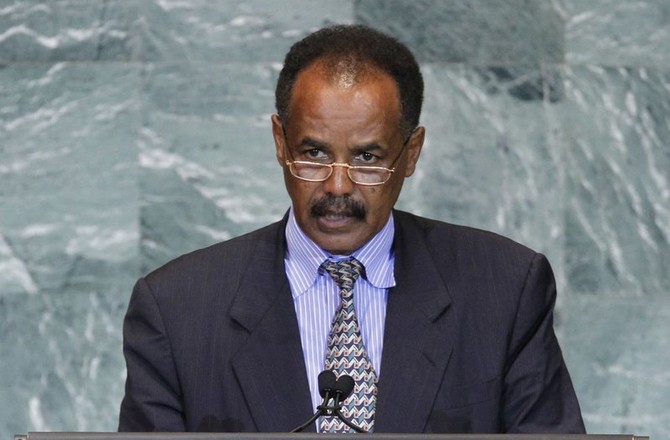
Eritrea’s President Isaias Afwerki is visiting Ethiopia he latest step in an unprecedented diplomatic thaw between the former archrivals. (AP)
Updated 13 July 2018
Follow

Eritrea leader visits Ethiopia on Saturday in historic thaw

ADDIS ABABA: Eritrea’s President Isaias Afwerki is visiting Ethiopia on Saturday, the latest step in an unprecedented diplomatic thaw between the former archrivals that is ending one of Africa’s longest-running conflicts.
Eritrea’s information minister, Yemane Gebremeskel, confirmed the visit on Twitter, saying it will “add momentum to the joint march for peace and cooperation.” The 72-year-old Isaias last visited Ethiopia in 1996.
The visit by the leader of one of the world’s most reclusive countries comes after Ethiopia’s new Prime Minister Abiy Ahmed made a historic trip to Eritrea last weekend for hugs, laughter and talks with Isaias, setting off the restoration of diplomatic ties after two decades.
Now phone lines are restored and scheduled Ethiopian Airlines flights to Eritrea begin next week.
The thaw began when the 42-year-old Abiy, who took office in April, announced Ethiopia would fully accept a peace deal that ended a two-year border war that killed tens of thousands and separated families.
The decision, which hands disputed border areas to Eritrea, was the boldest move yet in a wave of reforms in Ethiopia, Africa’s second most populous country, after years of anti-government protests.
Tiny Eritrea is one of the world’s most closed-off nations, ruled by Afwerki since gaining independence from Ethiopia in 1993 after years of rebel warfare. Eritrea has become a major source of migrants fleeing toward Europe, Israel and African nations in recent years as human rights groups criticize its harsh military conscription laws.
Observers now wonder whether the end of fighting with Ethiopia will lead Eritrea to open up and embrace new freedoms.


Philippine president announces new gas find in waters facing the disputed South China Sea

Updated 3 sec ago
Follow

Philippine president announces new gas find in waters facing the disputed South China Sea

MANILA: Philippine President Ferdinand Marcos Jr. announced the discovery of a new natural gas deposit near an existing gas field in waters facing the disputed South China Sea, which could shield his country from a potential power crisis.
The discovery of the gas reservoir northwest off Palawan province was “significant” and could eventually supply power to more than 5.7 million households annually, Marcos said Monday.
The undersea reservoir is estimated to contain about 98 billion cubic feet (2.7 billion cubic meters) of gas. Initial tests showed 60 million cubic feet (1.6 million cubic meters) of gas could be extracted each day from the well, Marcos said without providing other details including when commercial production could start.
“This helps Malampaya’s contribution and strengthens our domestic gas supply for many years to come,” Marcos said. “Aside from the natural gas, the discovery also includes condensate, which is a high-value liquid fuel.”
The new gas deposit, called Malampaya East 1, was discovered by a Philippine consortium about 5 kilometers (3.1 miles) east of the main Malampaya gas field, where commercial gas production started more than two decades ago and was projected to considerably decline in a few years.
The Malampaya gas to power facility has generated more than 20 percent of the electricity to Luzon, the most populous northern Philippine island region. In 2023, Marcos extended an exploration contract in Malampaya by 15 years.
Experts have predicted Malampaya could run out of gas in a few years, which has sparked fears of a potential power crisis in Luzon, where the bustling capital and main financial and business district is located.
The offshore gas field lies within the country’s Exclusive Economic Zone of the Philippines, a 200-nautical-mile (370-kilometer) stretch of water from a country’s coastline where it has exclusive rights to explore and harness resources under the 1982 United Nations Convention on the Law of the Sea.
Philippine efforts to explore for oil and gas in another offshore region, the Reed Bank, has been stalled for years because of opposition from Beijing, which claims sovereignty over the area along with most of the South China Sea. The Reed Bank also lies in the fringes of the South China Sea west of the Philippine island province of Palawan.
Vietnam’s oil and gas exploration in the disputed region also has been opposed by China. Beijing claims virtually the entire South China Sea and has reinforced its presence including coast guard and naval patrols in the disputed waterway in recent years.
Malaysia, Brunei and Taiwan also have been involved in the region’s long-simmering territorial standoffs.