

First space tourist flights could come in 2019

1 / 2
Above, the New Shepard on the launch pad in an undisclosed location from this photo provided by Blue Origin. (Blue Origin via AFP)
2 / 2
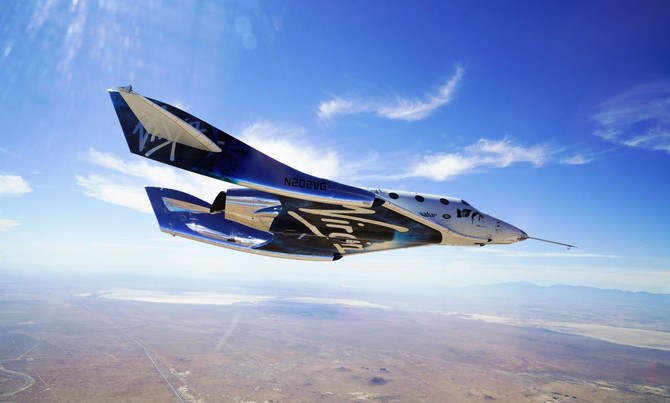
Above, Virgin Galactic’s Virgin Spaceship Unity spaceship. (Virgin Galactic via AFP)
Updated 13 July 2018
Follow

First space tourist flights could come in 2019

WASHINGTON: The two companies leading the pack in the pursuit of space tourism say they are just months away from their first out-of-this-world passenger flights — though neither has set a firm date.
Virgin Galactic, founded by British billionaire Richard Branson, and Blue Origin, by Amazon creator Jeff Bezos, are racing to be the first to finish their tests — with both companies using radically different technology.
Neither Virgin nor Blue Origin’s passengers will find themselves orbiting the Earth: instead, their weightless experience will last just minutes. It’s an offering far different from the first space tourists, who paid tens of millions of dollars to travel to the International Space Station (ISS) in the 2000s.
Having paid for a much cheaper ticket — costing $250,000 with Virgin, as yet unknown with Blue Origin — the new round of space tourists will be propelled dozens of miles into the atmosphere, before coming back down to Earth. By comparison, the ISS is in orbit 250 miles (400 kilometers) from our planet.
The goal is to approach or pass through the imaginary line marking where space begins — either the Karman line, at 100 kilometers or 62 miles, or the 50-mile boundary recognized by the US Air Force.
At this altitude, the sky looks dark and the curvature of the earth can be seen clearly.
With Virgin Galactic, six passengers and two pilots are boarded onto SpaceShipTwo VSS Unity, which resembles a private jet.
The VSS Unity will be attached to a carrier spacecraft — the WhiteKnightTwo — from which it will then detach at around 49,000 feet (15,000 meters.) Once released, the spaceship will fire up its rocket, and head for the sky.
Then, the passengers will float in zero-gravity for several minutes, before coming back to Earth.
The descent is slowed down by a “feathering” system that sees the spacecraft’s tail pivot, as if arching, before returning to normal and gliding to land at Virgin’s “spaceport” in the New Mexico desert.
In total, the mission lasts between 90 minutes and two hours. During a May 29 test in California’s Mojave desert, the spaceship reached an altitude of 21 miles, heading for space.
In October 2014, the Virgin spaceship broke down in flight due to a piloting error, killing one of two pilots on board. The tests later resumed with a new craft.

The company has now also reached a deal to open a second “spaceport” at Italy’s Tarente-Grottaglie airport, in the south of the country.
Branson in May told BBC Radio 4 that he hoped to himself be one of the first passengers in the next 12 months. About 650 people make up the rest of the waiting list, Virgin said.
Blue Origin, meanwhile, has developed a system closer to the traditional rocket: the New Shepard.
On this journey, six passengers take their place in a “capsule” fixed to the top of a 60-foot-long rocket. After launching, it detaches and continues its trajectory several miles toward the sky. During an April 29 test, the capsule made it 66 miles.
After a few minutes of weightlessness, during which passengers can take in the view through large windows, the capsule gradually falls back to earth with three large parachutes and retrorockets used to slow the spacecraft.
From take-off to landing, the flight took 10 minutes during the latest test.
Until now, tests have only been carried out using dummies at Blue Origin’s West Texas site.
But one of its directors, Rob Meyerson, said in June the first human tests would come “soon.”
Meanwhile, another company official, Yu Matsutomi, said during a conference Wednesday that the first tests with passengers would take place “at the end of this year,” according to Space News.
SpaceX and Boeing are developing their own capsules to transport NASA astronauts, most likely in 2020, after delays — a significant investment that the companies will likely make up for by offering private passenger flights.
“If you’re looking to go to space, you’ll have quadruple the menu of options that you ever had before,” Phil Larson, assistant dean at the University of Colorado, Boulder’s College of Engineering and Applied Science, said.
Longer term, the Russian firm that manufactures Soyuz rockets is studying the possibility of taking tourists back to the ISS. And a US start-up called Orion Span announced earlier this year it hopes to place a luxury space hotel into orbit within a few years — but the project is still in its early stages.


Rixos Obhur Jeddah sets new benchmark for all-inclusive luxury in Saudi Arabia

Updated 19 February 2026
Follow

Rixos Obhur Jeddah sets new benchmark for all-inclusive luxury in Saudi Arabia

  • This resort is an impressive contribution to the Kingdom’s global tourism ambitions

JEDDAH: From the moment you arrive at Rixos Obhur Jeddah, it’s clear this is not just another beachfront resort — it’s a statement. Billed as the first all-inclusive luxury experience “of its kind” in Jeddah, Rixos Obhur signals a shift in how hospitality is being represented in Saudi Arabia. It is a breath of fresh air — both literally and conceptually — introducing a global resort model while remaining rooted in regional culture.

The Kingdom has long been associated mainly with business travel and domestic tourism. But it is now positioning itself as a lifestyle destination for international travelers. Rixos Obhur actively contributes to that change, offering an experience that competes confidently with established upmarket resort destinations around the world. During my stay, it was impossible not to notice the wide range of international visitors alongside Saudi families and regional travelers.

The property is expansive, polished, and unmistakably luxurious. I stayed in a three-bedroom villa designed to accommodate up to six guests. The attention to detail throughout the space was immediately noticeable.

Rixos Obhur Jeddah also excels in its culinary and entertainment offerings, which are central to the all-inclusive concept. (Supplied)

The interiors are modern, sleek, and thoughtfully designed, striking a balance between contemporary aesthetics and warm, welcoming comfort. Everything feels new, curated, and intentional — from the furniture selection to the lighting and layout.

What truly stands out, though, is just how elevated even the smallest details feel. The bathroom amenities, including the shampoo and personal care products, are of exceptional quality — a small but telling detail that separates a luxury resort from a standard beachfront chalet experience. This is not the kind of stay where you feel you’ve “settled” for convenience; it’s one where indulgence is built into every element.

Rixos Obhur Jeddah also excels in its culinary and entertainment offerings, which are central to the all-inclusive concept. One of the highlights of my stay was the dinner and live show experience. Guests are treated to an open buffet that goes far beyond expectations, featuring premium cuts of steak, rich Turkish specialties, Arabic classics, and indulgent desserts — including Turkish Delights that live up to the brand’s heritage.

The food selection is impressively diverse, catering to an international audience while still celebrating regional flavors. This thoughtful balance ensures that every guest, regardless of background, finds something familiar and something new to enjoy. The live entertainment — including dancers and a live band — adds an energetic, celebratory atmosphere that transforms dinner into a full evening experience rather than just a meal, while the range of expertly crafted mocktails on offer further enhances the resort’s appeal.

Another standout feature of the resort is how seamlessly outdoor spaces are integrated into the overall experience. (Supplied) 

Service throughout the property is warm, attentive, and polished, creating an environment where guests feel genuinely welcomed rather than simply accommodated.

Another standout feature of the resort is how seamlessly outdoor spaces are integrated into the overall experience. Even during warmer weather, the presence of outdoor air-conditioning allows guests to enjoy open spaces comfortably — a thoughtful adaptation to the local climate. The beach, too, is immaculately clean, well-maintained, and clearly designed with families in mind.

Rixos Obhur Jeddah offers a vision of Saudi Arabia as a competitive global tourism destination, capable of delivering world-class hospitality experiences without compromise. It successfully highlights what an all-inclusive resort can look like in the Kingdom, blending international standards with regional identity in a way that feels authentic and forward-looking.

If this resort is a glimpse of where Saudi tourism is headed, the future looks both exciting and impressively refined.