

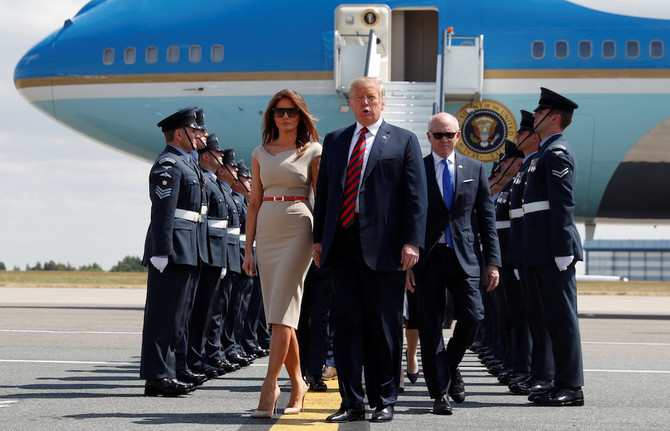
US President Donald Trump arrives in UK for four-day visit

U.S. President Donald Trump and first lady Melania Trump arrive at Stansted Airport, Britain, July 12 2018. (REUTERS/Kevin Lamarque)
Updated 12 July 2018
Follow

US President Donald Trump arrives in UK for four-day visit

  • US President Donald Trump has arrived in the UK for the start of a four-day visit
  • His visit comes after he accused his beleaguered host of failing to deliver on voters' intentions when they decided to quit the EU

LONDON: US President Donald Trump has arrived in the UK for the start of a four-day visit, during which he will meet with UK Prime Minister Theresa May as well as with Queen Elizabeth II during a weekend in Scotland.

His visit comes after he accused his beleaguered host of failing to deliver on voters' intentions when they decided to quit the EU.
Ignoring all diplomatic niceties, the convention-shredding US president set up the four-day visit with a rebuke of May as she battles to stop her government falling apart over Brexit.
Shrugging off the plans for mass protests, which will include a giant baby-shaped blimp bearing Trump's features, he said in Brussels: "They like me a lot in the UK. I think they agree with me on immigration.
"I think that's why Brexit happened," he said, noting that Britain was "a pretty hot spot right now with a lot of resignations".
"The people voted to break it up (Britain's ties with the EU)," Trump told a press conference.
"So I would imagine that's what they will do, but maybe they will take a little bit of a different route. I don't know (if) that is what they voted for," he added.
"I'd like to see them be able to work it out so it could go quickly."
The trip, which will include tea with the Queen and a private weekend in Scotland, is set to be greeted by a mass demonstration in London on Friday.
Some 77 percent of Britons have an unfavourable view of Trump, according to a poll by YouGov with 1,648 respondents.
The poll conducted this week said 63 percent found Trump racist, and 74 percent said he was sexist.
Despite a series of diplomatic spats between Britain and Trump, the British government is hoping for a quick trade deal with the United States after it leaves the European Union.
"There is no stronger alliance than that of our special relationship with the US and there will be no alliance more important in the years ahead," May said ahead of the visit.
Woody Johnson, US ambassador to the UK, has said a deal will be "a major priority" for Trump, calling Brexit "a once-in-a-lifetime opportunity to change direction".
Trump was flying over after a fraught NATO summit in Brussels where he piled pressure on allies to double their defence spending.
Trump is due to leave Britain on Sunday for talks in Helsinki the following day with Russian President Vladimir Putin, whose government stands accused by May's of unleashing a lethal nerve agent in the city of Salisbury.

Britain "is in somewhat turmoil", Trump said before departing Washington, remarking that dealing with Putin might surprisingly be the easiest part of the European trip.
That turmoil includes the resignations of May's Brexit and foreign ministers over her plan to retain close ties with the EU after leaving the bloc in March.
Ambassador Johnson sought to play down Trump's comments.
"We're extremely confident in the ability of the UK to plough through this issue with Brexit and move on," he told BBC radio.


‘A den of bandits’: Rwanda closes thousands of evangelical churches

Updated 4 sec ago
Follow

‘A den of bandits’: Rwanda closes thousands of evangelical churches

  • A 2018 law introduced new rules on health, safety, and financial disclosures, and requires all preachers to have theological training
  • Observers say the real reason for the closures comes down to control, noting that even those who complied with the law had been shut down 
  • President Kagame has described the church as a relic of the colonial period, a chapter of its history with which the country is still grappling


KIGALI: Grace Room Ministries once filled giant stadiums in Rwanda three times a week before the evangelical organization was shut down in May.
It is one of the 10,000 churches reportedly closed by the government for failing to comply with a 2018 law designed to regulate places of worship.
The law introduced new rules on health, safety, and financial disclosures, and requires all preachers to have theological training.
President Paul Kagame has been vocal in his criticisms of the evangelical churches that have sprouted across the small country in Africa’s Great Lakes region.
“If it were up to me I wouldn’t even reopen a single church,” Kagame told a news briefing last month.
“In all the development challenges we are dealing with, the wars... our country’s survival — what is the role of these churches? Are they also providing jobs? Many are just thieving... some churches are just a den of bandits,” he said.
The vast majority of Rwandans are Christian according to a 2024 census, with many now traveling long and costly distances to find places to pray.
Observers say the real reason for the closures comes down to control.
Kagame’s government is saying “there’s no rival in terms of influence,” Louis Gitinywa, a lawyer and political analyst based in Kigali, told AFP.
The ruling party “bristles when an organization or individual gains influence,” he said, a view also expressed to AFP by an anonymous government official.

‘Deceived’ 

The 2018 law requires churches to submit annual action plans stating how they align with “national values.” All donations must be channelled through registered accounts.
Pastor Sam Rugira, whose two church branches were shut down last year for failing to meet fire safety regulations, said the rules mostly affected new evangelical churches that have “mushroomed” in recent years.
But Kagame has described the church as a relic of the colonial period, a chapter of its history with which the country is still grappling.
“You have been deceived by the colonizers and you let yourself be deceived,” he said in November.
The closure of Grace Room Ministries came as a shock to many across the country.
Pastor Julienne Kabanda, had been drawing massive crowds to the shiny new BK Arena in Kigali when the church’s license was revoked.
The government had cited unauthorized evangelical activities and a failure to submit “annual activity and financial reports.”
AFP was unable to reach Kabanda for comment.

‘Open disdain, disgust’ 

A church leader in Kigali, speaking to AFP on condition of anonymity, said the president’s “open disdain and disgust” for churches “spells tough times ahead.”
“It is unfair that even those that fulfilled all requirements are still closed,” he added.
But some say the clampdown on places of worship is linked to the 1994 Rwandan genocide in which around 800,000 people, mostly ethnic Tutsis, were slaughtered.
Ismael Buchanan a political science lecturer at the National University of Rwanda, told AFP the church could sometimes act as “a conduit of recruitment” for the Democratic Forces for the Liberation of Rwanda (FDLR), the Hutu militia formed in exile in DR Congo by those who committed the genocide.
“I agree religion and faith have played a key role in healing Rwandans from the emotional and psychological wounds after the genocide, but it also makes no sense to have a church every two kilometers instead of hospitals and schools,” he said.
Pastor Rugira meanwhile suggested the government is “regulating what it doesn’t understand.”
It should instead work with churches to weed out “bad apples” and help them meet requirements, especially when it comes to the donations they rely on to survive, he said.