On Edhi’s second death anniversary, family vows to continue his mission

1 / 8
In this file photo, a Pakistani woman holds an oil lamp during a candlelight vigil for renowned social worker Abdul Sattar Edhi in Karachi on July 12, 2016. (RIZWAN TABASSUM/AFP)
2 / 8
A ‘baby cradle’ in front of Edhi headquarters in Karachi with notice reading; “Don’t kill innocent baby, put them in our cradle, Behum Balqees Edhi.” Staff says this cradle now remains empty due to a ban on child adoption. (AN photo by M.F. Sabir)
3 / 8
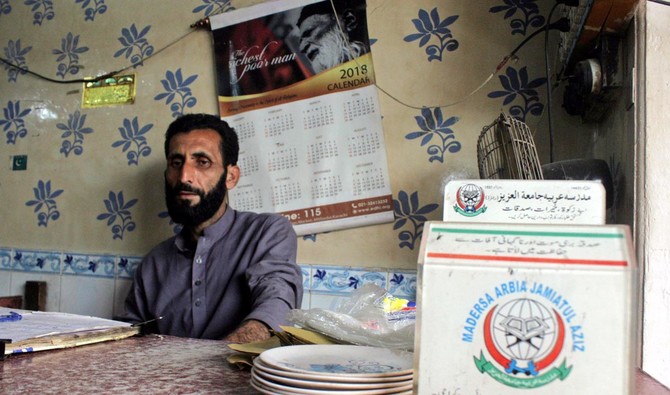
A ‘2018 calendar’ featuring Abdul Sattar Edhi hangs on a wall behind a man at the counter of a tea shop at Kharadar, adjacent to Edhi foundation’s headquarters. In front the man is laying an alms box asking for donations for a mosque. (AN photo by M.F. Sabir)
4 / 8
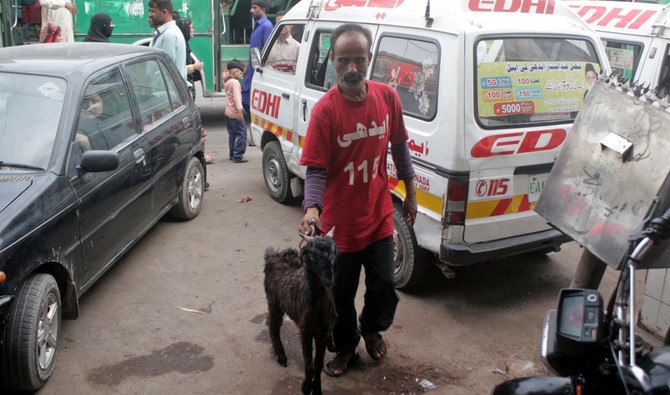
Family of Waseem Shehzad, driving in the car on left side, donated this goat as Sadaqa to Edhi Foundation after coming straight from a private hospital where his daughter Fatima was admitted and discharged in the evening on Sunday, July 8, 2018. (AN photo by M.F. Sabir)
5 / 8
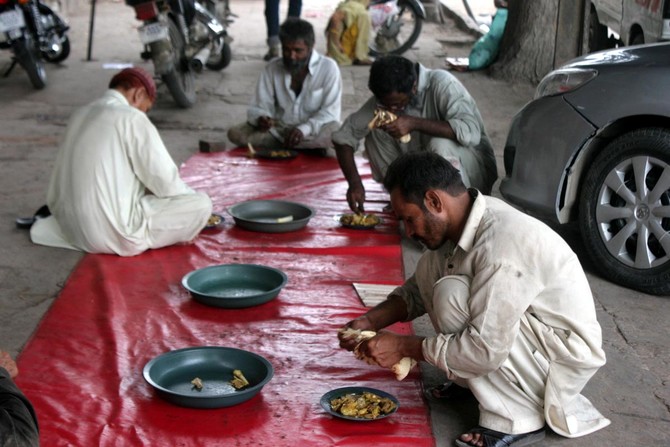
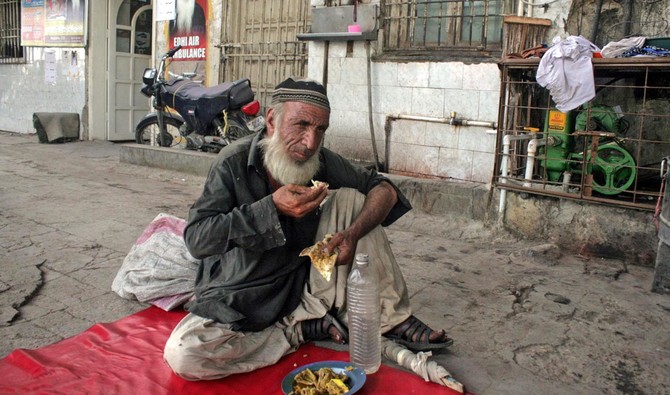
Free food is offered at several Drastakhwans of Edhi in Karachi. (AN photo by M.F. Sabir)
6 / 8
Two little girls are taking food from Edhi Drastakhwans in front of Edhi foundation’s headquarters at Tower, Karachi here on Sunday, July 8, 2018. (AN photo by M.F. Sabir)
7 / 8
Free food is offered at several Drastakhwans of Edhi in Karachi. (AN photo by M.F. Sabir)
8 / 8
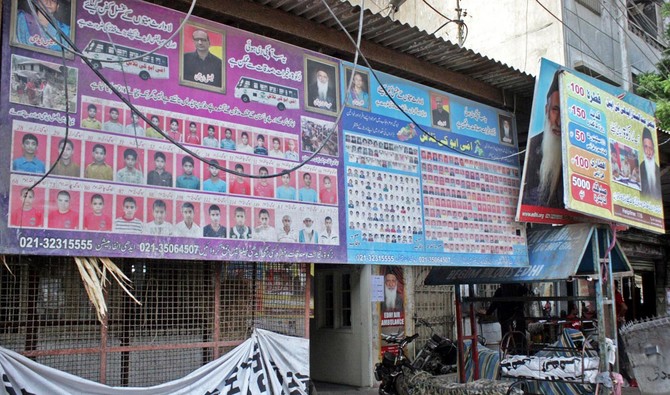
Noticeboards in front of Edhi foundation’s headquarters featuring missing children, who are residing in Edhi shelter homes and looking for their parents. (AN photo by M.F. Sabir)
Updated 09 July 2018
Follow

On Edhi’s second death anniversary, family vows to continue his mission

  • A selfless philanthropist, Edhi had trained his family members to provide services to needy and helpless people, says grandson
  • After initial drop-down, Edhi foundation is attracting donations but not enough to meet increasing needs of Pakistani society faced with growing social services gap

KARACHI: Saad was just nine when his grandfather, Abdul Sattar Edhi, an iconic Pakistani philanthropist, took him to Kashmir, a day after the area, along with other parts of northern Pakistan, Afghanistan and India, was hit by a devastating earthquake on Oct. 8, 2005.
“Edhi had just recovered from a stroke and his body was not fully functioning but he took me to help and rehabilitate the earthquake-hit Kashmir,” Saad Edhi told Arab News after attending a simple ceremony at Edhi Homes in Karachi where the late Edhi was laid to rest after the state funerals in Karachi’s National Cricket Stadium two years ago.
At Edhi’s home, on Sunday, his family observed Edhi’s second death anniversary, which was also attended by staff and people living in the foundation’s sheltered homes.
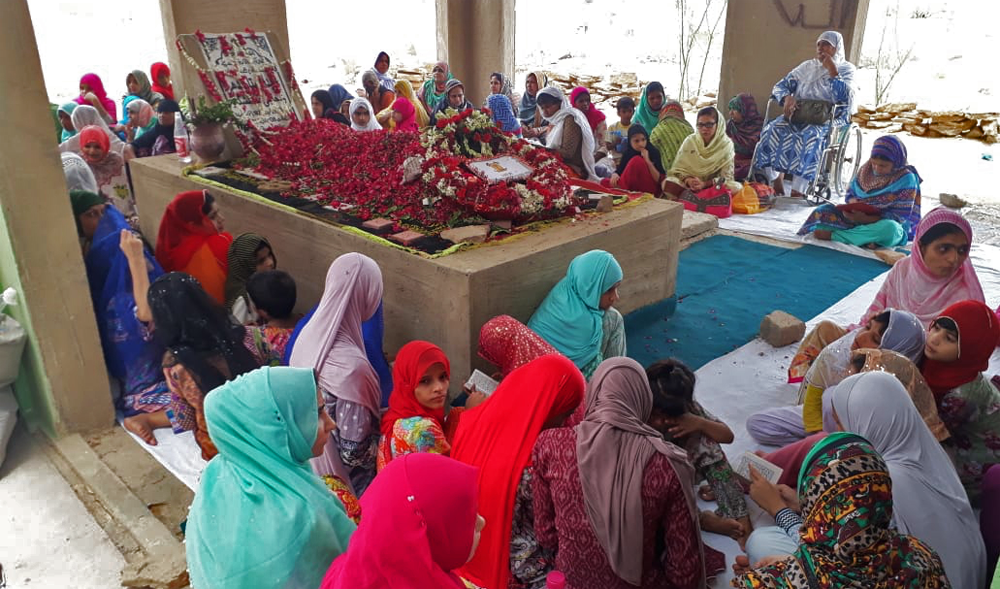


Women of Edhi Shelter home reciting the Qur’an on the occasion of Abdul Sattar Edhi’s second death anniversary here on Sunday, July 8, 2018. (Photo courtesy: Edhi Homes)

"Edhi would take us along with him to help affectees of every small and big accident. He told us it was part of the training which will help us take on his legacy of services for all,” Saad Edhi said, adding that except for one son, Quttab, who is living in the US, all Edhi’s children are working for the foundation he had founded in 1951.
Edhi’s son Faisal, who is Saad’s father, leads the foundation and is being assisted by his sisters Almas Edhi, Zeenat Edhi, Tughra Edhi, his wife, son and other members of the family.
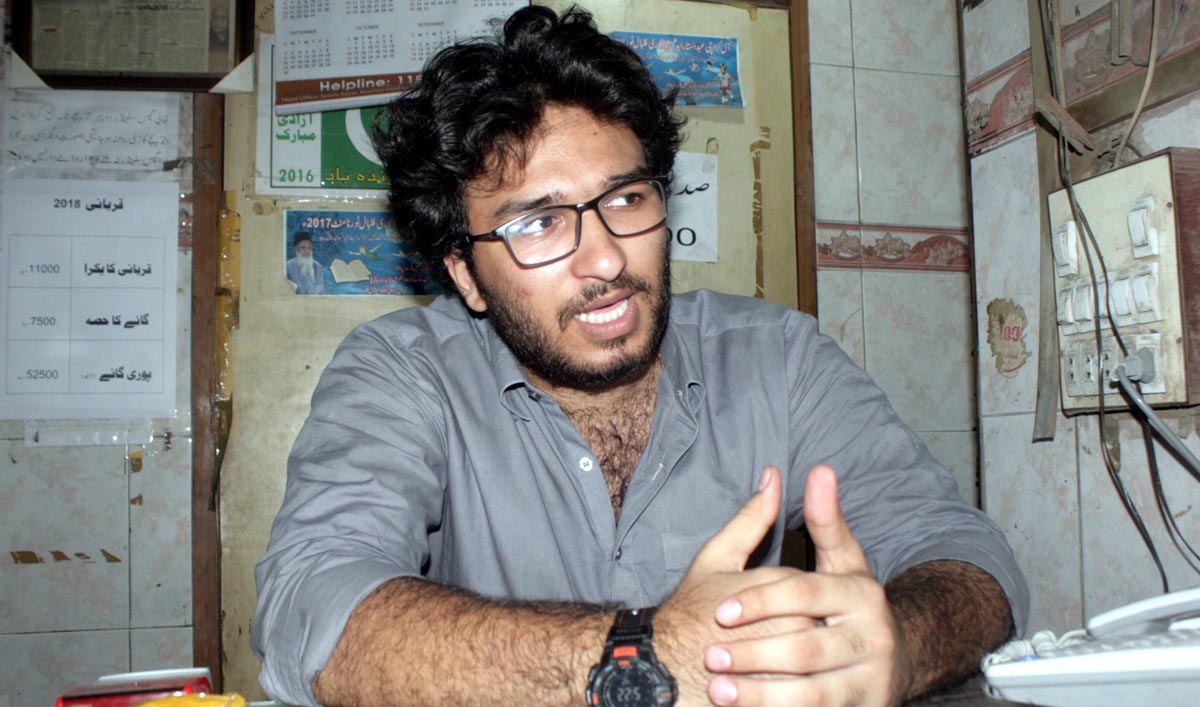


Saad Edhi, grandson of Abdul Sattar Edhi, speaking to Arab News at the Edhi foundation’s headquarters on Sunday, July 8, 2018. (AN photo by M.F. Sabir)

“My father Faisal got associated with the foundation when he was just nine years old.
“My grandfather Edhi was a selfless man. He wanted us to carry on his work for humanity.
“We are so much connected that we enjoy this work now. He trained us in way that we don’t feel it’s a burden,” Saad added.
Iconic Pakistani philanthropist
Recalling an incident, Imran Yousuf, a driver who has worked with Edhi, said a dead body was once found in a drain in Korangi, an area in Karachi.
“No one was willing to pick up the body as it was in the worst condition. Edhi immediately went down to pick up the body,” Yousuf told Arab News.
“His services were for all, regardless of their sect, language and faith,” his grandson Saad said.
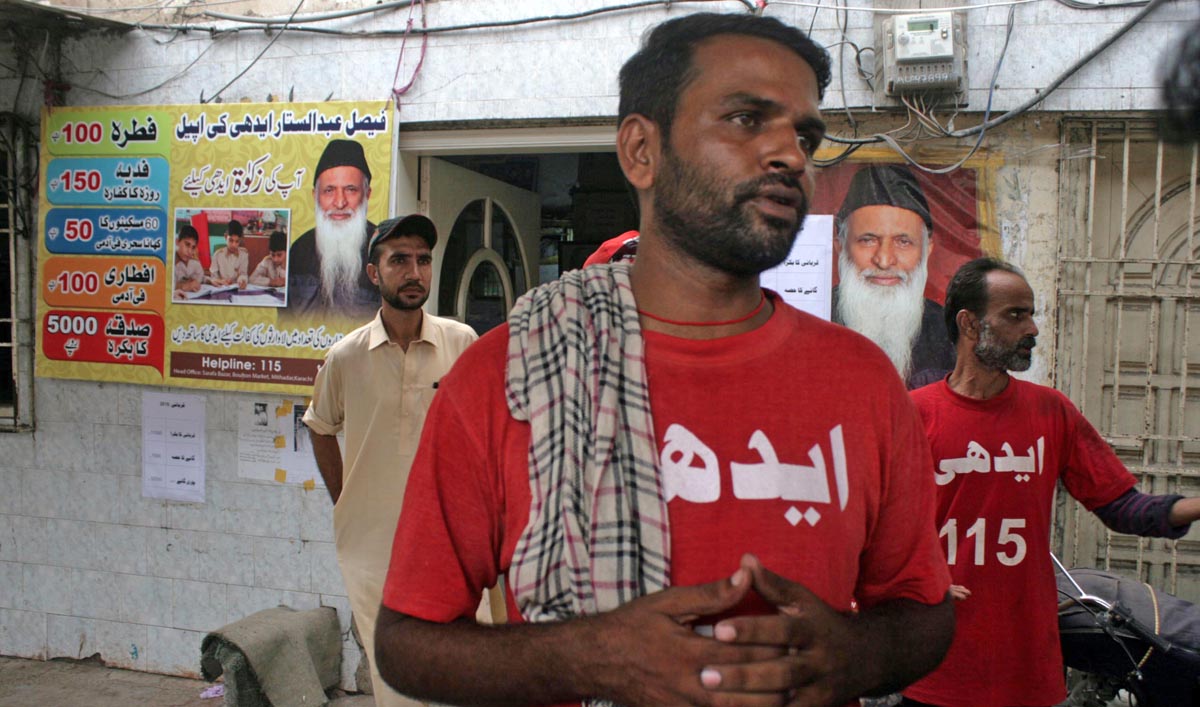


The Edhi Foundation’s Driver, Imran Yousuf, who has worked with Abdul Sattar Edhi, sharing his moments with Edhi with Arab News on the second death anniversary of Edhi on Sunday, July 8, 2018. (AN photo by M.F. Sabir)


Saad says the ambulance service has been upgraded. In Karachi, newly inducted ambulances have the capacity to lift up to four injured or dead bodies, whereas their speed and capacity helps the volunteers to take the injured at the earliest to health facilities.
Saad himself was born in Balqees Edhi Maternity Home in Kharadar the facility built by Edhi.
People from Balochistan and Sindh province come to this maternity home.
During the June 2015 heatwaves, a little more than a year before his demise, Edhi worked tirelessly.
“He continued his work till his last breath.”
“Abdul Sattar Edhi remains Pakistan’s most important icon of public service and filling a gap that the Pakistan state left in terms of providing basic services to its citizens,” said Raza Rumi, an author and journalist who has studied Edhi’s life.
“Edhi’s work was opposed especially by the religious extremists. They even criticized him when he died. Some of them said he could not be given an Islamic burial but all of that was rejected by the Pakistani people. That also goes to show that Pakistanis are not given up to extremist ideas.”
After his death a big vacuum persists, in terms of both carrying on the mission of Edhi and of finding the same kind of selfless icon that served Pakistani society, Rumi says.
“There are many who still give us alms but there were several who give contributions due to the iconic personality of Edhi,” said Kashif Khan, a member of staff at Edhi head offices.
“During the first Ramadan (after his death) -– along with Eid-al-Azha a season of donations -– there was a 30 percent drop but during the last Ramadan it raised again to its level. However the requirements have grown manifold,” Saad Edhi said.
“Edhi’s son is carrying on with the same mission, so one has to wish him best of luck,” Rumi concluded.

Nine Afghan citizens killed, 10 injured in accident in southwestern Pakistan— police 

Updated 5 sec ago
Follow

Nine Afghan citizens killed, 10 injured in accident in southwestern Pakistan— police 

  • Pickup truck carrying Afghan nationals collided with oil tanker in Nokundi town, says police official
  • Says Afghan nationals were attempting to enter Europe illegally via Iran as per preliminary probe

QUETTA: At least nine Afghan nationals were killed and 10 others injured in southwestern Pakistan on Sunday when the pickup truck they were traveling in collided with an oil tanker, a police official said.

The collision occurred in Nokundi, a town located on Pakistan’s border with Iran in the southwestern Balochistan province. District Police Officer Muhammad Shareef Kalhoro told Arab News that the Zamyad vehicle (a pickup truck made by Iranian automobile manufacturer Zamyad Co.) was transporting Afghan nationals illegally when the accident took place.

“Twenty-one illegal Afghan migrants were onboard the Zamyad vehicle when it was hit by an oil tanker in the kacha [remote] area of Nokundi,” Kalhoro said.

“Nine Afghans were killed on the spot and 10 were injured in the serious accident,” he added.

The police official said the bodies and injured persons were sent back to Afghanistan through cross-border coordination and in accordance with legal protocol.

Kalhoro said preliminary investigations indicate the Afghan nationals were attempting to enter Europe illegally from Afghanistan via Iran, facilitated by an organized human smuggling network.

“All legal proceedings have been initiated, and the human smuggling network is being traced for further action,” he said.

Pakistan launched a nationwide crackdown against people living in the country illegally in 2023, with Afghan refugees bearing the brunt of the deportation drive. Pakistan says it has deported over 1.5 million Afghans since then. The crackdown was launched after a spate of suicide attacks in the country that Islamabad blamed on Afghan nationals without providing proof.

Thousands of migrants travel illegally through the desolate areas of Chaghi district in Balochistan every year in an attempt to reach Europe via Iran.

Balochistan, home to the multi-billion-dollar China-Pakistan Economic Corridor project, is considered by experts to be Pakistan’s most underdeveloped province across almost all social and economic indicators.

The province is also home to multi-billion-dollar mineral projects such as Saindak and Reko Diq. However, most districts in Balochistan have dilapidated roads, which often lead to fatal accidents.