First quolls born in Australian wild in half a century

1 / 2
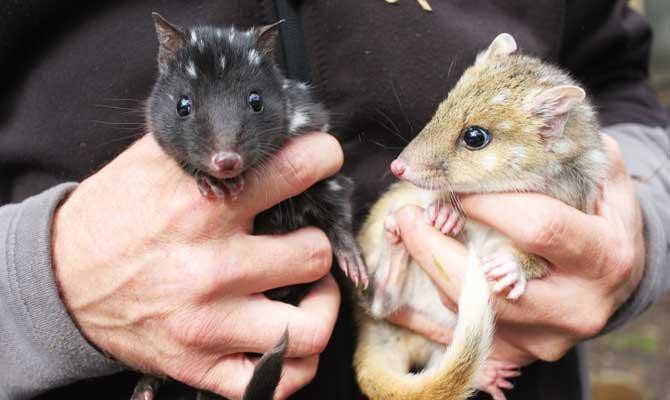
This handout photo taken on September 20, 2017 by WWF-Australia and released on July 9, 2018 shows an adult eastern quoll at the Devils @ Cradle conservation facility in Cradle Mountain, Tasmania. (AFP)
2 / 2
This handout photo taken on September 20, 2017 by WWF-Australia and released on July 9, 2018 shows juvenile eastern quolls at the Devils @ Cradle conservation facility in Cradle Mountain, Tasmania. (AFP)
Updated 09 July 2018
Follow

First quolls born in Australian wild in half a century

  • Quoll babies stay sheltered in the pouch for around three months while they gain weight and grow fur
  • Eastern quolls, which primarily eat insects, were present on the mainland for thousands of years

SYDNEY: The first eastern quolls in 50 years have been born in the wild on the Australian mainland, with the rice grain-sized pups offering hope to a species of marsupial devastated by foxes.
Eastern quolls — a furry carnivore that grows to about the size of a domestic cat — disappeared from the mainland in the 1960s but clung on in the island state of Tasmania.
Twenty of them were returned to their native environment in the Booderee National Park, south of Sydney, in March to see if they could survive and thrive.
It is the first time in Australia that a carnivore extinct on the mainland has been re-introduced to the wild and followed a 15-year project to bring feral predators in the area under control.
Booderee National Park Natural Resource Manager Nick Dexter said on Monday babies had been confirmed in three of the females’ pouches.
“There remains challenges ahead to establish a sustainable population, but to have 30 percent of the female quolls produce pouch young from this pilot project is a move in the right direction,” he said.
Quoll babies stay sheltered in the pouch for around three months while they gain weight and grow fur.
“We’ve been tracking every animal in this project with a GPS collar, and unlike other translocation projects we’ve been able to quickly discover and manage threats,” Dexter added.
Eastern quolls, which primarily eat insects, were present on the mainland for thousands of years. But large numbers were killed in the early 1900s by a mysterious epidemic, and their population was then devastated as foxes spread across south-eastern Australia.
They were last regularly seen on the mainland in the 1960s in the Sydney region.
Australian National University researcher Natasha Robinson said the new colony had demonstrated several vital points needed for a successful long-term future.
“We’ve proven the quolls can find food, shelter and breed. We’ve also shown a capacity to make changes to improve the quolls survival rate,” she said.


Filipinos master disaster readiness, one roll of the dice at a time

Updated 29 December 2025
Follow

Filipinos master disaster readiness, one roll of the dice at a time

  • In a library in the Philippines, a dice rattles on the surface of a board before coming to a stop, putting one of its players straight into the path of a powerful typhoon

MANILA: In a library in the Philippines, a dice rattles on the surface of a board before coming to a stop, putting one of its players straight into the path of a powerful typhoon.
The teenagers huddled around the table leap into action, shouting instructions and acting out the correct strategies for just one of the potential catastrophes laid out in the board game called Master of Disaster.
With fewer than half of Filipinos estimated to have undertaken disaster drills or to own a first-aid kit, the game aims to boost lagging preparedness in a country ranked the most disaster-prone on earth for four years running.
“(It) features disasters we’ve been experiencing in real life for the past few months and years,” 17-year-old Ansherina Agasen told AFP, noting that flooding routinely upends life in her hometown of Valenzuela, north of Manila.
Sitting in the arc of intense seismic activity called the “Pacific Ring of Fire,” the Philippines endures daily earthquakes and is hit by an average of 20 typhoons each year.
In November, back-to-back typhoons drove flooding that killed nearly 300 people in the archipelago nation, while a 6.9-magnitude quake in late September toppled buildings and killed 79 people around the city of Cebu.
“We realized that a lot of loss of lives and destruction of property could have been avoided if people knew about basic concepts related to disaster preparedness,” Francis Macatulad, one of the game’s developers, told AFP of its inception.
The Asia Society for Social Improvement and Sustainable Transformation (ASSIST), where Macatulad heads business development, first dreamt up the game in 2013, after Super Typhoon Haiyan ravaged the central Philippines and left thousands dead.
Launched six years later, Master of Disaster has been updated this year to address more events exacerbated by human-driven climate change, such as landslides, drought and heatwaves.
More than 10,000 editions of the game, aimed at players as young as nine years old, have been distributed across the archipelago nation.
“The youth are very essential in creating this disaster resiliency mindset,” Macatulad said.
‘Keeps on getting worse’ 
While the Philippines has introduced disaster readiness training into its K-12 curriculum, Master of Disaster is providing a jolt of innovation, Bianca Canlas of the Department of Science and Technology (DOST) told AFP.
“It’s important that it’s tactile, something that can be touched and can be seen by the eyes of the youth so they can have engagement with each other,” she said of the game.
Players roll a dice to move their pawns across the board, with each landing spot corresponding to cards containing questions or instructions to act out disaster-specific responses.
When a player is unable to fulfil a task, another can “save” them and receive a “hero token” — tallied at the end to determine a winner.
At least 27,500 deaths and economic losses of $35 billion have been attributed to extreme weather events in the past two decades, according to the 2026 Climate Risk Index.
“It just keeps on getting worse,” Canlas said, noting the lives lost in recent months.
The government is now determining if it will throw its weight behind the distribution of the game, with the sessions in Valenzuela City serving as a pilot to assess whether players find it engaging and informative.
While conceding the evidence was so far anecdotal, ASSIST’s Macatulad said he believed the game was bringing a “significant” improvement in its players’ disaster preparedness knowledge.
“Disaster is not picky. It affects from north to south. So we would like to expand this further,” Macatulad said, adding that poor communities “most vulnerable to the effects of climate change” were the priority.
“Disasters can happen to anyone,” Agasen, the teen, told AFP as the game broke up.
“As a young person, I can share the knowledge I’ve gained... with my classmates at school, with people at home, and those I’ll meet in the future.”