

UAE denies taking measures expelling Qatari nationals

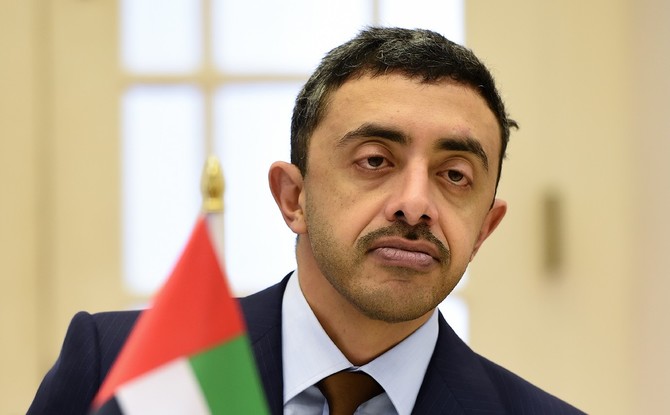
Minister of Foreign Affairs and International Cooperation of the United Arab Emirates Sheikh Abdullah bin Zayed bin Sultan Al-Nahyan on November 18, 2017. (File photo: AFP)
Updated 05 July 2018
Follow

UAE denies taking measures expelling Qatari nationals

  • The ministry stressed that Qataris who are already resident in the UAE will not need to obtain such a permit in order to continue their stay in the country
  • The statement came as a response to what the UAE says were false allegations made by Qatar

Dubai: The United Arab Emirates said on Thursday that it has not taken any administrative or legal measures to remove Qataris from the country since its decision to cut ties with Doha.

“Since the issuance of its statement on 5 June 2017, in which the UAE has taken a number of measures towards the State of Qatar for reasons related to the protection of national security, the UAE specified that Qatari nationals outside the country must obtain a prior permit to enter the country,” the Ministry of Foreign Affairs and International Cooperation said in a statement published by the state news agency, WAM.

The ministry stressed that Qataris who are already resident in the UAE will not need to obtain such a permit in order to continue their stay in the country.

The statement came as a response to what the UAE says were false allegations made by Qatar.

The statement read: “The UAE regrets that Qatar continues to falsify accuse the UAE’s polices. The UAE affirms its full respect and appreciation to the Qatari people.”

The UAE affirmed that it will continues to maintain the measures it has taken against Qatar to address its threats to regional safety and to the people of the UAE.

The statement called on Qatar to respect its international obligations and to cease supporting and sponsoring terrorist organizations and to refrain from interfering in the internal affairs of neighbouring countries.

The UAE is defending a lawsuit brought by Doha over the boycott imposed last June by the Anti-Terror Quartet (Saudi Arabia, the UAE, Bahrain and Egypt), severing diplomatic ties and transport links. Qatar claims the UAE has forcibly separated families, in violation of an international treaty signed by both countries.


US condemns RSF drone attack on World Food Programme convoy in Sudan’s North Kordofan

Updated 42 min 27 sec ago
Follow

US condemns RSF drone attack on World Food Programme convoy in Sudan’s North Kordofan

  • Denise Brown, the UN Humanitarian Coordinator for Sudan, also expresses concern over the drone attack

WASHINGTON: The US has condemned a drone attack by Rapid Support Forces on an aid convoy in Sudan’s North Kordofan state that killed one person and injured three others.

“The United States condemns the recent drone attack on a World Food Program convoy in North Kordofan transporting food to famine-stricken people which killed one and wounded many others,” US Senior Adviser for Arab and African Affairs Massad Boulos wrote on X.

“Destroying food intended for people in need and killing humanitarian workers is sickening,” the US envoy wrote.

“The Trump Administration has zero tolerance for this destruction of life and of U.S.-funded assistance; we demand accountability and extend our condolences to all those affected by these inexcusable events and terrible war,” he added.

The Sudan Doctors Network said the convoy was struck by RSF drones in the Allah Karim area as it headed toward displaced people in El-Obeid, the state capital, Anadolu Agency reported.

The network described the attack as a “clear violation of international humanitarian law,” warning that it undermines efforts to deliver life-saving aid to civilians amid worsening humanitarian conditions across the country.

There was no immediate comment from the rebel group.


Denise Brown, the UN Humanitarian Coordinator for Sudan, in a statement also expressed concern over the drone attack which hit the aid trucks in North Kordofan.

“I am deeply concerned by a drone attack earlier today on trucks contracted by the World Food Programme (WFP) in North Kordofan, the aftermath of which I came across a few hours later, as I left the state capital, El Obeid.”

“The trucks were en route from Kosti to deliver life-saving food assistance to displaced families near El Obeid when they were struck, tragically killing at least one individual and injuring many more. The trucks caught fire, destroying food commodities intended for life-saving humanitarian response.”

Brown added that “Humanitarian personnel, assets and supplies must be protected at all times. Attacks on aid operations undermine efforts to reach people facing hunger and displacement.”

“Safe and unimpeded humanitarian access remains critical to ensure assistance reaches the most vulnerable people across Sudan.”

Since April 2023, the conflict between Sudan’s army and the paramilitary forces has killed tens of thousands, displaced 11 million and which the UN has described as one of the world’s worst humanitarian crises.

An alert issued by the Integrated Food Security Phase Classification (IPC), confirmed famine conditions in El-Fasher and Kadugli, the capital of South Kordofan, about 800 kilometers to the east.

The IPC said that 20 more areas in Sudan’s Darfur and neighboring Kordofan were at risk of famine.

Of Sudan’s 18 states, the RSF controls all five states in the western Darfur region, except for parts of North Darfur that remain under army control. The army holds most areas of the remaining 13 states across the south, north, east and center of the country, including the capital, Khartoum.

The conflict between the army and the RSF, which erupted in April 2023, has killed thousands of people and displaced millions.