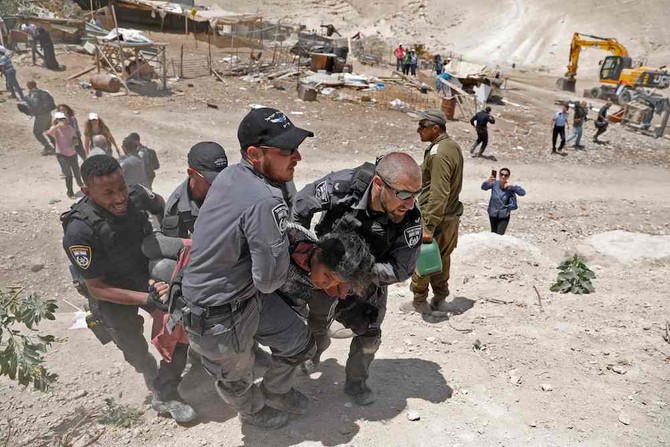
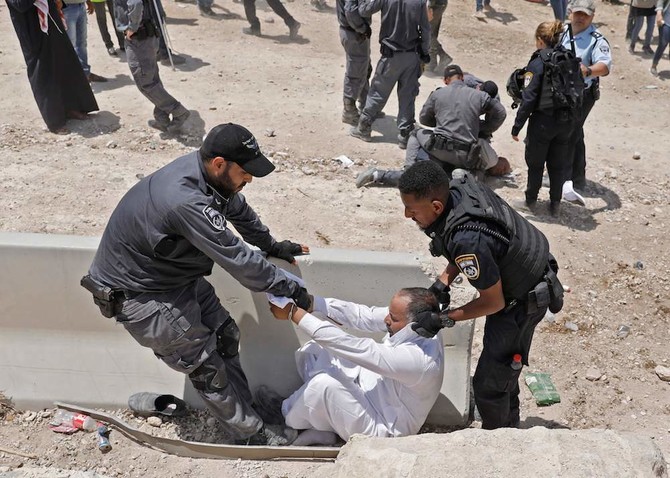
PALESTINIAN TERRITORIES: Scuffles broke out on Wednesday between Israeli authorities and protesters who feared preparations were underway to raze a Bedouin village in a strategic part of the occupied West Bank, despite international calls for a reprieve.
Protesters, including some waving Palestinian flags, tried to block a bulldozer and scuffled with police at Khan al-Ahmar, east of Jerusalem. Some climbed onto the bulldozer in protest.
Israeli police said 11 people were arrested. Israeli rights group B'Tselem said they included the organisation's own head of field research.
The Palestinian Red Crescent reported 35 people injured, with four taken to hospital. Police said the wounded included three officers, including one taken to hospital.
Police said stones were thrown at officers.
The incident came after activists said the Israeli military had issued a warrant to the 173 residents of Khan al-Ahmar on Tuesday, authorising soldiers to seize access roads to the village.
Heavy equipment was seen around the village on Wednesday, prompting speculation a road was being prepared to facilitate its evacuation and demolition.
"Today they are proceeding with infrastructure work to facilitate the demolition and forcible transfer of residents," Amit Gilutz, spokesman for B'Tselem, told AFP.
Israeli authorities say the village and its school were built illegally, and in May the supreme court rejected a final appeal against its demolition.
But activists say the villagers had little alternative but to build without Israeli construction permits, as the documents are almost never issued to Palestinians for building in parts of the West Bank where Israel has full control over civilian affairs.
Israel authorities say they have offered villagers an alternative site.
The village is made up mainly of makeshift structures of tin and wood, as is traditionally the case with Bedouin villages.
It is unclear when the demolition will take place.
Senior Palestinian official Saeb Erekat condemned the demolition plans and appealed to the international community.
"Are we coming to see one day that Israel can be held accountable?" he asked journalists in Ramallah.
"If not, it means you're pushing this region towards a deeper hole of violence and counter-violence and extremes."
Britain's minister of state for the Middle East, Alistair Burt, visited the village in May and called on the Israeli government to show restraint.
He warned that any forced relocation "could constitute forcible transfer of people as far as the United Nations is concerned."
Forcible transfer is considered a violation of the Geneva Conventions.
Khan al-Ahmar is located east of Jerusalem near several major Israeli settlement blocs and close to a highway leading to the Dead Sea.
Activists are concerned continued Israeli settlement construction in the area could effectively divide the West Bank in two.
In another Bedouin village in the same region, Abu Nuwar, Israel carried out a series of demolitions Wednesday on what it described as illegally built structures.
B'Tselem said nine residential structures and three agricultural ones were demolished, leaving 62 people homeless.
The Israeli defence ministry's COGAT unit for civilian affairs in the occupied Palestinian territories said the demolitions had taken place after the "owners of the buildings failed to utilise the planning procedures to their fullest extent".
"This despite the fact that they were given the opportunity to enquire in the matter and were told that if they did not, the illegal construction would be demolished," it said in a statement.

Clashes as Israel gets set to raze West Bank Bedouin village
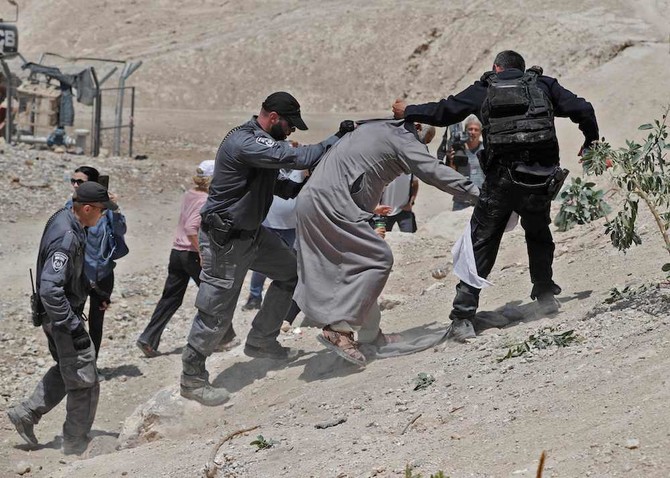
- Heavy equipment, including at least one bulldozer, were seen around the village
- Israeli authorities say the village and its school were built illegally and in May
How the Palestinian Circus sustains hope and resistance under Israeli occupation
- Under mounting Israeli raids and restrictions, a West Bank circus troupe turns art into political expression
- For displaced and traumatized Palestinian youth, joy, balance and teamwork help build mental resilience
DUBAI: On any given morning in the village of Birzeit, just 10 kilometers north of the West Bank city of Ramallah, the sound of juggling balls hitting the floor mixes with laughter, music, and the occasional gasp.
Inside a modest rehearsal space, young performers rehearse feats of balance and acrobatics at the Palestinian Circus, which has become a small outlet for resistance and joy among young people across the occupied West Bank.
However, the circus is under more pressure than ever. Mohamad Rabah, its executive director, told Arab News that Israeli raids had seen one of their colleagues detained and the troupe’s activities become more difficult to sustain.
“The military forces were in Birzeit one month ago. They were here in front of our building. But we are not a special case,” Rabah said.
“We are the same as any Palestinian suffering from this occupation, and we try to find ways to resist, to stay resilient and to find creative ways to work.”
Founded in 2006 in the aftermath of the Second Intifada, the Palestinian Circus was born from an urgency to reestablish hope and provide creative outlets for young Palestinians.
The circus offers children and young adults the chance to train in a range of arts and take part in professional productions around the world.
Given the physical demands and collective discipline required, Rabah says circus skills have become a language through which children and young people can express fear, anger, hope and resistance.
The group’s first production, launched amid intense Israeli restrictions, was bluntly political.
“The first show was called Circus Behind the Wall, and it was using circus disciplines to connect with acts like juggling over the wall,” Rabah said.
“The wall, built by Israel around major Palestinian cities, had cut families, friends and livelihoods apart. The circus answered symbolically.”
The show toured locally and internationally for several years. By 2008, those early performers had become teachers.
“The same young people who gained the skill at that time as circus performers started to teach other youth and kids,” Rabah said.
Since those early days, its programs have expanded into refugee camps in Hebron, Nablus, Jenin, Farah, Ramallah, and Jerusalem — areas where trauma was not abstract but a daily reality.
Nearly two decades later, the organization has grown into a prominent cultural institution. This year alone, Rabah said, the circus completed 90 performances — 55 in Palestine and 35 abroad.
It has appeared at festivals in France, Italy, Ireland and Belgium and even at the UK’s Glastonbury.
The occupied West Bank faces its gravest crisis in years, with escalating Israeli military raids, record settler attacks and accelerating displacement.
Raids in areas like Jenin and Nablus have killed hundreds and damaged vital infrastructure, while settler violence and demolitions have pushed many rural and herding communities off their land.
Settlement expansion continues, aimed at entrenching permanent control and foreclosing Palestinian statehood.
The Palestinian Authority is weakened by fiscal collapse, sanctions and loss of legitimacy, undermining services and governance, while humanitarian agencies warn of worsening protection risks and de facto forcible transfer.
Some Palestinian Circus productions confront politics head on, like “Sarah,” created in 2017, which tells the story of displacement. “It’s a performance … about the journey and the suffering of refugees,” Rabah said.
“We also have happy and uplifting performances … like Wonderland, which is like a children and family show inspired by the Alice in Wonderland theme.”
In a society saturated with loss, Rabah says joy itself becomes an act of resistance. However, performance is only one part of the work. The larger mission lies in training and psychosocial support.
“This year, we worked with 4,000 children, women and people with disabilities — 2,000 in Gaza and 2,000 in the West Bank and Jerusalem,” Rabah said.
“There are 16 disciplines in circus, so we use the term ‘circus for all,’ and with circus for all that’s inclusivity. Everyone can find their space under the circus.”
Unlike theater, Rabah says there are no singular stars in circus, which makes the whole endeavor a lesson in team building, with young people learning to rely on each other for balance during daring acrobatics.
That reliance has become more urgent as violence has escalated across the West Bank and Gaza. With mobility increasingly restricted, Rabah says freedom has been incrementally squeezed out of Palestinian life, especially for young people.
Relying on each other’s support is the only way to survive.
“From one city to another… it requires a lot of work to meet another young person,” Rabah said. “What the Israeli occupation is trying to do is to take from us every meaning of living.”
Still, the show goes on. This year, despite visa obstacles and excessive costs, the circus managed to send more than 40 children abroad for cultural exchanges — an achievement that Rabah admits came at a high price.
“This year alone, we spent more than half a million shekels ($157,350) … on flight tickets,” he said. “Looking at the demand, you wish to do more. It’s a drop in the ocean.”
In Gaza, the stakes are even higher. Rabah visited the enclave in 2022 to meet with circus artists, many of whom continued training amid the devastation wrought by the conflict that began in October 2023.
“They are inspiring,” he said. “They worked during the genocide with nothing, starving. Their schools were destroyed, but they continued to perform and to train. There are, I think, four to five artists who were lost, killed by the Israeli bombing.”
Rabah himself joined the organization in 2018, after the founding artists moved to Europe. He was not a performer but could see the social impact that the project could have. He said art was essential in a society where political participation is constrained.
“I didn’t have any circus background. My background is community and youth work and management,” he said.
“There are limited ways in which young people can express their voice … so art becomes not only a way of entertainment… it’s a way that you participate in the community.”
The circus does not impose any narrative, with most of the shows being produced by the performers themselves without a given script. “Most of our shows, the ideas come from the artists,” Rabah said. “They do it with their bodies and their circus tricks.”
As the organization approaches its 20th anniversary, it plans to expand with a mobile circus tent, bringing performances to the most isolated communities. This is something Rabah says will require further sponsorship, which he hopes will continue regardless of the political situation.
“Put yourself in the shoes of a 15-year-old Palestinian living in a refugee camp in Gaza … it’s a struggle for identity and existence,” he said.
“We need every bit of support to allow us to exist and keep existing with our identity and culture and every meaning of life.”