

Greenpeace crashes Superman-shaped drone into French nuclear plant

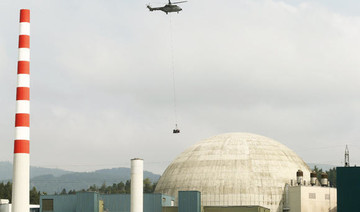
Above, a frame grab from a Greenpeace video shows a Superman-shaped drone abut to crash into a structure in EDF’s Bugey nuclear plant, near Lyon in France. (Courtesy Greenpeace)
Updated 03 July 2018
Follow

Greenpeace crashes Superman-shaped drone into French nuclear plant

PARIS: Greenpeace crashed a Superman-shaped drone into a French nuclear plant on Tuesday to demonstrate its vulnerability to outside attacks, the environmental group said.
Greenpeace said it had flown the drone — piloted by one of its activists — into the no-fly zone around utility EDF’s Bugey nuclear plant, near Lyon, and then crashed it against the wall of the plant’s spent-fuel pool building.
“This action again highlights the extreme vulnerability of this type of buildings, which contain the highest amount of radioactivity in nuclear plants,” Greenpeace said.
France generates 75 percent of its electricity from nuclear power in 19 nuclear plants operated by state-controlled EDF.
EDF said that two drones had flown over the Bugey site, of which one had been intercepted by French police.
“The presence of these drones had no impact on the security of the installations,” EDF said, adding that it will file a police complaint.
The drone stunt follows a series of staged break-ins by Greenpeace activists into French nuclear plants, which Greenpeace says are vulnerable to outside attack, especially the spent-fuel pools. These pools can hold the equivalent of several reactor cores, stored in concrete pools outside the highly reinforced reactor building.

Greenpeace says the spent-fuel buildings have not been designed to withstand outside attacks and are the most vulnerable part of French nuclear plants.
“Spent-fuel pools must be turned into bunkers in order to make nuclear plants safer,” said Greenpeace France’s chief nuclear campaigner Yannick Rousselet.
EDF said the spent-fuel pool buildings are robust and designed to withstand natural disasters and accidents.
Greenpeace’s security breaches have sparked a parliament investigation into nuclear security, which is due to present its report on Thursday.
In October, Greenpeace activists broke through two security barriers and launched fireworks over EDF’s Cattenom nuclear plant.
In February, a French court gave several Greenpeace activists suspended jail sentences while ordering the group to pay a fine and €50,000 ($58,300) in damages to EDF.

Chinese, Iranian warships in South Africa for exercises

Updated 4 sec ago
Follow

Chinese, Iranian warships in South Africa for exercises

  • China-led exercises near main navy base are also meant to involve Russia
  • Drills risk further straining South Africa’s ties with the United States
SIMON’S TOWN, South Africa: Chinese and Iranian warships were docked off South Africa’s main navy base Thursday ahead of exercises that officials said were also meant to involve Russia.
The January 9-16 “Will for Peace” drill hosted by South Africa risks further straining its ties with the United States, which is in dispute with many of the countries taking part.
AFP journalists saw two Chinese ships in Cape Town’s False Bay harbor on Wednesday, joined by an Iranian vessel on Thursday.
South African navy officials said warships from Russia were also expected to take part in the China-led exercises.
The drill was focused on the “safety of shipping and maritime economic activities,” the South African defense force said in December when it announced the maneuvers.
It was intended to “deepen cooperation in support of peaceful maritime security initiatives,” it said.
The statement said the exercise would involve navies from BRICS countries.
BRICS, originally made up of Brazil, Russia, India, China and South Africa, has expanded to include Egypt, Ethiopia, Iran, Saudi Arabia, the United Arab Emirates and, more recently, Indonesia.
The joint drills — previously known as Exercise Mosi — were initially scheduled for November 2025 but were postponed due to a clash with the G20 summit in Johannesburg.
South Africa’s Democratic Alliance (DA), a member of the ruling unity government, said parliament had not been “properly briefed” on the drills, including cost, command structure and diplomatic consequences.
“South Africa’s defense and foreign policy must be transparent, constitutional, and principled and certainly not being quietly reshaped through military exercises that contradict our stated neutrality and damage our standing in the world,” DA spokesperson on defense, Chris Hattingh, said in a statement.
The center-right party — which joined government after the African National Congress lost its majority in 2024 due to voter disillusionment with corruption and mismanagement — vowed to demand full transparency in parliament.
President Donald Trump has accused countries in the BRICS group of emerging nations of “anti-American” policies.
South Africa has drawn US criticism for its close ties with Russia and a range of other policies, including its decision to bring a genocide case against Israel at the International Court of Justice over the Gaza war.
South Africa’s military was criticized for hosting naval exercises with Russia and China in 2023 that coincided with the one-year anniversary of the Kremlin’s invasion of Ukraine.
The three countries first conducted joint naval drills in 2019.