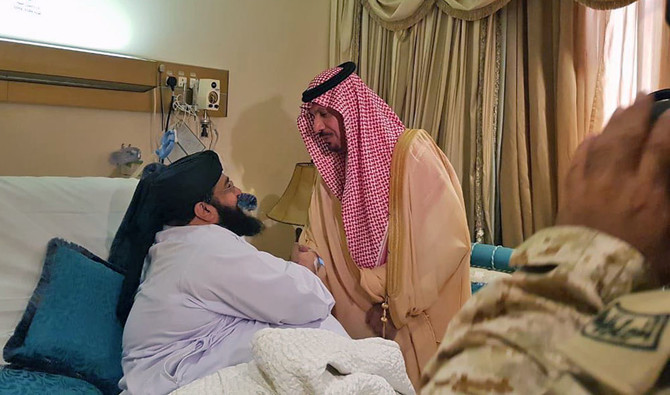
Pakistani cleric recovering in Saudi hospital

1 / 2
Saudi National Guard Minister Prince Khalid bin Abdul Aziz bin Mohammed bin Ayyaf met with Hafiz Tahir Ashrafi, chairman of the Pakistan Ulema Council, in hospital. (Photo shared by Ashrafi)
2 / 2
Sheikh Sulaiman bin Abdullah Aba Al-Khail, director of Al-Imam Mohammad ibn Saud Islamic University, met with Hafiz Tahir Ashrafi in hospital. (Photo shared by Ashrafi)
Updated 03 July 2018
Follow

Pakistani cleric recovering in Saudi hospital

  • “I’m recovering rapidly,” Ashrafi told Arab News, without elaborating on the reason for his hospitalization
  • In May, Saudi Grand Mufti Sheikh Abdul Aziz Al-Asheikh gave Ashrafi a special shield for his service to Muslim unity

ISLAMABAD: Pakistan Ulema Council Chairman Hafiz Tahir Ashrafi is being treated in King Abdul Aziz Medical City in Riyadh for “medical complications” while on a personal visit to Saudi Arabia.
“I’m recovering rapidly,” Ashrafi told Arab News, without elaborating on the reason for his hospitalization.
“After successful surgery, doctors are satisfied about the recovery process. I’m grateful to King Salman and Crown Prince Mohammed bin Salman for having the best treatment.”
Ashrafi, a frequent visitor to the Kingdom, said senior Saudi officials visited him in the hospital and enquired about his health.
In May, Saudi Grand Mufti Sheikh Abdul Aziz Al-Asheikh gave Ashrafi a special shield for his service to Muslim unity, and to the defense and protection of the Two Holy Mosques in the Kingdom.


At least 13 civilians killed in Pakistan strikes in Afghanistan, UN says

Updated 23 February 2026
Follow

At least 13 civilians killed in Pakistan strikes in Afghanistan, UN says

  • Pakistan said it launched the strikes after blaming recent suicide attacks on militants operating from Afghan territory
  • The reported toll adds to fears of a renewed cycle of retaliation between the neighbors, threatening a fragile ceasefire

ISLAMABAD/KABUL: At least 13 civilians ‌were killed and seven injured in Pakistani airstrikes in eastern Afghanistan, the United Nations said on Monday, as cross-border tensions escalated following a string ​of suicide bombings in Pakistan.

The reported toll adds to fears of a renewed cycle of retaliation between the neighbors, threatening a fragile ceasefire along their 2,600-km (1,600-mile) frontier and further straining ties as both sides trade blame over militant violence.

The United Nations Assistance Mission in Afghanistan (UNAMA) said it had received “credible reports” that overnight Pakistani airstrikes on February 21–22 killed at least 13 ‌civilians and injured ‌seven in the Behsud and Khogyani ​districts ‌of ⁠Nangarhar province.

Taliban ​spokesman Zabihullah ⁠Mujahid earlier reported dozens killed or wounded in the strikes, which also hit locations in Paktika province. Reuters could not independently verify the reported toll.

Pakistan said it launched the strikes after blaming recent suicide attacks, including during Ramadan, on militants operating from Afghan territory.

Pakistan’s information ministry in a post on X said ⁠the “intelligence-based” operation struck seven camps of the Pakistani Taliban ‌and Daesh (Islamic State) Khorasan Province ‌and that it had “conclusive evidence” the militant ​assaults on Pakistan were directed ‌by “Afghanistan-based leadership and handlers.”

Kabul has repeatedly denied allowing militants ‌to use Afghan territory to launch attacks in Pakistan.

The strikes took place days after Kabul released three Pakistani soldiers in a Saudi-mediated exchange aimed at easing months of tensions along the border.

Afghanistan’s defense ministry condemned ‌the strikes and called them a violation of sovereignty and international law, saying an “appropriate and measured ⁠response will ⁠be taken at a suitable time.” The Afghan foreign ministry said it had summoned Pakistan’s ambassador.

In a statement on the February 21-22 strikes, Afghanistan’s education ministry said eight school students; five boys and three girls, were killed in Behsud in Nangarhar province, and one madrasa student injured in Barmal in Paktika province, adding that dozens of other civilians were killed or wounded and educational centers destroyed. Reuters could not independently verify the information.

The latest strikes follow months of clashes and repeated border closures ​that have disrupted trade ​and movement along the rugged frontier.