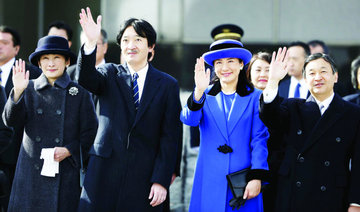
TOKYO: Japanese Emperor Akihito canceled his public duties after suffering dizziness and nausea due to cerebral anemia, a condition caused by insufficient blood flow to the brain, a palace official said on Monday.
Akihito, 84, who has spent much of his nearly three decades on the throne seeking to heal the wounds of war, is set to step down on April 30 next year in the first abdication by a Japanese emperor in nearly two centuries.
The Imperial Household Agency, which manages the imperial family’s affairs, said the emperor was diagnosed with cerebral anemia after complaining of nausea and dizziness.
The emperor will be monitored while he rests at the Imperial Palace in Tokyo, the agency said.
Kyodo news agency said Akihito’s wife, Empress Michiko, will still meet Princess Ayako, daughter of Akihito’s late cousin, Prince Takamado, who was set to call on the imperial couple on Monday following the announcement of her engagement to a 32-year-old commoner.
Akihito, who has had heart surgery and treatment for prostate cancer, said in 2016 that he feared age might make it hard for him to fulfill his duties.
Once considered divine, Japan’s emperor is now defined by the constitution as “a symbol of the state and the unity of the people,” but has no political power.
Akihito and Michiko have spent much of their time trying to address the legacy of World War Two, which was fought in the name of his father Hirohito, and consoling victims of disasters or other woes. He is widely respected by average Japanese.
His heir is the 58-year-old Crown Prince Naruhito.


![]()


Japanese Emperor Akihito resting due to cerebral anemia
Japanese Emperor Akihito resting due to cerebral anemia
- Akihito, 84, who has spent much of his nearly three decades on the throne seeking to heal the wounds of war, is set to step down on April 30 next year
- The emperor was diagnosed with cerebral anemia after complaining of nausea and dizziness

Somalia welcomes its first bowling alley as the middle class and diaspora returnees grow
MOGADISHU: In a city long defined by conflict, Somalia ‘s capital of Mogadishu now echoes with the crash of pins at the country’s first modern bowling alley.
It’s the latest sign of revival in the once-thriving Indian Ocean port shaped by 35 years of civil war and militant bombings. Millions of people were forced to flee what became one of the world’s most dangerous cities. Those who remained avoided public spaces as the Al-Qaeda-linked group Al-Shabab waged an insurgency against the Somali state.
In recent years, improved security measures against Al-Shabab, an expanded government presence and growing private investment have allowed daily life to re-emerge. Cafes line newly reopened streets, beaches draw evening crowds and traffic congestion, once unimaginable, now clogs key intersections.
The Feynuus Bowling Center opened last year and draws many locals and Somalis returning from the diaspora, who bring investment and business ideas after years of sending billions of dollars in remittances from abroad.
On a recent evening, young Somalis gathered in groups, laughing and filming each other on their phones while music played. Many from the diaspora are visiting Mogadishu for the first time in years, or the first time ever.
“I couldn’t believe Mogadishu has this place,” said Hudoon Abdi, a Somali-Canadian on holiday, as she prepared to take her turn to bowl.
“I’m enjoying it. Mogadishu is actually safe,” she said, urging others to visit.
Mogadishu remains vulnerable to militant attacks, however, with security measures like checkpoints and heavily guarded zones part of daily life. Non-Somalis remain largely confined to a compound at the international airport.
But residents say the ability to gather for recreation signals an important psychological shift. Such venues provide a welcoming environment for a younger generation eager for safe spaces to socialize.
Abukar Hajji returned from the United Kingdom on holiday after many years away and found the difference between what he imagined and what he experienced eye-opening.
“When I was flying from the UK, I believed it was a scary place, like a war-torn country,” he said. “Everyone told me, ‘Good luck,’ but when I came and saw it with my own eyes, I didn’t want to leave.”
Sadaq Abdurahman, the manager of the bowling center, said the idea for the business emerged from a growing demand among young people for recreational facilities.
“It has created employment opportunities for at least 40 youths,” he said.
According to the Somali National Bureau of Statistics, Somalia’s unemployment rate stands at 21.4 percent.
The bowling alley has private security guards, bag checks and surveillance cameras, reflecting the precautions common at public venues in Mogadishu.
Urban planners and economists say businesses like the bowling alley signal a broader shift in Mogadishu’s recovery, as private sector growth increasingly complements international aid and government-led rebuilding efforts.
Ahmed Khadar Abdi Jama, a lecturer in economics at the University of Somalia, said innovative businesses are responding to the needs of diaspora returnees and the growing middle class, “which in turn adds to the expected increase in Somalia’s GDP.”
Outside the bowling alley, traffic hummed and neon signs flickered, other reminders of Mogadishu’s fragile transformation.
It’s the latest sign of revival in the once-thriving Indian Ocean port shaped by 35 years of civil war and militant bombings. Millions of people were forced to flee what became one of the world’s most dangerous cities. Those who remained avoided public spaces as the Al-Qaeda-linked group Al-Shabab waged an insurgency against the Somali state.
In recent years, improved security measures against Al-Shabab, an expanded government presence and growing private investment have allowed daily life to re-emerge. Cafes line newly reopened streets, beaches draw evening crowds and traffic congestion, once unimaginable, now clogs key intersections.
The Feynuus Bowling Center opened last year and draws many locals and Somalis returning from the diaspora, who bring investment and business ideas after years of sending billions of dollars in remittances from abroad.
On a recent evening, young Somalis gathered in groups, laughing and filming each other on their phones while music played. Many from the diaspora are visiting Mogadishu for the first time in years, or the first time ever.
“I couldn’t believe Mogadishu has this place,” said Hudoon Abdi, a Somali-Canadian on holiday, as she prepared to take her turn to bowl.
“I’m enjoying it. Mogadishu is actually safe,” she said, urging others to visit.
Mogadishu remains vulnerable to militant attacks, however, with security measures like checkpoints and heavily guarded zones part of daily life. Non-Somalis remain largely confined to a compound at the international airport.
But residents say the ability to gather for recreation signals an important psychological shift. Such venues provide a welcoming environment for a younger generation eager for safe spaces to socialize.
Abukar Hajji returned from the United Kingdom on holiday after many years away and found the difference between what he imagined and what he experienced eye-opening.
“When I was flying from the UK, I believed it was a scary place, like a war-torn country,” he said. “Everyone told me, ‘Good luck,’ but when I came and saw it with my own eyes, I didn’t want to leave.”
Sadaq Abdurahman, the manager of the bowling center, said the idea for the business emerged from a growing demand among young people for recreational facilities.
“It has created employment opportunities for at least 40 youths,” he said.
According to the Somali National Bureau of Statistics, Somalia’s unemployment rate stands at 21.4 percent.
The bowling alley has private security guards, bag checks and surveillance cameras, reflecting the precautions common at public venues in Mogadishu.
Urban planners and economists say businesses like the bowling alley signal a broader shift in Mogadishu’s recovery, as private sector growth increasingly complements international aid and government-led rebuilding efforts.
Ahmed Khadar Abdi Jama, a lecturer in economics at the University of Somalia, said innovative businesses are responding to the needs of diaspora returnees and the growing middle class, “which in turn adds to the expected increase in Somalia’s GDP.”
Outside the bowling alley, traffic hummed and neon signs flickered, other reminders of Mogadishu’s fragile transformation.
Latest updates


Recommended


© 2026 SAUDI RESEARCH & PUBLISHING COMPANY, All Rights Reserved And subject to Terms of Use Agreement.