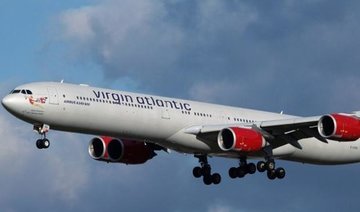
LONDON: Increasingly tough competition on London-Dubai flights pushed Virgin Atlantic out of the market, underscoring the dominance of Emirates on the prized route.
Having operated flights from Heathrow to Dubai for more than a decade, Virgin Atlantic said it was “no longer economically viable” to operate the route.
With Dubai’s flagship airline Emirates operating numerous daily flights to London’s Heathrow as well as serving six other UK airports, Virgin Atlantic was poorly positioned to compete, experts said.
“London to Dubai is served not only by Emirates, but also by British Airways. Both offering several flights per day, thus, there is obviously sufficient offer,” said Tobias Ruckerl, CEO and consultant at Advanced Aviation Consulting. BA operates regular flights from its London Heathrow hub.
“Virgin is a smaller player in this market and obviously they cannot stand the competition any more,” he said.
“Dubai probably has not been a profitable route for Virgin Atlantic in some time,” added US-based aviation expert Jason Rabinowitz.
“Emirates now has up to 10 daily flights to the London area, with nearly 5,000 seats offered each day each way. Virgin, on the other hand, offered a single flight.
“Even if Virgin could compete on price, and it probably cannot, there is simply too much competition on the London-Dubai route to keep it up,” he said.
Virgin Atlantic cited “external factors” behind its decision to cancel the route, in a statement issued late Wednesday.
“It’s never an easy decision to withdraw a route, and we’d like to thank our customers and dedicated team in Dubai for their loyalty over the last 12 years,” said Shai Weiss, chief commercial officer for Virgin Atlantic. The airline will continue to fly to Dubai until March 31 next year.
It is the second airline this year to ditch flights between the emirate and the UK capital, with Royal Brunei Airlines announcing last month that it would no longer fly from Brunei to London via Dubai.
Direct non-stop Brunei-London flights are to launch later this year.
Last year, Australia’s airline Qantas announced plans to return its transit hub from Dubai to Singapore.
While such developments have raised concerns that transit traffic and tourist numbers traveling via the Gulf airport could be negatively affected, most analysts have said that the strength of Emirates airline will maintain Dubai’s global predominance.
“As long as Emirates remains the powerful airline it is, I don’t see Dubai being in any sort of risk of losing its status as a major transit hub,” said Rabinowitz.
“While some airlines have opted to start ultra long-haul flights, offering non-stop routes where previously they stopped in Dubai, that is still a very small niche for airlines. The few other airlines that do stop at Dubai are insignificant when compared to the massive Emirates operation,” he said.
Andrew Charlton, managing director at Switzerland-based Aviation Advocacy was similarly upbeat. “No destination likes to see airlines leave, but in the scheme of things it is part of the parry and thrust of commercial aviation and should be seen in that context, not as a major statement on the health of Dubai or of aviation in the market.”
Emirates has further strengthened its presence in the UK this year, with the launch of its new daily service between Dubai and Stansted airport — located on the outskirts of the capital — this month.
The Middle Eastern airline is also set to launch a new service to Edinburgh later this year. It already flies to Glasgow, Newcastle, Manchester, Birmingham and London Gatwick and Heathrow.
Passenger traffic at Dubai International reached 7.6 million in April, relatively flat compared to the same month the previous year.
Year-to-date, traffic reached 30.35 million passengers, up 0.8 percent on the same time period last year, according to Dubai Airports data.
Dubai remained the third busiest airport in 2017, with passenger traffic rising by 5.5 percent last year, according to the Airports Council International. It is the world’s busiest airport in terms of international passengers.


![]()
![]()

Virgin Atlantic says goodbye to Dubai as competition gets too fierce

Virgin Atlantic says goodbye to Dubai as competition gets too fierce
- Having operated flights from Heathrow to Dubai for more than a decade, Virgin Atlantic said it was “no longer economically viable” to operate the route.
- With Dubai’s flagship airline Emirates operating numerous daily flights to London’s Heathrow as well as serving six other UK airports, Virgin Atlantic was poorly positioned to compete, experts said.

Latest updates


© 2026 SAUDI RESEARCH & PUBLISHING COMPANY, All Rights Reserved And subject to Terms of Use Agreement.